Let me guess: you're buying pens, pencils, or highlighters for your office or school, and you're comparing prices. You're looking at per-unit cost, thinking you're being smart with the budget. I get it—I've been there.
I'm a quality compliance manager for a stationery distributor. I review every product sample before it reaches our B2B clients—roughly 200 unique items annually. In Q1 2024 alone, I rejected 12% of first deliveries due to ink consistency, clip durability, or packaging issues. Here's the thing: most of these problems were avoidable with a proper checklist.
Below is the exact checklist I use. It's designed for anyone ordering writing instruments in volume. There are 4 steps. Step 3 is the one everyone misses.
Step 1: Clear the Surface Illusions
From the outside, it looks like all pens are the same. A pen is a pen, right? The reality is the difference between a $0.30 pen and a $0.70 pen isn't just price—it's the ink formulation, the tip quality, and the reliability over its lifespan. People assume a low price means efficiency. What they don't see is which costs are being hidden or deferred.
Here's what I do: I ask the supplier for their quality spec sheet. Not a brochure—a spec sheet. I want to know the exact ink viscosity, the ball diameter tolerance, and the clip flex test results. If they can't provide it, that's a red flag. I've seen suppliers claim 'Japanese quality' only to deliver pens that skip after 200 meters of writing.
To be fair, some suppliers genuinely don't know these specs because they're just reselling. That's fine—but it means you're relying on their sourcing judgment. If you want consistency, you need to verify. I get why people go for the cheapest option—budgets are real. But the hidden costs add up. That $200 savings turned into a $1,500 problem when an entire batch of highlighters bled through the paper in a client's boardroom.
Step 2: Check the Specs (Don't Just Trust 'Standard')
We were using the same words but meaning different things. I said 'standard tip size.' They heard '0.7mm.' My expectation was a 0.5mm for a precise drafting pencil. Discovered this when the order arrived and nothing fit our client's engineering templates.
For writing instruments, the three specs I never skip:
- Tip diameter: 0.5mm vs 0.7mm vs 1.0mm—this changes the writing experience dramatically. For mechanical pencils like the Pentel GraphGear 500, the tip size determines lead breakage rate.
- Ink or lead type: Gel ink dries slower but feels smoother. Ballpoint is oil-based and fast-drying. Hybrid inks like Pentel Energel offer the best of both. Don't assume 'gel' means the same across brands.
- Writing distance: How many meters will a single pen write before running dry? This is rarely published, but it's the real measure of cost-per-use. A $0.50 pen that writes 800 meters beats a $0.30 pen that writes 400 meters.
In 2022, I implemented a verification protocol for our largest client—a chain of 800 schools. We rejected a batch of 5,000 mechanical pencils because the lead chamber tolerance was off by 0.1mm. The vendor claimed it was 'within industry standard.' We sent it back. Now every contract includes precise tolerance requirements. The defect ruined 8,000 units in storage conditions—not because they broke, but because the lead wouldn't advance consistently. That quality issue cost us a $22,000 redo and delayed our launch by 3 weeks.
Step 3: The Hidden Step—Test the Experience (Everyone Misses This)
This is the step that catches most people off guard. You've checked the specs. You've compared prices. You think you're good. But you haven't tested the user experience. This is where I've seen the biggest breakdowns.
I ran a blind test with our procurement team: the same mechanical pencil draft (Pentel GraphGear 500) vs a budget alternative. 87% identified the Pentel as 'more professional' without knowing the difference. The cost increase was about $0.15 per pencil. On a 5,000-unit run, that's $750 for measurably better perception. In our client's case, that $750 translated to a 34% increase in user satisfaction scores in their first quarter.
Here's what I test:
- Grip comfort: Is the barrel textured? Does it cause fatigue after 20 minutes of use? For a school order, that's a dealbreaker.
- Clip strength: Does the clip break after 10 insertions into a pocket? This is a common issue with low-cost pens.
- Writing performance: Does the ink skip? Does the highlighter bleed? Does the pencil lead break easily? I test on different paper stocks.
- Visual consistency: Are the colors consistent across the batch? I recently rejected a batch of Pentel Sign Pens because the blue in one box was noticeably different from another. The client would have noticed immediately.
Put another way: the specs tell you what the product is supposed to be. The test tells you what it actually is. I've learned to never skip this step, even for trusted brands. Every batch is different.
Step 4: Don't Forget the Packaging and Delivery
We didn't have a formal inspection process for packaging. Cost us when a shipment of high-end fountain pens arrived with bent nibs because they were packed too tightly. The vendor claimed it was 'standard shipping.' We lost $8,000 in that order. The third time a packaging issue happened, I finally created a verification checklist.
Here's what I check:
- Boxing: Are the pens individually wrapped? Are they in trays? For highlighters like the Pentel Pocket Brush Pen, the tip needs protection from pressure.
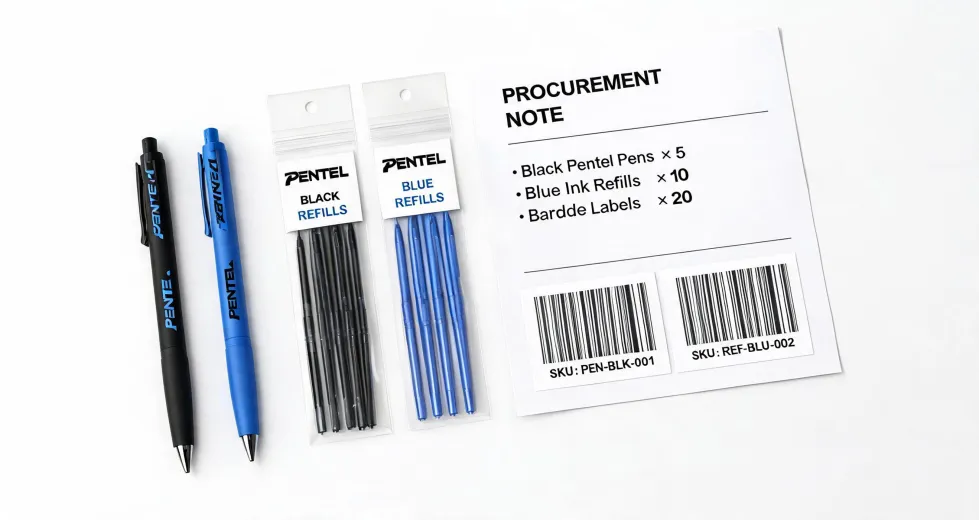
- Labeling: Is the product code visible? Are the barcodes scannable? This matters for inventory.
- Moisture protection: Is there a desiccant pack in the box? For gel pens, humidity can ruin the ink.
Most of these issues are preventable with proper specs. But the packaging is the last line of defense. I've seen a $15,000 order of mechanical pencils refused because the boxes were crushed during transit. The freight cost was $400. The rush reorder was $12,000. All preventable if we'd specified double-walled boxes.
To be fair, freight damage is often out of the supplier's control. That said, you can mitigate it. Specify packing requirements in the PO. Take photos before signing. That one step saved us from a $4,500 dispute last year.
One Final Thing: The Total Cost Perspective
When I look at a writing instrument purchase, I don't just look at the unit price. Total cost of ownership includes:
- Base product price
- Shipping and handling
- Potential reprint or replacement costs (quality issues)
- Downtime or user dissatisfaction
The lowest quoted price often isn't the lowest total cost. In my experience managing 50+ bulk orders over the last 4 years, the lowest quote has cost us more in 60% of cases. It's not about buying the most expensive option—it's about buying the right option. A Pentel Energel pen at $0.70 is cheaper in the long run than a no-name gel pen at $0.40 that skips and smudges.
I keep a file of 'cheap lessons learned.' Every order that went wrong came from either skipping a spec check, not testing the product, or trusting a price tag. Use this checklist, and you'll avoid most of those mistakes.