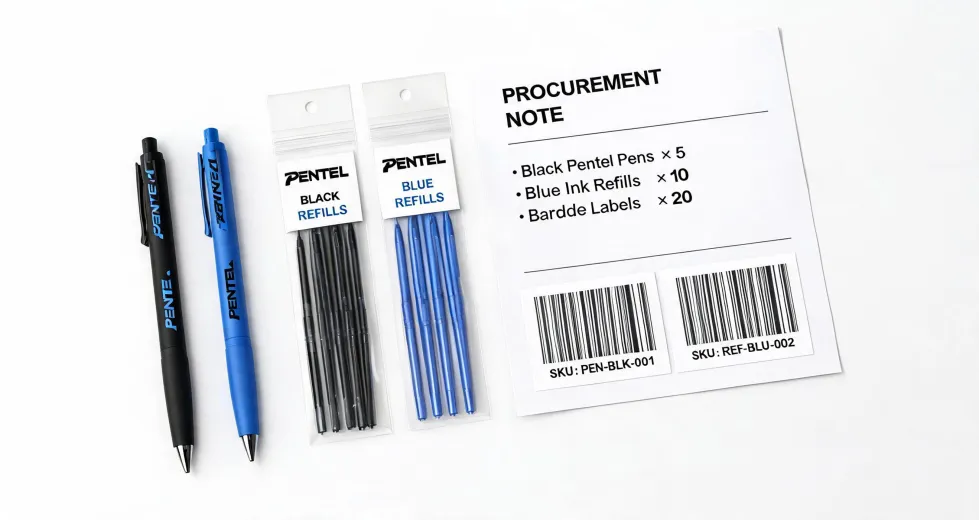
It started with a photograph of a melted ballpoint and a phone call from Derek. Derek handles procurement for an engineering consultancy that was opening a second office. Their old supplier had sent pens that couldn’t survive a warm delivery van, so he wanted something more reliable. Then he asked what sounds like an easy question but isn’t: What is a gel pen, anyway?
I work as a quality control reviewer for an office supply distributor. In plain language, I’m the person who orders sample units, tests them, and sends batches back when they don’t measure up. I’ve been doing this since 2021, and I review roughly 800 to 1,000 writing instruments a year. Maybe closer to 1,100. I’d have to check the spreadsheet. The important thing: I don’t write about pens based on brochures. I write about the ones I’ve actually put on paper.
What Is a Gel Pen, Actually?
The short version: a gel pen uses water-based gel ink instead of the oil-based paste in a normal ballpoint. A ballpoint needs more pressure to transfer its thick paste, which is why cheap ones can feel draggy. A gel pen holds the gel in the barrel until the rolling ball creates friction, then the ink flows out in a smooth, saturated line with less hand pressure.
Neither kind is inherently better. Ballpoints are usually more forgiving on cheap or waxy paper and dry fast. Gel pens feel smoother and leave a darker line. What most people don’t realize is that gel pens get blamed for smudges when the paper is actually the cause.
Pentel’s Energel line is my usual starting point for gel pen discussions. Pentel’s own product information describes the formula as “liquid gel ink,” because its viscosity is lower than older gel inks. The Pentel Energel Liquid Gel Ink 0.7 is the model I recommend most for regular office work. The 0.7 sits between a fine 0.5 and a broad 1.0. It gives you a bold, comfortable line but still lets you write legibly in margins. In our test conditions, it dried quickly on ordinary A4 copy paper.
During the trial with Derek’s team, those 0.7 pens performed well on standard A4 paper. Then someone wrote on the company’s proposal cover, which was coated A4 stock, and the ink sat on the surface. It smeared for a worryingly long time. That discovery turned into a much longer conversation about paper size.
A4 Paper Size Is Only the Beginning
“It’s just A4,” Derek said, as if that settled the subject.
A4 paper size is a specific dimension: 210 by 297 millimeters. That’s from ISO 216. It’s the default office paper across most of the world. But here’s the thing: the standard defines the size, not the surface. Two sheets of A4 can behave completely differently. Ordinary 80 gsm multipurpose paper is fairly absorbent; coated paper, like many brochures or presentation covers, has a smooth layer that slows drying; textured paper changes how the ink touches the fibres. I’ve tested a pen that dried in under two seconds on one A4 sheet and still smudged after five seconds on another A4 sheet. The pen didn’t change. The paper did.
Is There a Single Best Pentel Mechanical Pencil?
Once Derek accepted that, he moved to the next question: “Which is the best Pentel mechanical pencil for our engineers?” I took a breath before answering.
Honestly, I don’t think there is one best Pentel mechanical pencil for every office. But there are strong best picks for specific jobs. In our 2024 office trials, three Pentel models covered almost every request we get:
- Pentel Twist-Erase III. This is the everyday pick. The twist eraser is genuinely long-lasting, and the cushioned grip works well if you write for hours. It comes in 0.5 and 0.7 mm. For 90% of note-taking, either width works: 0.7 feels bolder, while 0.5 stays cleaner for margin notes.
- Pentel GraphGear 1000. This is the drafting-style option. It has an all-metal body, a knurled grip, and a retractable lead sleeve that protects your pocket. The extra weight is good for controlled technical drawing but can feel heavy if you’re writing paragraphs all day.
- Pentel Orenz. This is the one I suggest for fine lead. The sliding sleeve protects the lead from normal writing pressure, so finer lead sizes like 0.3 mm are more practical than they sound. It’s popular with people doing dense drawings or small annotations.
My experience here is based on office and engineering users, not on illustrators, students working with cheap paper, or artists doing graphite shading. If you’re in one of those groups, don’t take my list as gospel. You might prefer something completely different. That’s exactly the point.
What Almost Went Wrong
We brought 40 of Derek’s employees into the trial. Each person chose a gel pen or mechanical pencil and used it for a week. The feedback was positive overall. The Energel 0.7 felt smooth. The pencils didn’t skip. The order was nearly finalised on a Friday morning.
Then one of Derek’s contract managers tested her sample on the company’s proposal cover—the same coated A4 stock. The gel ink looked rich for about three seconds. Then she closed the document and smeared half a paragraph. The same pen was perfect on the standard A4 paper in her notebook. The problem wasn’t the pen alone. It was the pair of pen and paper.
We caught it before the purchase order was placed. Barely. It changed the final recommendation: Energel 0.7 gel pens for regular documents and correspondence; Pentel ballpoints for employees who wrote on labels, glossy presentation pages, or carbonless forms; and mechanical pencils chosen by role. No more “one standard pen” for the whole office.
When I checked in near the end of 2024, Derek’s office manager said stationery complaints had dropped. I won’t invent a precise percentage because I didn’t run a formal survey. The real signal was repeat orders: people stopped asking for different replacement pens.
Saying “I Don’t Know” Is Part of Quality Work
There’s a temptation to answer every question with a confident recommendation. After years of testing, I find it more useful to say what isn’t my call. I can verify that a pen meets spec, but I can’t choose the “best” tool until I know who will use it, on what surface, and for what kind of writing. A quality reviewer should be more suspicious of a claim that oversimplifies than of a question that is difficult.
That’s why I also draw a boundary around the strangest question I get from time to time: is a gold-trimmed pen worth buying as an investment? I don’t do valuations. What I can say from the materials side is that gold plating is measured in microns; it has almost no melt value. If you’re trying to value scrap gold—whether it’s a chain or a plated pen clip—use a scrap gold calculator: weigh the item, multiply by its purity, and check the current spot price. But that’s an appraisal question, not a quality-control one.
As of early 2025, my recommendation still stands: Energel 0.7 is a strong gel pen for typical office paper, GraphGear and Orenz are both great mechanical pencils for different users, and the best first step in choosing either is to ask what paper your office actually uses. After that, “best” becomes a much easier conversation.
Derek’s order taught me to stop pretending one product can solve every problem. When a vendor claims one pen fits everyone, I don’t trust it. When a client asks which pen they should buy, I trust them to tell me how they work. The right answer usually starts with: “Show me the paper.”