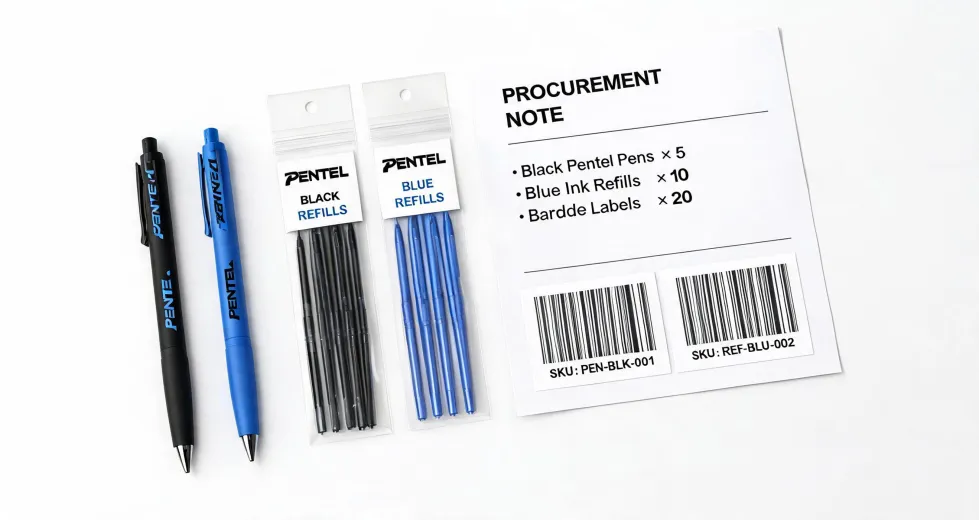
Pentel 4 color pen or Pentel mechanical pencils 0.7 mm? That question lands on my desk at least once a quarter. Usually someone new to the supply budget opens the catalog, sees two popular Pentel items at different price points, and asks where to put the money.
When I first took over purchasing for our office in 2020, I had the same reflex: compare the price tags. The mechanical pencil was cheaper, and I almost treated that as the whole decision. Three budget cycles later, I know the reflex is wrong. A unit price is not a total cost. The cheaper item can get expensive through refills, replacements and complaints; the pricier item can end up saving money if it is doing something valuable—say, replacing four separate pens.
I’m an office administrator for a roughly 280-person engineering and product company. I place about 60 to 80 orders per year across nine vendors and report to both operations and finance. Here is how I compare these two tools now, and where the comparison usually surprises people.
First, compare the job, not just the product
The Pentel 4 color pen solves a color-coding problem. Four retractable ink colors live in one barrel: black, red, blue and green. In a project office, that’s not a luxury. Red means blocked right now. Green means action taken. Blue means needs approval. Black means owner assigned. If a coordinator tries that workflow with separate ballpoint pens, they end up carrying three or four pens around all day.
A Pentel 0.7 mm mechanical pencil solves a different problem: it needs to be erasable but still precise enough for drawings and margins. The 0.7 mm lead width sits in a useful middle zone. It feels closer to a real pencil, it doesn’t snap the way 0.5 lead does under normal pressure, and it gives a consistent fine line for sketching. Our engineers and product team use that line constantly. Many of them sketch on a printable graph paper template before going to software. If they used ink at that stage, every drawing would look finished before the plan was actually finished.
The analytics group is a good example of both tools showing up in one workflow. They run a p value calculator before they call a result significant. Then, when they print the output for review, they use the four colors to flag what changed, what cleared and what is still open. The same person keeps a 0.7 pencil nearby for margin notes that will probably change after the next model run. A 4 color pen would be the wrong tool for erasing; a mechanical pencil would be useless for color flags.
So the first conclusion is not a tie. It is a separation. These two products don’t replace each other. But they do compete for the same budget line, which is why the rest of the comparison matters.
What real office use does to each tool
The second dimension is durability, and this is where my early assumptions got corrected.
The Pentel 4 color pen has more moving parts, so I expected more mechanical failures. In practice, failures happen, but they get reported. When a click mechanism stops catching after a drop, the user brings the pen back. They treat it like a tool that should last, which means we see the problem and can respond.
The 0.7 mm mechanical pencil is simpler and lighter. That sounds like a reliability advantage, and it is. But it also has a quieter inventory problem. When a pencil with an empty eraser or a bent clip stops being useful, it rarely comes back for repair. It just disappears. The next order quietly includes a few more pencils. Nothing gets logged as a defect, yet the spending is still there.
That distinction took me a while to see. In our purchasing data from 2022, the pencil group looked almost problem-free by complaint count. The complaints were not lying; they just weren’t telling the full story. Once we started tracking monthly quantities issued per team, the real usage pattern showed up.
Should mention: our first reaction was to call the disappearances a people problem. It wasn’t. It was a purchasing visibility problem. I fixed it by adding a simple stock review every 90 days. Nothing about the pencils themselves changed.
Why 0.7 mm is usually the safe office choice
Let me pause on the 0.7 part, because it comes up more than people expect. The number refers to the lead diameter. 0.5 mm lead is great for fine technical drawing, but it breaks more often when someone writes with normal pressure. 0.9 mm lead is tough, but the line starts to look heavy for everyday notes and margin marks.
0.7 mm sits in between. It can handle quick note-taking, but it still produces a clean enough line for sketching and layout work. That’s why our staff usually asks for “Pentel mechanical pencils 0.7” rather than a specific model. They have learned from experience which size actually survives a full workday.
Total cost over a year, not the price per unit
Now the part finance usually cares about. On our September 2024 purchase order, the Pentel 4 color pen was about $6.10 per unit and the Pentel mechanical pencil 0.7 mm was around $3.50. If you stopped at that line, you would tell everyone to buy pencils.
But the mechanical pencil does not exist alone. It pulls refill lead, replacement erasers and the occasional complete replacement into the order. The 4 color pen also has a refill cost, but it arrives as one refill set that renews all four colors at once. In our 2024 records, the pencil accessories—lead and eraser refills—added roughly 25% to the pencil line over twelve months. The color pen’s refill adds to its line too, but it is one line item and it replaces four single-pen purchases.
Actually, that last point is where the cost comparison flips for certain teams. If your staff color-codes documents all day, the 4 color pen is effectively four pens in one. A barrel plus one set of refills costs less than buying four individual pens every time one color runs out. The higher unit price is misleading because it is not one pen; it is the whole set. For a person who only writes black text, that logic doesn’t apply. For a project coordinator or product manager, it often does.
The same logic defends the pencil for its users. A $3.50 pencil that takes $3.00 of lead over a year is still cheaper than forcing an engineer to sketch with disposable pens or a constant stream of stick pens. As long as the tool matches the work, it earns its place.
I have a separate example that explains the value-over-price mindset better than any spreadsheet. In 2024, a vendor offered us generic refills for less—about 35% less than the Pentel refill set. The saving on the whole order was roughly $23. Three users came back within two weeks with skipping ink and leaky refills. The order was written off, and the replacement order cost us additional time and shipping. The $23 saving turned into roughly $140 of problem. Since then, our internal spec says original refills. The same mindset applies to choosing between the multi-pen and the pencil: the total experience over a year matters more than the temporary line on an invoice.
Which one should you stock?
If the choice is truly one or the other for your next order, use the work roles to decide, not the sticker. For meeting-heavy offices, customer-facing staff, accountants, product people and anyone color-coding paper, choose the Pentel 4 color pen. It will replace three or four separate pens and reduce your per-person stationery cost over time.
For technical teams, drafters, artists, engineers and people who work on printable graph paper or printed output all day, choose Pentel mechanical pencils 0.7 mm. The 0.7 lead is durable enough for everyday writing but fine enough for layout and precision marks. It is the tool they will actually reach for.
If you manage a broader office with a mix of roles, don’t force a single solution. My biggest purchasing mistake was standardizing to one writing tool for 400 employees in 2021. It seemed efficient. Then I spent two months hearing about all the jobs that tool could not do. The fix was not complicated, though. We buy a modest quantity of both Pentel products, and I keep a clear rule: matching the tool to the role is itself a cost-control measure.
A final note from the purchasing desk: when a request seems outside the stationery category—an art teacher asking how to use polymer clay, an analyst asking for a p value calculator refresher, an engineer asking where to find printable graph paper—the first question is still the same. What job are you trying to do? The answer tells you what to buy. The Pentel 4 color pen and the Pentel mechanical pencil 0.7 mm both earn their place when the people who use them have the right job match.