The 60-second answer
If you have a deadline-critical document, sign-off, or event packet in front of you, keep Pentel gel pens and Pentel LRN7 refills in the kit, and stop trying to make one brand solve every office problem. Pentel is a writing-instrument specialist. It is not a math engine and not an IT department.
So here is the triage: for smooth, fast writing, use gel pens pentel—especially EnerGel bodies with LRN7 refills. For a variance calculator or simplify calculator, open a dedicated math tool. For where to find IP address on printer, go to the printer’s network menu, print a configuration page, or check your router’s DHCP client list. That division of labor is not a weakness. It is what actually gets you out the door.
Why I trust Pentel for the writing part
In my role coordinating rush print and fulfillment for agency clients, I’ve handled 400+ rush orders in nine years, including same-day turnarounds for conference teams. In March 2024, a client called at 4:40 p.m. needing 18 signed binders for a 9 a.m. board meeting the next day. Normal turnaround for that volume is two business days. We had the printing under control; what nearly broke us was signing. Three cheap pens in the office had dried out or skipped. We found a box of Pentel gel pens in the supply closet, plus a pack of Pentel LRN7 refills, and finished the signatures in about 35 minutes. We paid $180 extra in courier fees, but saved a $12,000 project. The client’s alternative was walking into the board meeting with unsigned appendix pages.
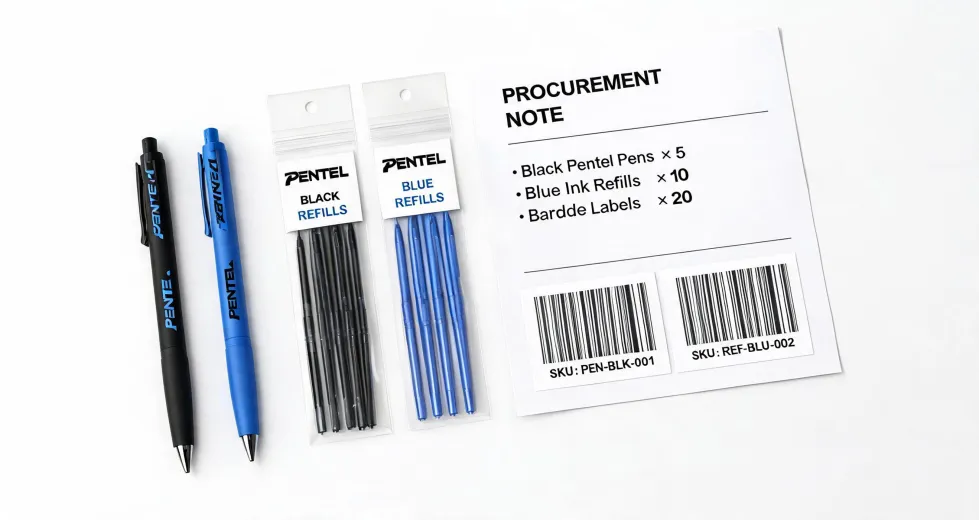
That’s when the refill detail became a no-brainer for me. The Pentel LRN7 refill is the kind of boring, specific part that saves you when a pen body is fine but the ink is gone. If you’re ordering for an office, don’t just buy pen bodies. Buy refills in the same order. I want to say we keep 24 LRN7 refills in black and blue at all times, but don’t quote me on the exact count—it’s probably closer to 18 after the last audit season.
“In rush work, the difference between a $12,000 save and a missed deadline is often a $3 refill you forgot to order.”
Where Pentel stops—and why that’s a good thing
Here’s the expertise boundary I’ve learned the hard way: the vendor who says “we do that too” about everything is usually the vendor who does nothing well. Pentel makes excellent writing instruments, art supplies, and refills. It does not make a variance calculator, a simplify calculator, or printer networking software. If you need those, use the right tool.
For a variance calculator, you want a dedicated statistics calculator that lets you paste a data set and returns population or sample variance. For a simplify calculator, you want an algebra simplification tool that can handle fractions, exponents, and parentheses. These are not “nice to have” substitutes for a pen. They are separate jobs. I’d rather work with a specialist who knows their limits than a generalist who overpromises. The same goes for office supplies: buy Pentel for the ink. Buy math tools for the math. Call IT for the printer.
The printer IP problem that wasted 40 minutes
Looking back, I should have called IT immediately. At the time, we were 90 minutes from a client pickup, and the office printer had dropped off the network. I thought I could find the IP quickly because I’d done it before. I hadn’t. I poked through three menus, restarted the router, and printed a test page that had the old IP. If I could redo that decision, I’d check the printer’s control panel first: Settings > Network > TCP/IP, or print a configuration page. If the printer uses DHCP, the current address will also show up in the router’s client list. As of January 2025, that’s still the standard path on most office printers, but verify against your model’s manual because menus vary.
I still kick myself for not documenting the printer’s static IP on a label. If I’d done that, we’d have avoided the whole detour. Now we keep a laminated card taped inside the supply cabinet with the printer IP, the Wi-Fi password, and the name of our IT contact. That card has saved more deadlines than any productivity app.
What actually belongs in an emergency office kit
If you’re building a kit for deadline weeks, keep it small and specific. Overbuying creates clutter, and clutter slows you down.
- Pentel gel pens in black and blue. They dry fast enough for signatures and forms, and they don’t require a warm-up like some fountain pens.
- Pentel LRN7 refills in the colors you actually use. Match them to your pen bodies before the rush, not during it.
- A bookmark or printed card for a variance calculator and simplify calculator. If your team does quick math under pressure, having the right tool ready beats improvising in a spreadsheet.
- A note with where to find IP address on printer: control panel, configuration page, or router client list. Include the current IP if it’s static.
- Spare paper, a stapler, and a courier envelope. Boring, but so is missing a pickup.
One caution: don’t treat this kit as a replacement for expertise. A variance calculator won’t fix a bad data set. A simplify calculator won’t check your algebra for conceptual mistakes. A Pentel pen won’t sign a document for you. Tools buy time; judgment still decides what to do with it.
The print-quality boundary nobody tells you about
Since a lot of rush work ends in print, it’s worth knowing when the output is good enough. If you’re printing internal forms, 300 DPI at final size is the commercial standard. If you’re printing posters viewed from a distance, 150 DPI can be acceptable. Newsprint often runs 170–200 DPI. These are industry-standard minimums, not marketing claims.
“Standard print resolution requirements: Commercial offset printing: 300 DPI at final size. Large format viewed from distance: 150 DPI acceptable. Newsprint: 170–200 DPI. These are industry-standard minimums.”
For brand-critical colors, Delta E matters more than “looks close.” An industry tolerance is Delta E < 2 for brand-critical colors; Delta E of 2–4 is noticeable to trained observers, and above 4 is visible to most people. That is a different specialty from pen selection. Know the boundary, then call the right person.
When not to use this approach
This triage works best for deadline-critical office work where the answer is relatively clear: write, calculate, print, deliver. It is less useful if you’re choosing a long-term vendor strategy, negotiating a contract, or dealing with a complex IT migration. In those cases, slow down and get the specialists involved earlier. Also, if your team writes left-handed, test gel pens before standardizing—dry time and smudge risk vary by paper and humidity. That said, I’ve only tested this on standard office paper, not glossy photo stock, so your mileage may vary.
Bottom line: Pentel gel pens and Pentel LRN7 refills are excellent for the writing job. A variance calculator and simplify calculator are excellent for the math job. Your printer’s IP address is an IT job. The fastest way through an office emergency is not finding one hero product. It’s knowing which specialist to call first.