-
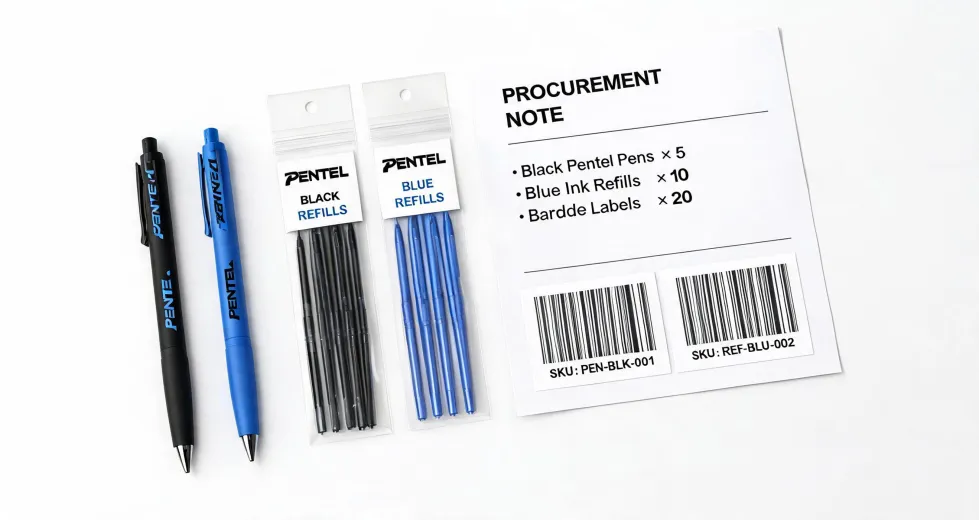
If you need everyday office pens: Pentel retractable gel pens
-
If you’re making hand-lettered signs: the Pentel Touch Sign Pen
-
If labels are the problem: sticker printer or print shop?
-
If the search is “is acrylic paint water based?”
-
And yes, the “Chipotle calorie calculator” can also be part of triage
-
How to tell which scenario you’re in
I coordinate rush orders at a B2B office and print supplier. I’ve handled maybe 200 emergency jobs in the last five years — or closer to 180, I’d have to check the CRM before giving you a firm count.
When a deadline is close, the worst question is “What’s the best option?” The better question is “Which option is least likely to fail me in the next few hours?” There is no single correct product for every emergency. There are branches, and you need to find the branch that matches your situation.
If you need everyday office pens: Pentel retractable gel pens
A client once called at 3pm because they needed to replace every pen in a conference center by a 7am board meeting. (Note to self: I really should draft a checklist for those calls.) They didn’t need expensive presentation pens; they needed pens that would survive being borrowed, dropped, and left in random rooms.
I pointed them to Pentel retractable gel pens. Why? Because a pen with a cap has two failure points: the cap gets lost, and the tip dries out when someone does not put the cap back. A retractable pen removes that failure mode.
I’m not going to claim every Pentel gel pen works perfectly on every surface. Gel ink is still ink, and paper quality varies. But for normal office writing, quick notes, signing forms, and bulk reordering, retractable gel pens have been my default recommendation for years. If you’re buying for a lot of people, buy one style and test it on your own paper first. That test costs five minutes and can save a 500-pen mistake.
If you’re making hand-lettered signs: the Pentel Touch Sign Pen
Another common call goes like this: “Can I make signs look polished without hiring a calligrapher?” Sometimes the answer is a Pentel Touch Sign Pen.
A Touch Sign Pen has a flexible brush tip, so your strokes can vary from thin to thick while you write. It’s not a permanent marker, and it’s not trying to be one. It shines on paper — name cards, tent cards, welcome boards, quote cards, workshop place cards. For a last-minute event, it gives you a hand-lettered look with only one tool.
One caveat: no pen will save you if you skip practice. If you’ve never used a brush pen before, spend twenty minutes on scrap paper before you write on the actual signage. The good news is that this is still faster than ordering custom printed signs when your volume is small.
And if you’re making one oversized sign that will live outside in the rain? That’s a different branch. A brush pen is not the right tool; you need outdoor-grade printed vinyl or another sign solution. Know the scenario before you buy.
If labels are the problem: sticker printer or print shop?
When the emergency is stickers or labels, the right answer looks completely different.
If every label has the same message, a print shop can handle it. In many cases, online printing is affordable. Based on major online printer fee structures in January 2025, a 2–3 day rush is usually 25–50% over standard, and next business day is around 50–100% over standard. You’re not just paying for speed. You’re paying for a committed turnaround.
If every label is different — name badges, seat assignments, unique barcodes, event codes — handwriting is too slow and a print shop is clunky. That’s where a sticker printer earns its place. A sticker printer lets you create individual labels in-house, but only if you have the right label rolls and a small amount of setup time. It’s not ideal for a one-time batch of 10 stickers. It becomes valuable when your workflow depends on printing custom labels continuously.
In March 2024, a client called at 6pm for 60 custom sleeve badges needed in 44 hours. Their usual print vendor quoted a four-day standard turnaround. We paid an $110 rush fee on top of a $240 order to get a guaranteed next-day delivery. The client’s alternative was walking into a busy recruiting event with blank table tents. Was $110 worth it? Yes. Missing that event would have cost the whole recruiting season.
If the search is “is acrylic paint water based?”
Some emergencies are not about pens at all. They start when a volunteer receives a cooler full of acrylic paint and needs to know whether water is enough for cleanup.
The short answer: most acrylic paints are water-based. Water thins them while they are wet, and soap and water cleans brushes, rollers, and trays. Once acrylic paint cures, it becomes water-resistant — so “water-based” does not mean “rewettable later.”
I’m not a paint chemist, so I won’t speak to every industrial or artist-grade formula. If you’re responsible for a room full of students or a painted wall that needs to last, read the label. Look for terms like “water-based acrylic” and check the SDS if you need specifics. What I can tell you from a procurement perspective is this: “water-based” answers a cleanup and safety question, not a durability question.
If the real question is “can I use brush pens with acrylic?”, the answer is the same type of branch: it depends on the surface and what comes next after the paint dries.
And yes, the “Chipotle calorie calculator” can also be part of triage
One more scenario shows up more often than you’d think: someone searching for a Chipotle calorie calculator while a deadline crowd tries to order lunch.
I’m not a nutritionist, so I won’t review the accuracy of their nutrition data. What I can say is that the tool makes sense as triage. If you’re tracking macros and you need a usable answer before the team finishes ordering, a calculator is faster than building your own spreadsheet. It gives you an estimate. Then you decide.
That’s different from how I think about rush orders. With a calorie calculator, an estimate is usually fine. With a delivery date, an estimate is not enough. You need a written commitment and a realistic fallback. That’s why emergency print services charge premiums. The premium buys certainty — not just speed. When the alternative is missing a deadline, the premium becomes the bargain.
How to tell which scenario you’re in
Ask three questions:
- What is the failure mode? Losing a cap? Ink drying out? A sign that does not look finished? A label that cannot be read? Naming the failure point usually tells you which branch you’re on.
- Can you test quickly? For a new office pen, test it on your paper. For a brush pen, practice on scrap paper. For a sticker printer, run one label. The fastest fix is not necessarily the one labeled “fast”; it’s the one you can validate in two minutes.
- What is the cost of being late or wrong? If missing the date would lose a contract, choose the option with a guaranteed date. If making the wrong sign would mean a reprint, leave enough buffer to redo it.
This is why I rarely give one recommendation for every client. The best gel pen is the one your employees won’t abandon. The best sign pen is the one you have time to practice with. The best sticker workflow depends on your volume. And if you’re trying to pin down the exact calories in your burrito bowl, a calculator is a fine first pass — just don’t treat it like a shipping guarantee.
There’s something satisfying about watching an order arrive exactly when it was promised, especially after years of stress, missed lunches, and 11pm calls. But that satisfaction is not an accident. It comes from forcing every decision through triage: What fails? What is the cost? What is the certainty? Answer those three questions, and you’ll know which scenario you’re in — and which tool deserves the rush.