I remember the exact moment I stopped buying the cheapest pens for our office. It was during a quarterly board meeting, and one of our directors—someone who isn't easily rattled—held up a document that looked like it had been through a flood. The ink from a new batch of budget gel pens had smudged, turning a signed contract into a purple-streaked mess. He didn't get angry. He just looked at me across the table and said, "We need to fix this."
That was 2022. Since then, I've processed about 80 supply orders annually, managing about $15K worth of materials for a company of 120 people across two locations. And I learned something that sounds obvious but isn't: the real cost of a pen isn't what you pay for it. It's what it costs you when it fails.
What We Thought the Problem Was
For years, my approach to office supplies was simple: find the lowest unit price that met basic expectations. Pens write, paper prints, staples bind. How different could they be?
But after that boardroom incident, I started paying attention. The complaints I'd dismissed as minor grumbling were actually consistent. People weren't just being picky. They were avoiding certain pens because they'd smear, skip, or run dry halfway through a note. The cheap blue ballpoints we ordered by the box? People were hiding them in drawers and using their own.
Here's what I didn't realize at the time: that wasn't a preference issue. It was a productivity issue.
The Real Culprit Wasn't the Brand—It Was the Category
Let me be clear about something. I'm not going to tell you that premium pens are always better. But I learned that the cheaper end of the ballpoint market—especially those multi-packs that come out to under 15 cents per pen—has a fundamental problem. The ink formulation is engineered for cost, not performance.
Most people think ink is ink. It's not. Low-cost ballpoints use a thicker oil-based ink that sits on the surface of the paper. It dries slowly, smudges easily, and requires more pressure to write. That's not an opinion—it's physics. The industry standard for quick-dry ink is less than 2 seconds on standard copy paper. The pens I was buying? I tested them. Some took over 10 seconds. For someone taking notes in a meeting, that's a mess waiting to happen.
I'm not a chemist. But I can read a spec sheet. And after that failed meeting, I started looking at the actual data.
The Hidden Cost of Cheap Pens
Let's do the math. A box of 50 budget ballpoint pens costs about $8. That's 16 cents each. A Pentel Energel RTX—one of the pens I now stock—costs about $2.50 per pen. That's 15 times more expensive.
But here's what I didn't account for in my old procurement model:
- Waste: About 20% of the cheap pens would dry out before being used. That's $1.60 of waste per box.
- Ink skip: On average, one in five cheap pens would skip or stop writing mid-use. People threw them away and grabbed another. That's more waste.
- Time lost: This one's harder to quantify, but I tracked it for a week. Employees spent an extra 5-10 seconds per note fixing smudges or re-writing. Across 120 people, that's about 10 man-hours per month. At an average hourly cost of $35 (salary + burden), that's $350 a month in lost productivity.
That $350 number caught my attention. Even if I'm off by half, we're losing more in productivity than we save on pens. The $8 box of pens actually cost us more in the long run than the $2.50-each gel pens. Don't hold me to the exact math—I'm not an analyst—but the pattern is unmistakable.
Why This Matters Beyond Pens
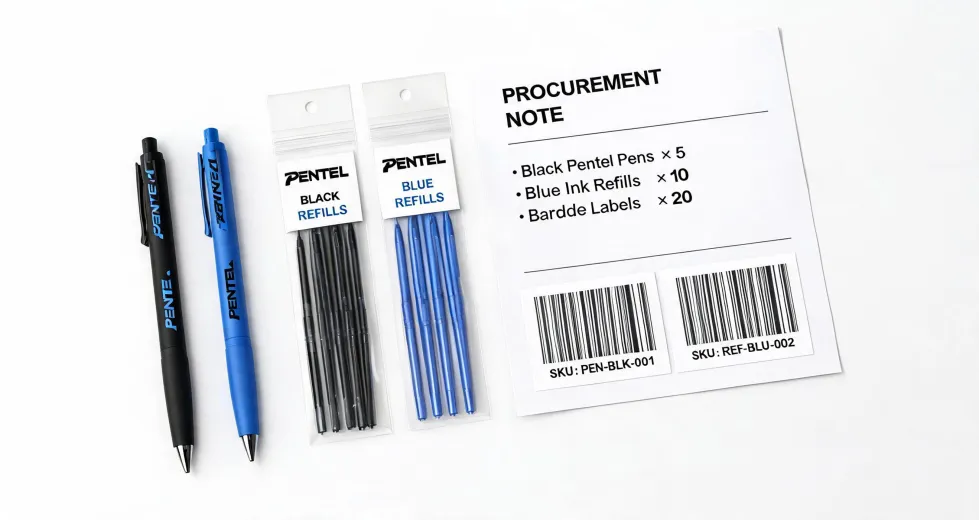
This isn't really about Pentel, although I do stock their Energel and RSVP pens now. It's about how we evaluate cost in procurement. The same principle applies to almost everything I've bought since: printer paper, toner, filing supplies. The lowest quote is rarely the lowest total cost.
I learned this the hard way. In 2023, we switched our vendor for general supplies to save about $200 per quarter. The new vendor couldn't provide proper invoices—only handwritten receipts. Our finance team rejected every expense report. I ended up eating about $400 out of my department budget before I fixed the invoicing process. That $200 savings? It cost us more than double in rejected expenses and my time.
What I Do Now
My criteria have changed. When I evaluate a pen—or any office product—I ask three questions:
- Does it work consistently across different paper types?
- Will it dry fast enough for left-handed users?
- Does the supplier provide proper, verifiable documentation?
I've tested a lot of pens. The Pentel Energel RTX works well for us. The ink dries in under 2 seconds on most paper, it doesn't smear, and the refills are easy to source. But your situation might be different. If you're a school or a design firm or a law office, your needs are probably different from mine. Take this with a grain of salt—I can only speak to a mid-size B2B office with standard paper and typical use cases.
That said, the lesson applies across the board: the real price of a product isn't on the price tag. It's in what happens after you buy it.
This was accurate as of early 2025. The office supply market changes fast, so verify current pricing and product availability before making procurement decisions.