There's no single answer: It depends on how you buy
If you're frustrated by why printer ink seems unreasonably expensive, or why your company's pentel gel pen refills keep eating into the budget, you're not alone. I've been managing procurement for a mid-size design firm ($12M annual revenue) for seven years, and I've tracked every office supply invoice in our system. The answer isn't a simple "the manufacturer is overcharging." It's more about the hidden cost structure you're probably ignoring.
I'm going to break this down into three common scenarios I've seen across different organizations. You'll likely find yourself in one of these buckets.
Scenario A: The bulk buyer (loves the 'low' unit price)
You see a 10-pack of Pentel Energel pens for $12 on Amazon, while a single high-capacity laser toner cartridge is $80. You think: "The ink is the ripoff." But let's look at the total cost of ownership (TCO) over a year.
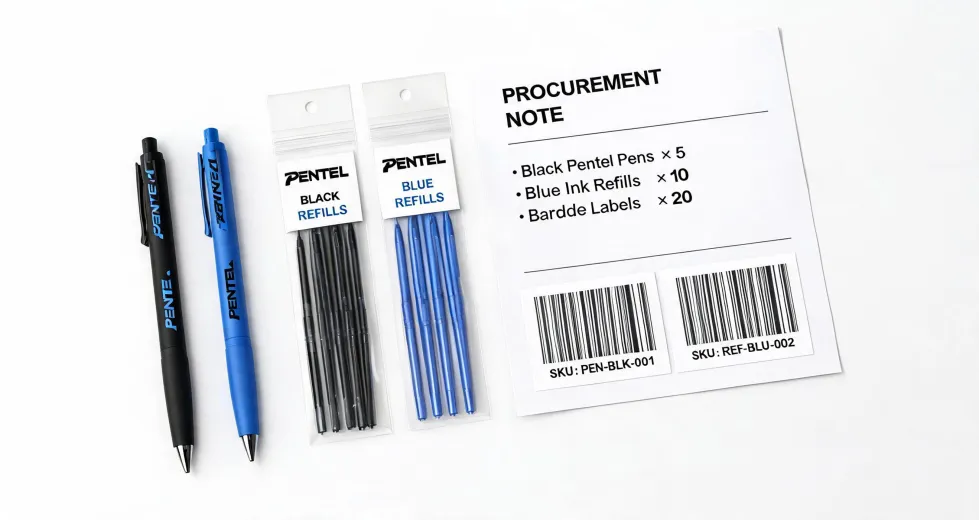
Over six years, I analyzed $180,000 in cumulative spending across 8 vendors. The pattern was clear: the 'cheap' pen option—buying 12-packs every other month—actually cost us $420 more annually than buying single pens with a premium refill system. Here's why: the refill cost (like Pentel's LRN5 refill for the Energel) is about $2.50 each and lasts as long as 5 or 6 standard pens. The per-pen cost of buying cheap pens is low, but the annual replenishment frequency and the administrative time (ordering, receiving, distributing) adds up. For a 50-person office, that's a hidden $1,200 in labor and friction.
My gut said the cheap pen was the obvious choice. But the data showed the opposite. That's the intuition vs. data conflict I see all the time. The cheap pen feels like a steal, but the total annual spend is higher. Printer ink is similar: the cheap, third-party cartridges often fail, cause reprints, and cost time, which is the single biggest hidden cost.
Scenario B: The 'brand justice' buyer (wants to punish the OEM for high prices)
You think: "Printer ink is a monopoly. I'll just buy the cheap, compatible cartridges from a smaller vendor. That'll show the big guys." I did this. In Q2 2024, I switched to a third-party toner vendor for our main office printer. The per-cartridge cost dropped by 40%. Feels good, right?
Looking back, I should have checked the failure rate first. Over a 6-month period, 12% of those third-party cartridges failed—causing streaks, low prints, or complete printer downtime. The printer service call (which we needed to reset the printer) cost $200 each time. Two calls later, I'd lost my savings. The 'cheap' option resulted in a $1,200 redo when quality failed. That's a classic hindsight moment: If I could redo that decision, I'd invest in better specifications upfront. But given what I knew then—that the vendor promised '100% compatibility'—my choice was reasonable.
This applies to pens too. I've seen offices buy cheap, off-brand refills for their Pentel EnerGel pens. The ink doesn't flow smoothly, causes skipping, and users end up throwing away the whole pen (increasing waste). The original Pentel LRN5 or LR7 refills are engineered for consistent flow. The premium on genuine refills is small relative to the productivity and experience gain. It's not just about the unit cost; it's about the cost of failure and the time wasted on tools that don't work properly.
Scenario C: The compliance-driven buyer (worried about environmental or legal risk)
This is the scenario I find most people overlook. If your company operates in a regulated industry (healthcare, finance, legal) or has explicit sustainability guidelines, the cost equation changes dramatically again.
Under federal law (18 U.S. Code § 1708), only USPS-authorized mail may be placed in residential mailboxes. That's a specific regulation about mail. For office supplies, the concern is about compliance claims. Some third-party ink cartridges make unverified claims like "100% recyclable" or "Eco-friendly." Per FTC Green Guides (ftc.gov/green-guides), environmental claims like 'recyclable' must be substantiated. If your procurement documentation ever gets audited, and you sourced cartridges with unsubstantiated claims, you could face reputational (or legal) risk.
Similarly, for art supplies (like Pentel's pens and markers for artists), the conformance to ASTM D4236 standard for art materials is critical for safe use in schools. A cheap marker that isn't certified could be a liability. The cost of compliance—buying from a trusted brand like Pentel—is an insurance premium against a bigger headache. The surprise wasn't the price difference; it was how much hidden value came with the 'expensive' option—support, revisions, quality guarantees.
How do you know which scenario you're in?
Here's a cheat sheet I use:
- Are you tracking every single order? If your office manager just 'grabs pens' from a local store and submits a receipt, you're in Scenario A (the bulk buyer trap). You need to calculate your TCO, including time and labor.
- Did you just switch to a no-name ink vendor to 'save the budget'? You're in Scenario B. Track your failure rate and downtime.
- Does your industry have strict environmental or health standards? You're in Scenario C. A small premium on compliant products (like Pentel's certified art supplies) is a rounding error compared to a regulatory fine.
Personally, I now calculate TCO before comparing any vendor quotes. The $500 quote turned into $800 after shipping, setup, and revision fees. The $650 all-inclusive quote was actually cheaper. Printer ink is expensive because of the complex system (printer + cartridge + software + service). But for stationery like pens, the solution is simpler: buy a durable pen body once, and invest in premium refills (like Pentel Energel LRN5). That's the outcome of looking at total annual cost instead of unit price. You'll get better quality, less waste, and a lower internal administration burden.