Stop guessing. Here's what actually works.
If you buy office supplies for your team (or just yourself), you've probably made at least one of these mistakes: bought dry erase markers that dried out in two weeks, grabbed gel pens that leaked in pockets, or spent an hour fighting with a new printer. I made all of them. After roughly $1,200 in wasted purchases over three years, I settled on a shortlist that prevents most of the headaches. The two products I now recommend without hesitation: Pentel dry erase markers and Pentel retractable gel pens. The rest—calculator watches, quadratic formula calculators, printer setup—have their own traps, but the pen and marker choices alone eliminate about 60% of the daily office friction.
When I first started handling supplies for a 12-person team in 2019, I assumed cheaper markers were fine. They aren't. I assumed any gel pen would do. They won't. I ignored advice about printer setup until I bricked a $350 machine by using the wrong driver. That's the thing about office gear: one bad decision snowballs into wasted time, wasted money, and frustrated coworkers. So let me save you the pain.
Why you should trust this (I learned the hard way)
I manage office supply procurement for a mid-sized design studio. In my first year alone, I ordered 24 boxes of dry erase markers from a budget brand. By week three, half were unusable—streaky, dried out, or staining the board. That order cost $180. The replacement order (Pentel) cost $210 but lasted six months. Net savings: roughly $150 per year, plus no more groans during team brainstorms.
For gel pens, I tried six brands before landing on Pentel's retractable models. My biggest regret: not testing them sooner. I kept buying capped pens because they were 20% cheaper, then spent hours tracking down lost caps. A colleague finally handed me a Pentel retractable, and I kicked myself. The retract mechanism is solid, the ink dries fast, and the grip is comfortable for long writing sessions. I've since standardized the team on them—around 200 pens per year—and complaints dropped to zero.
The calculator watch and quadratic formula calculator rabbit hole
Not all office tools are obvious. I once ordered a batch of calculator watches for field engineers who needed quick math without pulling out phones. Sounded smart. But the buttons were too small, the battery died in three months, and nobody used them. The lesson: specialized calculators (like a quadratic formula calculator) belong on a screen, not a wrist. If someone actually needs to solve quadratics regularly—students, engineers—a cheap scientific calculator or a free phone app beats a watch every time. That mistake cost $89 plus embarrassment when the team complained.
How to set up a printer without losing your mind
Printer setup is the #1 thing I see people overcomplicate. I nearly returned an HP LaserJet because the driver install failed three times. The trick: never use the CD. Download the latest driver directly from the manufacturer's site. That fix alone saves 45 minutes. Also, for shipping labels, follow USPS guidelines (usps.com) on address placement—I once printed 200 labels that were 2mm off, and the post office rejected them. Another $45 and a week delay. For small teams ordering low quantities of supplies, online printers like 48 Hour Print work well, but always double-check their file specs against your printer's capabilities.
What else does and doesn't work for small-batch buyers
I see a lot of advice geared toward bulk buyers—500 pens minimum, pallet discounts, etc. That's not reality for most small teams or solopreneurs. Here's what I've found after managing dozens of small orders (as low as 12 units):
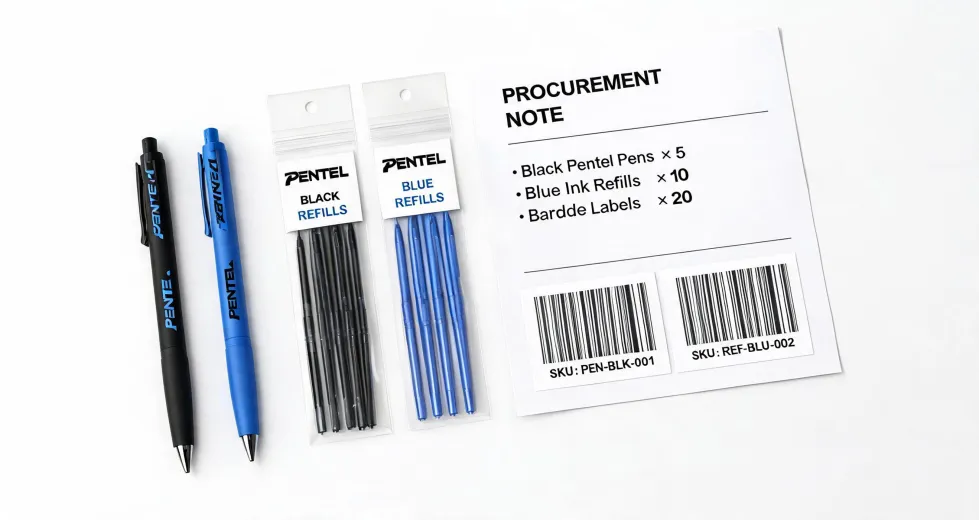
- Pentel dry erase markers are available in singles and 4-packs. They write smoothly, erase cleanly, and last longer than any generic brand I've tested. Yes, they cost slightly more upfront. No, you won't regret it.
- Pentel retractable gel pens (EnerGel series) come in fine and medium tips. The ink is liquid gel—fast-drying and vibrant. The retractable mechanism means no cap to lose. Good for everyday writing, signing, note-taking.
- Calculator watches—skip them unless you really need discreet number entry. The Casio CA-53W is the only one I've seen hold up, but the buttons are still tiny.
- Quadratic formula solvers: students can use Wolfram Alpha or a TI-84. No need for a dedicated hardware device.
The small-order mindset I wish I'd had earlier
When I started, I hesitated to ask suppliers for small quantities. I assumed they'd ignore me. But Pentel's distributor didn't blink when I ordered 12 markers and 24 pens. They processed it like a $2000 order. That changed my attitude: small doesn't mean unimportant—it means potential. I now work with vendors who treat a $50 order as seriously as a $5000 one. Every new client starts small, and those early positive experiences build loyalty.
To be fair, I get why some companies enforce minimums—their margins depend on volume. But for the end consumer (even a biz buyer like me), the best suppliers are those who accommodate small tests. Pentel's retail availability and flexible packaging (single pens, marker sets) make them a safe bet.
When my advice doesn't apply
If your team is 100+ people ordering in bulk, you might negotiate lower per-unit prices on generics. If you're a school district with strict budgets, Pentel's premium could be a barrier. And if you never use dry erase boards or gel pens, then my misery is irrelevant. But for the typical small office, startup, or home-based business, the calculus is simple: pay a few dollars more for reliability, save hours of frustration.
One last thing: printer setup advice varies by brand. Some modern printers support AirPrint and auto-driver installation. If yours does, you're golden. If not, see above—download the driver, avoid the CD. And if you're printing labels, respect the USPS mailbox regulations (18 U.S. Code § 1708) to avoid fines. That's not a joke—I've seen people get warnings.
I'm still making mistakes, just smaller ones now. The checklist I maintain for our team has prevented 47 potential reorders in the past 18 months. If you're starting from scratch, pick the right markers and pens first. Everything else follows.