When I first started managing office supply purchases for our company, I made the same mistake a lot of people make: I bought the cheapest pens I could find in bulk. It's an easy trap. You see a price like 12 cents per pen and think you're saving the company money. Then you spend six months watching your colleagues complain, running out of ink mid-sentence, and throwing away half the box because the caps crack or the clips break off. The math does not work the way you think it does.
I've been managing purchasing for about five years now, processing roughly 60–80 supply orders a year across 8 vendors. That experience has taught me one thing pretty clearly: unit price is a terrible way to evaluate office supplies — especially writing instruments. You need to look at total cost of ownership (TCO).
And honestly? I think the same logic applies to a lot of big financial decisions people make, from choosing between a 529 calculator to figuring out the rent vs buy calculator for housing. The up-front number is only the beginning.
I Used to Think Cheap Pens Were a Win
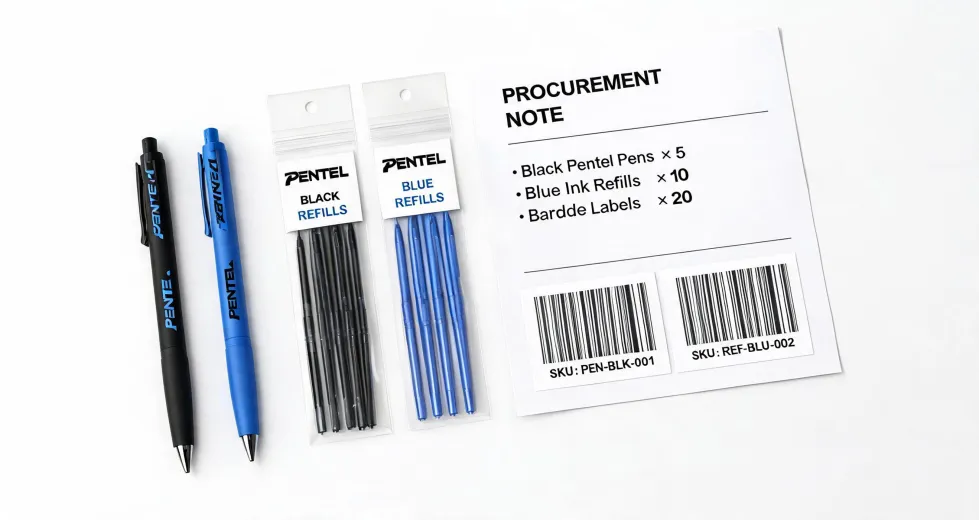
Here's what I mean. In Q4 2024, I ran a comparison on writing instruments for our main office — about 85 people across two locations. I looked at three options: a super-cheap bulk ballpoint (about 8 cents per unit), a mid-range gel pen (roughly 65 cents), and a Pentel Energel with the needle tip refill (around $1.10 for the pen plus about 80 cents for each refill).
My initial instinct, based purely on unit cost, was to go with the cheap ballpoint. Simple math: 8 cents vs 65 cents vs over a dollar. No contest, right?
Wrong.
What I did not account for: how long each pen actually lasts, how often people lose or abandon cheap pens, and how much time is wasted when a pen fails. The cheap ballpoints ran out of ink after about 1.5 pages of writing. They also dried out if left uncapped for more than about 20 minutes. People would grab five at a time because they could not trust a single one to last a day. So the actual consumption went way up.
If I remember correctly, the cheap pens lasted an average of 3 days per person. The Energel needle tip refills? About 3 to 4 weeks. That changes the math considerably.
The Energel Case: Hidden Costs You Don't See in the Unit Price
I should add that this is not just about how long the ink lasts. It's about workflow. Here is a quick breakdown of what I found:
- Cheap ballpoints: 8 cents each. Average lifespan: 3 days. Commonly thrown away when empty — but also thrown away when the cap cracks, which happened about 20% of the time. No refills available. Effective cost per month of use: roughly 80 cents per person.
- Mid-range gel pen: 65 cents each. Average lifespan: about 10–14 days. Some refills available, but not consistently stocked by our vendor. People often replaced the whole pen because the grip got grimy. Effective cost per month: roughly $1.30–$1.70 per person.
- Pentel Energel (with needle tip refill): Pen body about $1.10 (one-time purchase), refills about 80 cents each. Lifespan of a refill: 3–4 weeks. People kept the pen because the grip is comfortable and the clip is metal. I bought 85 pens once — still have most of them. Effective cost per month: roughly 80 cents per person (including amortized pen body).
So the cheapest option (per unit) and the Energel option (per unit) ended up costing about the same per person per month. But the Energel gave people a writing experience they actually liked — smoother, no skipping, and the needle tip is great for detailed work. The cheap ballpoints made people angry. I'm not exaggerating. I got complaints.
Oh, and we did not have a formal process for tracking how often we reordered. Cost us when I found out we'd ordered 2,000 cheap pens in a single quarter — more than 20 per person. That was our budget getting eaten alive, line by line, without anyone noticing.
The 'Rent vs Buy' Mentality for Office Supplies
This is where the TCO mindset comes in — and it actually connects to something bigger. The logic is kind of similar to how you'd use a rent vs buy calculator when thinking about housing. Renting looks cheaper month-to-month because you avoid the down payment. But over time, buying can build equity. The up-front cost doesn't tell you the story.
With pens, the up-front cost of a Pentel fountain pen (which runs around $15–$25) might look outrageous compared to a 20-cent ballpoint. But a fountain pen, if maintained reasonably, can last for years. The ink is cheap. The nib can be replaced if needed. The body is built from quality materials — metal and resin, not cheap plastic that cracks. Over a 3-year horizon, the fountain pen might actually come out ahead.
I haven't done that exact calculation for our office (we're mostly a gel pen and rollerball crowd). But I've seen it play out with other items. I bought a $35 Pentel GraphGear 1000 mechanical pencil about 4 years ago — still using it. The $2 plastic pencil I had before lasted maybe 4 months.
Granted, you have to account for people losing things. But that's part of TCO too — if people value and keep a higher-quality tool, it costs less over time.
What a 529 Calculator Taught Me About Office Procurement
This sounds like an odd connection, but bear with me. When I was looking into college savings plans for my kids, I used a 529 calculator to compare different contribution strategies. One thing that surprised me: the account with the lower monthly contribution wasn't always the better choice — not once you accounted for fees, tax treatment, and state-specific deductions. The headline number was misleading.
Same thing with office supplies. The headline price per unit is misleading unless you account for every cost bucket: purchase price, shipping, storage, usage lifespan, failure rate, and the hidden cost of employee dissatisfaction.
This was true 15 years ago when the supply chain was simpler. Today, with inflated shipping costs and longer lead times, it matters even more. I started calculating TCO formally in 2023 after a $240 reorder of cheap pens that should have lasted 6 months but lasted 7 weeks. That was a wake-up call.
Addressing the Obvious Objection
To be fair, I get why people go with the cheapest option. Budgets are real. The CFO wants to see a low per-unit cost on the invoice. And the TCO approach requires more work — you have to track usage data, calculate failure rates, factor in satisfaction. That's more time than just scanning a price sheet.
But here's the thing: the cost of not doing the math is often higher than the cost of doing it. In our case, the cheap pens were quietly costing us about the same as the better ones, while generating complaints and waste. We switched to Pentel Energel needle tip refills across the board in early 2024. I haven't had a single complaint since. And the per-person cost? It went down slightly, actually, because people stopped wasting pens.
So no, I don't think you should always buy the most expensive pen. But I do think you should stop buying the cheapest one without running the real numbers first. Use a TCO framework. Look at refillability, build quality, and actual use lifespan. If you do that, you might find — as I did — that a Pensil Energel or even a Pentel fountain pen is actually the more cost-effective choice over a 12-month period.
And if you're making a decision on a house or a college savings plan, do the same thing. The rent vs buy calculator and the 529 calculator are not just numbers — they're frameworks for thinking about hidden costs. The same logic applies to a 12-cent pen.
Prices as of January 2025; verify current rates at your preferred vendor.