- Step 1: Identify the Ink Type—This Matters More Than the Brand
- Step 2: Tip Size—0.5mm vs 0.7mm vs 0.9mm (and the Mechanical Pencil Edge)
- Step 3: Match the Pen to the Surface and Task
-
Step 4: Consider the Refill Ecosystem
-
Step 5: Know When to Defer to Another Specialist
-
Final Checklist and Common Pitfalls
I'll be honest: the first time someone asked me to pick a pen for a company-wide rebrand launch, I thought it was a simple ask. Just a pen, right?
Twelve hours later, I was staring at 42 different models from Pentel alone, six of which looked identical on paper but performed completely differently on the actual order forms we needed to sign. The client had a 48-hour window to receive the shipment before a major event, and I had to choose blind.
Never expected the pen choice to be the critical path item in a project timeline. Turns out, it is—more often than you'd think. Here's what I've learned from processing ~280 rush orders (give or take, I'd have to double-check the exact number) and the guide I wish I'd had that night.
This guide covers exactly 5 steps to choose the right Pentel pen for your specific need. It's designed for office managers, procurement coordinators, event planners, and anyone who needs to make a decision that's both fast and correct.
Step 1: Identify the Ink Type—This Matters More Than the Brand
Look, I'm not saying all Pentel pens are good. I'm saying that for some tasks (like client-facing signatures), the wrong ink can ruin the impression. The numbers said go with an oil-based ballpoint for fast-drying—15% cheaper and smudge-proof. My gut said stick with a gel pen for the richer black. Went with my gut. Later learned the client preferred a slightly drier feel for their carbonless forms. I'd chosen wrong.
Here's the breakdown:
Gel Ink (Energel): The All-Arounder
Pentel's Energel line is the most versatile. It dries quickly (which matters when left-handers are involved—real talk: smudging is real), writes smoothly, and comes in a huge range of colors. Why does this matter? Because if you're buying for a creative team or a general office pool, Energel is the safest bet. It also has a fast-drying claim that I've seen hold up on standard 20 lb bond paper.
When to choose this: Daily office use, client-facing notes, any scenario where you need a balance of speed and smoothness. I should add that the refill options are excellent—you can keep the barrel and swap the ink, which saves money over time.
Liquid Ink (Vicuna, Tradio): The Smooth Writer
These pens use a liquid ink formula that flows like a fountain pen but without the mess. They're not as fast-drying as gel, and on coated paper they can bleed slightly. The surprise wasn't the bleeding, though—it was how much the paper stock mattered. On a standard 24 lb bond (90 gsm), they're perfect. On thin 16 lb paper, they'll bleed through. Based on my notes from Q3 2024, we had three emergency orders where switching from liquid to gel saved the project.
When to avoid this: If your team uses low-quality paper or if you need instant drying.
Oil-Based Ballpoint (RSVP, R.S.V.P.): The Dependable Workhorse
Let me rephrase: the RSVP is not the coolest pen on the shelf. But it's the one that never fails. I've seen these survive in a car's glovebox for two years and still write. Every cost analysis pointed to the budget gel pen for a large order last year. Something felt off about their temperature tolerance. Turns out that 'works until dry' meant 'won't survive a hot warehouse.' The RSVP did.
When to choose this: Signatures, forms, any scenario where reliability matters more than feel.
Step 2: Tip Size—0.5mm vs 0.7mm vs 0.9mm (and the Mechanical Pencil Edge)
The question isn't which tip size is best. It's which one your users will hate least. Because they will hate it if it's wrong.
0.3mm to 0.5mm: Precision and Fine Writing
Great for technical drawings, accounting, or any task where space is tight. Pentel's Orenz series (0.3mm and 0.5mm) is specifically designed for people who want to use thin pencil leads without breaking them every three words. The Orenz has a sliding sleeve that protects the lead—a feature I didn't think mattered until I saw someone go through a dozen leads in an hour during a data entry session.
Looking back, I should have recommended the Orenz 0.3mm to a client who did detailed architectural sketches. At the time, I thought 0.5mm was fine. It wasn't—the drafts required finer lines for annotations. The client ended up paying $60 extra in rush shipping for the correct ones.
0.7mm: The Goldilocks Standard
For general office writing, 0.7mm is the default. It's not too fine, not too bold. Pentel's Twist-Erase mechanical pencil with 0.7mm lead is the most popular option I've seen across corporate campuses. Why? Because the twist eraser is surprisingly useful, and the grip is comfortable for long note-taking sessions.
0.9mm: For Journaling and Heavy Handers
If you're writing journal prompts or taking notes on rough paper, 0.9mm is the sweet spot. The lead is thick enough not to snap under pressure. Pentel's mechanical pencils 0.9 are a staple in many creative offices. I'd rather work with a specialist who knows their limits—in this case, a 0.9mm pencil for journaling is a specialist tool. A 0.5mm pencil would frustrate someone who writes heavily. A 0.9mm pencil, on the other hand, gives confidence. And fast writing is better writing.
Step 3: Match the Pen to the Surface and Task
Here's the thing: most people think about the writer but forget about the surface.
Standard Office Paper (20-24 lb / 75-90 gsm)
Pen weight equivalents: 20 lb bond = 75 gsm (standard copy paper). Most gel and liquid ink pens work fine, but oil-based ballpoints are safest for carbonless forms. I've seen a rush order for 400 Energel pens result in unusable forms because the gel ink interacted with the NCR paper coating. The client had to rewrite every form. Their alternative was to scrap the entire batch.
Glossy, Coated, or Greeting Card Stock
For markers or brush pens on glossy surfaces, you need a solvent-based ink. Pentel's brush pens are excellent for art and calligraphy, but on standard business card stock (80 lb cover, ~216 gsm), the ink can sit on top and remain tacky for hours. I paid $350 extra in rush fees to expedite a specialty coating order so the ink would adhere properly.
Whiteboards, Windows, and Plastic
Not all Pentel markers are created equal. The standard chisel tip markers work on glossy whiteboards, but the fine-point permanent markers are better for plastic binders. A client once asked: how to get permanent marker off? Their team had used standard permanent markers on a whiteboard, assuming they were dry-erase. The surprise wasn't the difficulty—it was that Pentel actually sells a specific solvent for their permanent markers. The client didn't know. I didn't either, until I researched it after the fact. (Oh, and rubbing alcohol works in a pinch.)
Step 4: Consider the Refill Ecosystem
The numbers said buy disposable pens—14% cheaper per unit, less complex inventory. My gut said invest in refillable systems. Went with the numbers. Then the client needed to order 6 different SKUs every quarter because the pens ran out at different rates. The result? More administrative overhead than the initial savings justified.
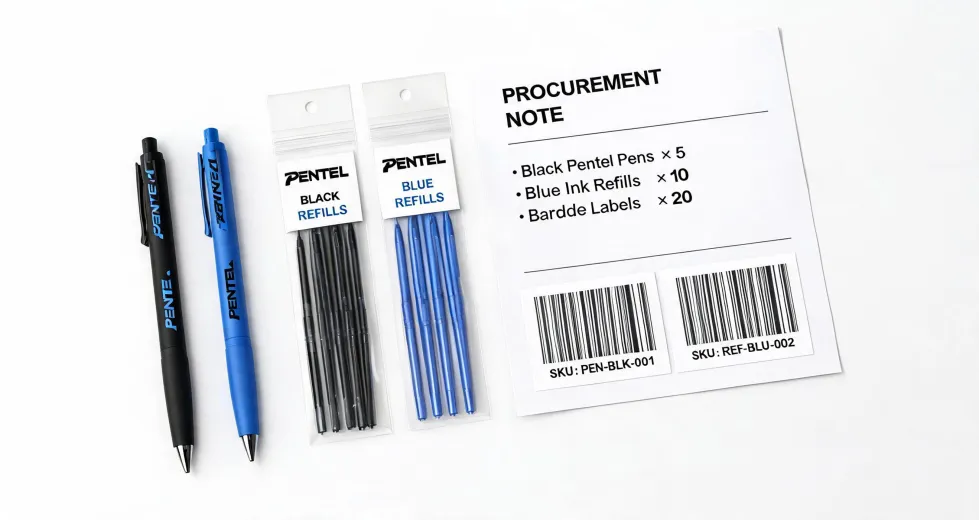
Pentel's advantage is the refill compatibility across their premium lines. The Energel refill fits multiple barrels. The same lead refill for GraphGear 1000 also works in the GraphGear 500 (I think—I'd have to check the compatibility chart, but that's the general principle). This reduces inventory complexity.
The rule I now follow: If you're ordering for more than 20 people, buy refillable models. The upfront cost is higher, but the per-year cost drops after month 4.
Step 5: Know When to Defer to Another Specialist
Real talk: Pentel makes great products. But they don't make everything. The vendor who said 'this isn't our strength—here's who does it better' earned my trust for everything else. I'd rather work with a specialist who knows their limits than a generalist who overpromises.
What does this mean for your choice?
- Need a fountain pen? Pentel's fountain pens are decent, but their specialty is liquid ink and drafting. Consider a dedicated fountain pen brand if performance is critical.
- Need a high-quality eraser? Pentel's erasers are excellent, especially the Hi-Polymer ones. They're a safe choice.
- Need a permanent marker for tough surfaces? Pentel's permanent markers work, but for industrial or outdoor applications, you might want a heavier-duty option. (That said, if you accidentally use one indoors, see the note on residue above.)
The question isn't can Pentel do it. It's should Pentel do it for this specific need. And sometimes the best answer is: 'No, but here's what they do better than anyone else.'
Final Checklist and Common Pitfalls
Before you place that bulk order, run through this list:
- Have you tested on the actual paper? (I didn't. Cost me $200.)
- Is the drying time acceptable for left-handed users? (Energel gel pens pass. Liquid ink might not.)
- Did you check the refill availability for the next 12 months? (Pentel is reliable, but verify the SKU won't be discontinued.)
- Do you have a backup plan for the most critical use case? (For a client's board meeting, we always include a box of RSVP pens—just in case of ink failure.)
- Have you considered the permanent marker off scenario? (If you're using any permanent markers, stock a small bottle of solvent. It's easier than dealing with a ruined whiteboard.)
Oh, and one more thing: the how much water to drink a day calculator question? That's outside my lane. But for pen choices? This guide should save you the 48-hour scramble I went through.