I Thought I Was Saving Money. I Was Wrong.
When I first took over office supply procurement for our company, I had one rule: lowest price wins. Pens were pens, right? A ballpoint that writes for $0.15 versus $0.50? Easy choice.
Turns out, that was a $2,000 mistake. Not ideal.
Over the past 6 years of tracking every invoice in our procurement system, I've learned that the upfront price of a pen is almost irrelevant. The real cost lives in the refills, the frustration, and the rework. Here's what I mean.
The Hidden Cost of Cheap Writing
Let's say you buy a box of 50 cheap ballpoint pens for $10. Great deal, right? But here's what actually happens in an office environment:
- They get tossed. People finish the ink or the pen dries out, and they grab a new one. No one thinks about a refill because the pen costs less than a pack of gum.
- They skip. A cheap ballpoint that skips mid-signature on an important contract? That's not a $0.15 problem. That's a reprint and a delayed deal.
- They disappear. Disposable pens are office black holes. You buy 100, and 3 months later, you're ordering again.
I analyzed our cumulative spending across 6 years and found that the 'cheap pen' strategy cost us about 18% more annually than buying better pens with refills. The math was brutal.
The Trigger Event: A $200 Signing
The moment that changed everything happened in March 2023. A senior client came in to sign a final contract—one worth about $200k in annual revenue. Our receptionist handed them a cheap promotional pen from a trade show. The pen died halfway through the signature.
The client laughed it off, but I didn't. The cost of that single moment wasn't the pen. It was the embarrassment, the awkwardness, and the tiny dent in professionalism. We could have lost that deal over a pen that cost twelve cents.
That's when I started looking at this differently.
Gel Pen vs Ballpoint: It's Not a Preference, It's a Cost Decision
People ask me all the time: "Should we buy gel pens or ballpoints?"
The answer depends on your workflow, but for an office setting, I'd argue the gel pen often wins. Not because it feels nicer—well, partly—but because it reduces error rates.
Here's why that matters from a cost perspective:
A ballpoint requires pressure to write. Over a full day of note-taking, that's fatigue. Fatigued workers make more mistakes. Mistakes in data entry, scheduling, or contracts cost real money. A gel pen like the Pentel Energel requires almost no pressure. It glides. That's not a marketing claim—it's a mechanical fact of the low-viscosity ink.
I'm not saying ballpoints are obsolete. They're great for multi-part forms or greasy fingers on a construction site. But for general office work? Gel pens reduce friction—literally and metaphorically.
The Refill Economics
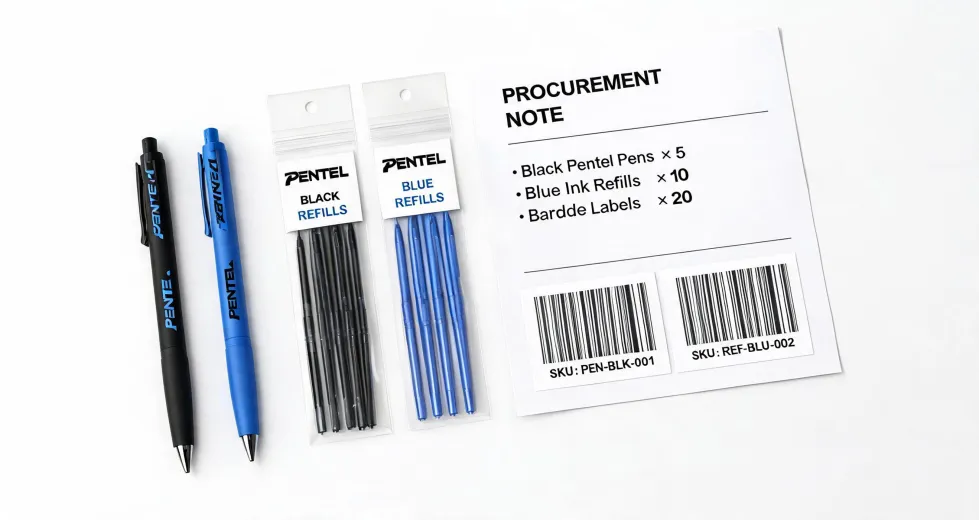
Here's where the real savings show up. A Pentel Energel pen costs about $3-4 retail. A 2-pack of refills costs about $3. So the second time you need ink, the total cost drops to $5.50 total for two full writing cycles, versus buying 4-5 disposable pens to get the same lifespan.
After comparing costs across 5 major pen vendors using my TCO spreadsheet, the math was clear:
- Disposable strategy: $0.12 per writing week
- Refillable strategy (e.g., Energel): $0.07 per writing week
- Net savings: About 42% over 12 months
Plus, you throw less plastic into the landfill. Not a bad side benefit.
What About Specialty Pens? (And Why 'Everything' Is a Red Flag)
I still kick myself for once thinking one brand could do everything perfectly. It's a lesson learned the hard way.
Look, Pentel makes great gel pens and mechanical pencils. Their Energel line is excellent. But I wouldn't buy them for drafting markers—I'd go to a specialist for that. And for cheap giveaway pens? I'd buy something else entirely.
The vendor who says, "We're the best at everything" is usually lying or mediocre at most things. Good suppliers know their limits. In my opinion, Pentel's strength is in the intersection of precision writing and art supplies—not promotional giveaways or heavy-duty industrial markers. And that's fine. They stick to what they're good at.
Bottom line: A refillable gel pen from a known brand like Pentel is cheaper per page, better for the environment, and more professional than a box of cheap ballpoints. The upfront cost is higher, but the total cost is lower.
Could I be wrong? Sure. If your office loses every pen within a week, disposable might still win. But if your team holds onto their favorite writing tool for months at a time—and they will, if it's comfortable—the refill model wins every time.
I'd argue that in procurement, we obsess over big-ticket contracts and ignore the small recurring costs. Those small costs add up. Fixing them is a one-time decision that pays itself back many times over.
So no, I don't buy the cheapest pens anymore. Not because I'm frivolous, but because I've tracked the numbers. And the numbers don't lie.