Let me paint you a picture. It's a Tuesday morning, and your team lead just realized the quarterly presentation is in two days. You need 50 high-quality pens for the client gift bags, and you need them now. You jump online, find the cheapest option with 'express shipping,' and click 'buy.'
Sound familiar? I've been there. More times than I'd like to admit. In my six years managing procurement for a 200-person marketing firm, I've placed over 400 orders for office supplies. And I've learned the hard way that the cheapest option, especially under a deadline, is rarely the cheapest in the end.
The Surface Problem: The Rush Order Trap
Here's what most people think the problem is: Rush orders are expensive. That $5 pen suddenly costs $12 with 'overnight shipping.' You pay a premium for speed, and it feels like a waste.
I used to think that, too. In Q2 2024, when we switched vendors to shave 15% off our quarterly stationery budget, I felt like a hero. We'd save $1,200 a year! Easy win.
But then, the rush orders hit. The new vendor's 'standard' delivery was 5-7 business days, not the 3-5 we were used to. Suddenly, every time something was urgent, we paid double for shipping. It wasn't until I did a full audit of our 2023 spending that I saw the ugly truth.
What I Didn't See: The Hidden Costs of 'Cheap'
It took me three years and about 150 orders to understand this: The cost of a rush order isn't the $15 shipping fee. It's the domino effect of that fee.
Here's what a standard cost analysis misses:
- The 'Breakdown' Factor: If a cheaper pen leaks or smudges during a client presentation, what's the cost? Think about the lost trust, the awkward follow-up email, maybe even a lost contract. I've seen a $1.50 pen cause a $15,000 problem. Not exaggerating.
- The 'But It's Cheaper' Spiral: You buy the cheap pens once. They're fine. Then you need some urgently. The 'standard' shipping is too slow, so you pay for express. Next time, you're in a similar rush. You do it again. Suddenly, you're paying for 'express' on 30% of your orders, and your average cost per pen is higher than if you'd just bought the good ones upfront.
- The Opportunity Cost: My time. Your time. The hours spent tracking down missing shipments from a budget vendor, re-reordering, dealing with customer service calls. All that time could be spent on something more valuable—like, you know, your actual job.
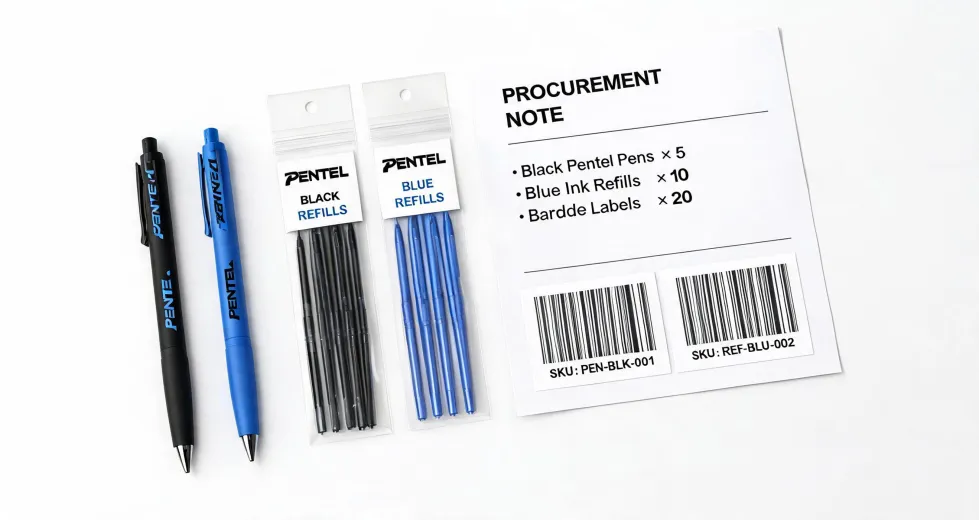
I only fully believed this after ignoring it myself. In March 2024, I approved a $400 rush fee for a set of 200 Pentel Energel pens. My boss questioned it. 'That's almost double the standard order cost!' I defended it because missing our client's 15,000-person conference would have been a catastrophe. The delivery arrived on time. The client loved the pens. We saved the day. That $400? Best money we spent all quarter.
The Real Price: What Happens When You Get It Wrong
Let's be clear. The risk isn't just a bad review. It's a loss of credibility.
I've seen teams scramble to hand-write name cards the morning of an event because the 'custom' pens with the client logo arrived with a typo. I've seen a project manager spend six hours on the phone trying to get a refund for a defective bulk order of markers. The 'cheap' option resulted in a $1,200 redo that we had to absorb. And that's just the hard cost.
The soft cost—the stress, the fire drills, the team morale—that's harder to measure, but it's very, very real.
What I Do Now: The Certainty Premium
So, what's the solution? It's not 'always buy the most expensive thing.' Please, don't hear that. I'm a cost-controller at heart. But I've changed my framework.
Instead of asking, 'What's the cheapest price?' I now ask, 'What's the cheapest price, given our timeline and the consequences of failure?'
For everyday items we need regularly? I still shop around. I still negotiate. For standard office supplies (paperclips, notepads, basic ballpoints), the budget option is usually fine.
But for anything that goes directly to a client, or has a hard deadline, I've built a different rule: Pay for certainty.
For us, that means brands like Pentel. It's a Japanese company with a reputation for precision. Their Energel pens? I've never had one leak. Their mechanical pencils (like the GraphGear or Orenz series) are known for reliability. Is that certainty worth paying for? Absolutely.
In my experience, the best approach is to buy quality from a vendor you trust for the critical stuff, and save the budget-shopping for the rest. It sounds simple, but it took me six years to get there.
Bottom line: The lowest quoted price for a pen is not the lowest total cost for your project. Account for the 'what ifs.' You'll thank yourself later.
Prices as of early 2026. I’d recommend checking current rates on specific online stores, but use this as a guide for your own cost-benefit analysis.