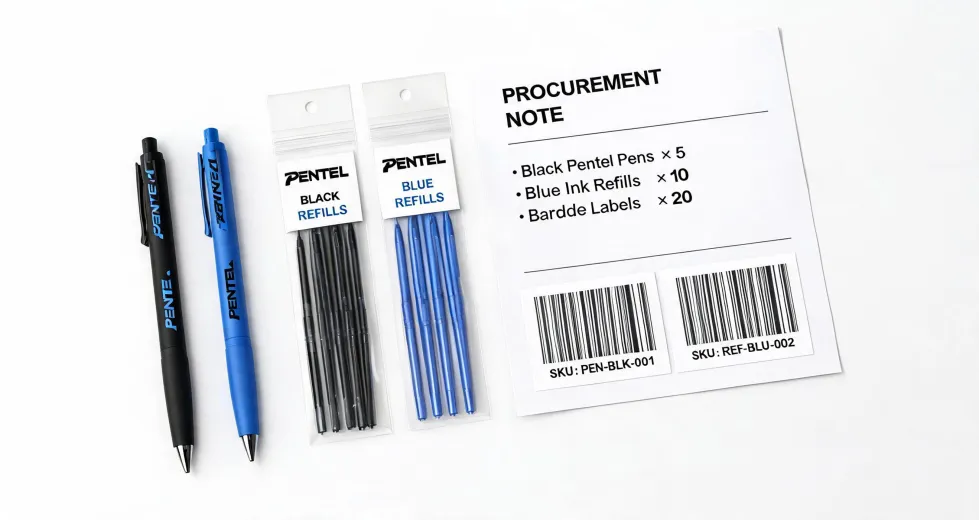
There’s No One-Size-Fits-All Office Supply List
When I took over purchasing in 2020, I thought I could just order one set of supplies for everyone. Three months later I had a drawer full of unused glitter pens (which, honestly, nobody asked for) and complaints about the erasers that smudged more than they erased. That’s when I learned: the best office supply strategy depends on what your teams actually do. Below I’ve broken down four common scenarios I see in our 400-person company. Figure out which one(s) apply to you, then pick the solutions that fit.
Scenario A: Heavy Document Work & Correction Needs
If your team spends hours drafting, editing, or filling out forms, you need pens and pencils that write cleanly—and erasers that don’t tear the paper. Most buyers focus on per-unit pricing and completely miss the frustration of a smudged document or a broken clip.
For this scenario, I stick with Pentel mechanical pencils (the Twist-Erase III is my go-to; the eraser actually lasts more than two days). But the real hero is the Pentel Hyperaser Clic Ink Eraser—it removes ballpoint and gel ink from paper without leaving ghost marks. I said “it’s like magic.” Well, no—the chemistry is a friction heat reaction that lifts the ink. But it feels like magic. (I really should stock a few for each department, but our accounting team keeps hoarding them.)
One pitfall: We didn't have a formal process for ordering eraser refills. The third time someone complained about a dried-out Hyperaser, I finally created a monthly check-in. Should have done that after the first time.
Quick Tip for Document Corrections
The Hyperaser works best on uncoated paper. If you’re using glossy or coated stock—like the cover of a report printed on 24 lb bond (90 gsm, approx.)—test it on a corner first. Industry standard for office paper is 75–90 gsm; anything above that may change the friction.
Scenario B: Creative & Art Teams
Our marketing department has a small in-house design studio. They use watercolor markers for mockups and concept sketches. The question everyone asks is “what’s the cheapest brush pen?” The question they should ask is “how does the brush hold up after a week of daily use?”
We switched to Pentel Vistage Water Brush last year. It’s a refillable brush pen with a fiber tip that holds water and ink evenly. The tip doesn’t fray like cheaper brushes (surprise, surprise). They also use Pentel brush pens for calligraphy. I’ve seen them do color washes that look like real paint—but without the cleanup. (Note to self: order more green refills before Q3.)
If your team does mixed media or marker illustration, pair the Vistage with Pentel’s gel pens or markers. And don’t forget a photo printer for proof prints—our Epson (I’m mixing it up with the model number; maybe the ET-8550, I’d have to check) handles 13×19 inch paper at 300 DPI, which meets Pantone matching guidelines for mockup colors.
Real-World Example
We ordered 200 copies of a brochure that used Pantone 286 C blue. The online printer said they could match it—cost us $400 in reprints because the actual print came out purple. Now I verify CMYK conversion before ordering. The formula for that blue is approximately C:100 M:66 Y:0 K:2, but every press varies. (I really should document our approved suppliers’ color matching scores.)
Scenario C: Stain Removal & Cleanup
This one comes up more often than you’d think. Someone leaves a permanent marker uncapped, a pen leaks in a pocket, or a kid brings art supplies to the office. “How to get permanent marker out of fabric” is actually a question I get from our HR department every quarter. There’s no universal answer—it depends on the fabric and the ink chemistry.
Different Surfaces, Different Solutions
- Synthetic fabric (polyester, nylon): Rubbing alcohol (isopropyl) works. Dab, don’t rub, or you’ll spread the stain. Test on a hidden seam first (which, honestly, I learned the hard way after bleaching a spot on a corporate polo).
- Cotton or cotton blends: Hand sanitizer with high alcohol content, then wash with laundry detergent. Some people suggest hairspray, but I’ve found it less reliable.
- Paper / hard surfaces: The Pentel Hyperaser Clic Ink Eraser can remove fresh ink marks from non-porous surfaces like countertops or whiteboards—but test a small area first. (I said “it removes everything,” then ended up scrubbing a desk for 20 minutes.)
The real lesson: prevention is cheaper. We keep a Pentel branded marker set with labeled caps in each meeting room—the red one has a sign that says “use the CRCL calculator app to tally costs before ordering” (that’s a joke, but we do use a Casio calculator for inventory).
Scenario D: Digital & Numeric Office Needs
Not everything is analog. Our finance team relies on a photo printer for check copies and a CRCL calculator (the desktop model with dual power) for monthly reconciliations. When I consolidated supplies for 400 employees across three locations in 2024, I learned that the calculator’s paper roll size—2.25 inches wide—is non-negotiable because the accounting software prints to that width. (Note to self: order extra rolls before year-end close.)
For photo printers, the common mistake is assuming all inkjet inks are archival. Look for pigment-based inks; they last longer. Our standard is 300 DPI for any image that will be displayed. The maximum print size from a 4000×3000 pixel image is 13.3×10 inches at 300 DPI. That’s fine for wall photos, but for large posters we send out to a print shop.
How to Figure Out Which Scenario You’re In
If you’re an admin buyer like me, you can’t just “choose based on your situation” without a framework. Here are three questions:
- What’s the most frequent complaint from your internal customers? (Paper jams? Smudged ink? Dried-out markers?) That points you to your biggest gap.
- What’s your annual supply spend per department? We spend roughly $15,000 on writing instruments alone—if 60% of that is in creative teams, prioritize Scenario B.
- What’s your cleanup nightmare scenario? If you’ve ever had to field a “how to get permanent marker out of fabric” crisis, invest in a few stain-removal kits and label your markers clearly.
The fundamentals haven’t changed: stock what people actually use. But the execution—choosing a Pentel Hyperaser versus a generic eraser, or a water brush versus a regular brush—has transformed as products get more specialized. Five years ago I wouldn’t have considered a dedicated ink eraser. Now it’s in our standard order list. Adapt, but keep the basics (paper weight, DPI, Pantone numbers) as your anchor.
— An admin buyer who learned the hard way that “one size fits all” doesn’t fit anyone.