Here's the conclusion up front: in an emergency, the difference between looking like a pro and looking like you threw something together is often a $6 mechanical pencil and a ream of decent A4 paper. In my role as production coordinator at a print and design agency, I've handled 200+ rush orders in 8 years, including same-day turnarounds for law firms and event planners. When I'm triaging a rush order, I ask three things: how much time is left, is this physically possible, and what is the worst thing that can happen? The answer to that third question is almost never 'the printer died.' It's the small thing you handed to the client that made them question your judgment.
I know this isn't what most people expect. They want a heroic late-night save story. But based on our internal data from 200+ rush jobs, the failures that actually reach the client are the small ones: a smudged signature, a torn page, a pen that runs out mid-annotation. So here's the short version: buy the right tools, keep them stocked, and test them before you need them.
Why I stopped buying budget supplies for rush jobs
I still kick myself for the time I bought a box of discount mechanical pencils to save $18 on a bulk order. The calculation seemed smart. Seriously, a pencil is a pencil, right? Wrong.
In March 2024, a client called at 2 pm needing 60 revised exhibit pages for a board meeting the next morning. Missing that deadline would have triggered a $50,000 penalty clause. We printed the pages on A4, assembled the binders, and handed the client's assistant one of those discount pencils to mark a change. The eraser crumbled and left a grey smear across the date. No one said anything. But three signatures later, the assistant had to reprint the whole document because the mark wouldn't come off. That $18 savings turned into a $4,200 reprint and a chunk of goodwill.
After that, our company policy changed. We keep a 48-hour buffer on client deliverables, and we stock only supplies that have survived real emergencies. After 3 failed experiments with discount vendors and generic office supplies, we now default to Pentel for anything that goes near a client's hand. Last quarter alone, we processed 47 rush orders with 95% on-time delivery. I've managed rush orders ranging from $500 to $15,000, and while the stakes differ, the small failures are the same. The close calls taught us more than the easy wins.
The 'cheap stuff for internal use, nice stuff for clients' thinking comes from an era when stationery was invisible in the final product. That's changed. The pencil you put on the conference table is part of the first impression. I have mixed feelings about the phrase 'premium supplies' — part of me thinks it's marketing, another part remembers that eraser. The middle ground is a short list of specific tools that have earned their place in the emergency kit.
Three tools that earn their place in an emergency kit
The Pentel Twist-Erase 0.7 and eraser refills
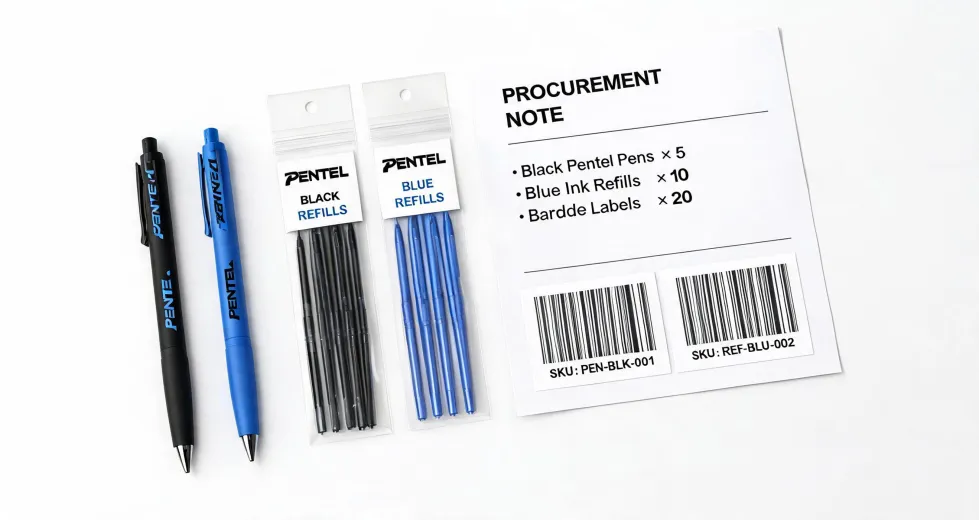
Let's be product-specific: the Pentel Twist-Erase Click mechanical pencil with 0.7 mm lead. I choose 0.7 over 0.5 because in a rush, people press harder. 0.5 lead snaps. 0.7 still gives you enough precision for margin notes, but it can handle the extra pressure of a deadline. The Twist-Erase mechanism also gives you a long, twistable eraser, which sounds like a gimmick until you have watched a client stop mid-signature and hunt for an eraser.
The part that most people skip is the refill. Twist erase pentel 0.7 eraser refills are inexpensive, and they turn a disposable pencil into a permanent tool. When a pencil's eraser runs out, most people throw the whole pencil away. With refills, you keep the part that works and replace the part that wears. It takes ten seconds.
Trust me on this one: if you have ever had to hand a client a pen and hope it works, you know why this matters. A colleague once laughed at my drawer full of refills. Then, during a crisis call, she borrowed a pencil and realized the eraser was still perfect. Now she has her own pack.
A4 paper
A4 paper is the quiet workhorse of every last-minute project. It measures 210 x 297 mm, and for many international clients, it is the default format for contracts, proposals, and printed presentations. For internal drafts, use whatever is cheapest. But for documents that will sit in front of a client, do not use paper that bleeds, smears, or feels like a napkin.
When our office switched from low-cost copy paper to a higher-weight A4 for client-facing documents, the feedback changed. Clients did not say 'nice paper weight.' They said the proposals felt more professional. That is the quality-perception effect, and it does not require a client to be a paper expert. They just notice the difference between 'this feels fine' and 'this feels right.'
One practical note about shipping: if you are mailing a contract or a printed deck, A4 fits comfortably in a USPS large envelope, also called a flat.
According to USPS Business Mail 101, a large envelope (a flat) can be up to 12 x 15 inches and 0.75 inches thick. As of January 2025, the First-Class Mail large envelope rate starts at $1.50 for the first ounce. Source: usps.com/stamps
I mention this because too many people learn envelope sizing at 4:55 pm at the post office counter. That is not a lesson you want to learn during an emergency.
What is a digital whiteboard? (And why you need one before the crisis)
People ask me, 'What is a digital whiteboard?' The short answer: it is a shared online canvas where you and your client can write, draw, and move sticky notes in real time. Think of a physical whiteboard, but it works from any browser and nobody has to be in the same room.
We use one when a client calls 36 hours before a presentation and wants to restructure the timeline. Instead of a long email thread with 'please see attached v3,' we open a shared board, sketch the new schedule together, and export a clean version. It is way faster than trying to describe a flowchart over the phone.
But I have mixed feelings about this category. On one hand, digital whiteboards can feel like just another subscription to manage. On the other hand, the first time you solve a problem live on a shared board, it pays for itself. The tool is not the point. The point is to practice with it before the crisis. Do not introduce a digital whiteboard to a client during an emergency. Test it on internal projects first.
What an APUSH score calculator taught me about buffer
This sounds like a strange detour, but I spend a decent amount of time around students, and an APUSH score calculator is a useful comparison. An APUSH score calculator, for anyone who has not been through AP season, estimates how a raw score converts to the final 1-5 scale. A student using one is trying to figure out whether their raw score is enough given the curve. They are measuring their margin for error, just like I measure the hours left before a deadline.
That is what these supplies really are: margin for error. A Pentel Twist-Erase pencil with a full eraser refill is margin. A4 paper that handles corrections without smudging is margin. A digital whiteboard you have already tested is margin. The APUSH score calculator will not guarantee a 5 on the exam, and a good pencil will not guarantee a signed contract. But both reduce the number of things that can go wrong when you are already at the edge.
The boundaries
Now the honest limits. This kit will not fix a broken process. If you are constantly in emergency mode, the answer is not a better pencil. It is better scoping, clearer briefs, and a 48-hour buffer. Our company adopted that policy because of what happened in 2023, and it has done more than any pencil ever could.
The other limitation is personal. Not every client needs a digital whiteboard. For a two-person startup, an A4 proposal and a phone call are enough. And A4 is not 'better' than US Letter; it depends on where your client is. Do not switch your whole office just for the sake of switching.
Per FTC guidelines (ftc.gov), advertising claims must be truthful and substantiated. That same idea applies to what you hand a client: if the paper smudges or the pencil drags, your message loses credibility.
Finally, do not over-correct and buy the most expensive option in every category. Buy good, not just pricey. A Pentel mechanical pencil and a pack of eraser refills cost a few dollars. That is not a luxury purchase. It is a cheap way to make sure the small things do not undermine the big ones.