I'll Say It Straight: The Cheapest Brush Pen Is Expensive
I manage buying for a 90-person creative agency. For the past six years, I've watched our annual art and office supplies budget of around $120,000, negotiated with more than 40 vendors, and logged every order in our cost tracking system. That doesn't make me an artist. It makes me someone who sees the real price of a pen.
This is my honest pentel brush pen review, written from a procurement desk instead of an art studio. And my opinion is simple: the cheapest brush pen is usually the one that costs the most in the long run.
I know that sounds like a line from a motivational poster. I do not mean it that way. I mean it the way someone talks after they've audited too many invoices.
What a 50-Pen Order Taught Me
In Q2 2024, we needed brush pens for a client workshop. We set aside $300. A generic bundle was $180. A pentel brush pen set was $260. The difference: $80.
I knew I should order samples and test them on real paper. But we were already behind, and I thought, “What are the odds a whole package of pens is bad?” The odds caught up with me: 14 of the 50 pens dried out within a week, and another 6 developed bent tips. We had to expedite a second order. Including rush fees, that second order cost $482.
So the “smart” $180 purchase turned into an $180 plus $482 problem. The $260 set would have covered the workshop and lasted for months afterward. That's a $402 swing, caused by an $80 difference in price.
When I audit our spending, I see the same pattern again and again. It's not the item with a slightly higher unit cost that creates budget overruns. It's the item that fails and has to be replaced.
The Hidden Costs You Don't Get From a Quote
Most people ask me for a simple answer: “Which pen is cheapest?” I tell them to stop looking at the price tag and start looking at total cost. I use a four-line cost model:
- Material cost: the purchase price.
- Labor cost: the time your team spends fighting with the product, cleaning up bleed, or redrawing a sketch.
- Replacement cost: how often you order the same thing again.
- Risk cost: the chance that a product fails right before a deadline.
This framework applies to more than pens. If you're researching a pokemon binder, you already know the cheap binder and the expensive binder look surprisingly similar on day one. The difference shows up later, when the pockets loosen and a valuable card slides out. The binder is not the expensive part; the card inside is. In an agency, the client deliverable is the card, and the pen is the binder.
I also use a chipotle calorie calculator when I'm planning lunch. It's useful because it forces you to see the total before you commit. That's exactly how a purchase order should work. The sticker price is like the calorie count on a menu. It gives you one number, but it doesn't tell you whether you'll be starving at 4 p.m. A cheap pen is the same: it looks fine until the moment it doesn't.
When I audited our 2023 spending, I found that 12% of our office supplies budget went to rush replacements. Not because we were careless, but because we were saving money on items that kept failing.
Why I Keep Coming Back to Pentel Brush Pens
Let's talk about the actual products. This wouldn't be a useful pentel brush pen review without naming what I order.
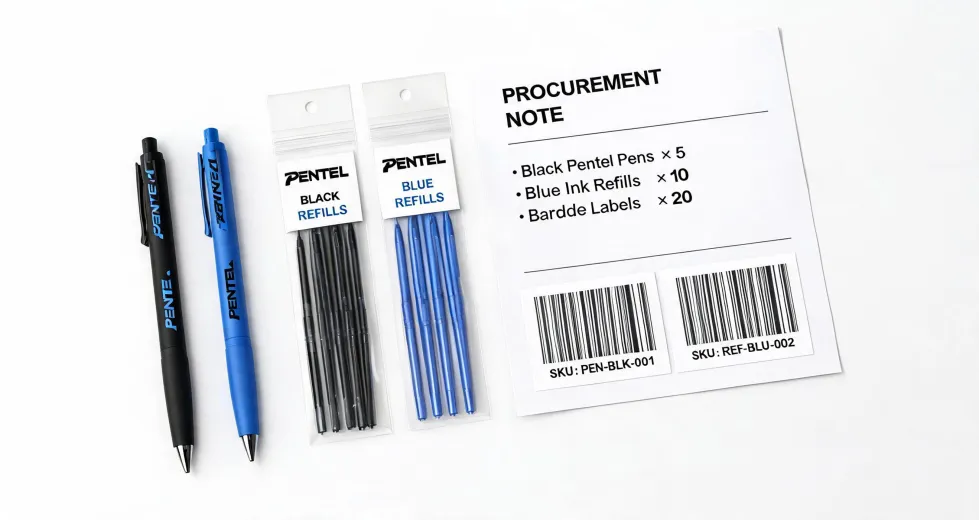
The Pentel Pocket Brush Pen is the one I buy over and over. The bristle tip keeps a point, the ink feed is reliable, and the refillable cartridge system makes the long-term cost lower than a disposable pen. I can't promise it will never skip, because that would be a lie. But I can tell you that out of our last four orders, we had zero defective Pocket Brush Pens. I can't say that about any other brand in our supply closet.
For a pentel brush pen set, the Color Brush line makes sense when you want a coordinated palette. The pens in a set share the same tip behavior, so a designer isn't fighting one brush that feels soft while another feels stiff. When you're buying for a team, that consistency is a real cost saver. You're sort of paying for predictability, which is harder to see on a quote than a unit price.
Price check as of January 2025: I saw the Pentel Pocket Brush Pen listed at around $7–10, and color brush sets between $15–25 depending on the number of colors. Verify current listings, of course. But compare that to one hour of a designer's salary, and the pen becomes a small insurance policy.
If you're learning how to use acrylic paint, the same logic applies. You need a brush that doesn't shed and keeps its shape. I'm not going to write a full acrylic painting tutorial here, but from a cost perspective, the tool matters more than the technique. A $2 brush that sheds in the first wash is more expensive than a $9 brush that survives a hundred washes.
Objection: “What If I Only Need One Pen?”
I hear you. If you're an individual sketcher, you don't need a 12-pen set. Buy one Pentel Pocket Brush Pen and see what you think. My argument is not “buy the bundle.” My argument is “don't buy ten cheap pens just because they're cheap.”
I also hear “Pentel costs more than the generic brand.” True. But let me put it in context. Over the last six years, I've tracked 240+ orders in our procurement system. The most expensive mistakes were rarely products that had a higher initial price. They were products that failed silently, forcing us to reorder, redo work, or apologize to a client. Our procurement policy now requires quotes from at least three vendors. We don't simply pick the lowest one. We pick the one with the lowest total cost.
One more objection: “You're a procurement manager, so you probably only think about money.” Fair enough. But I also think about time, trust, and whether a tool shows up when you need it. A cheap pen that works 80% of the time is a 20% tax on your attention.
My Bottom Line
If you take one thing from this pentel brush pen review, take this: the lowest quote is not the lowest cost.
When you look at a pentel brush pen set, calculate the total cost over a year. If a budget set dries out every month, you'll replace it twelve times. If a Pentel lasts three times as long and works consistently, the expensive-looking option may actually be the cost-effective one.
And if you arrived here with other tabs open—a chipotle calorie calculator, a pokemon binder, a page about how to use acrylic paint—you already understand the theme. One number, one cover, or one first stroke doesn't define the result. The total picture does. Pick the brush pen that helps you do your best work, not the one that just looks cheapest on the first click.
Full disclosure: I'm not paid by Pentel or anyone else to recommend this. I just like products that don't create hidden costs.