I manage office and stationery orders for a small outpatient clinic. I've been doing it for six years, and I've personally made 17 significant supply mistakes—roughly $4,000 in wasted budget. The most common mistake was buying one 'perfect' tool and trying to make it do all jobs. Now I keep a checklist before every stationery order, and this comparison is part of that checklist.
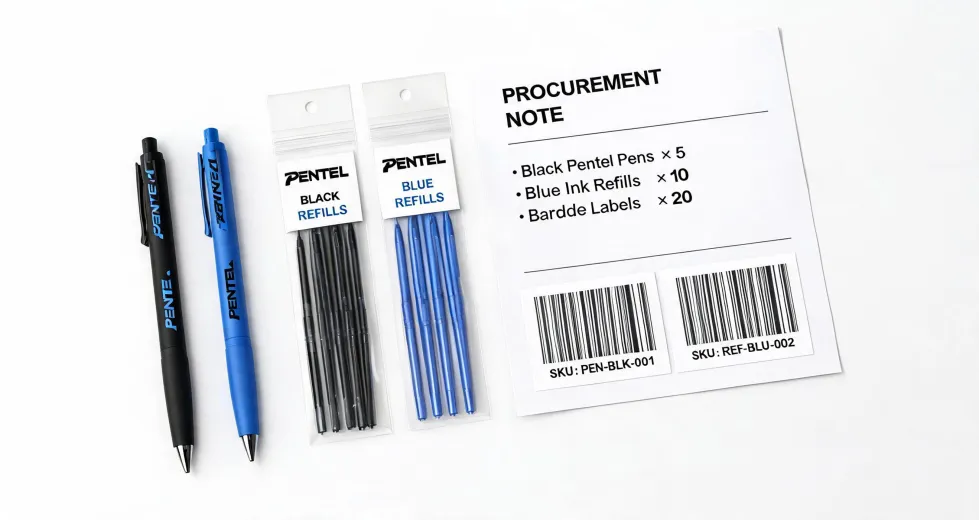
This is not a comprehensive review of every Pentel product. I have used a lot of Pentel pens, but I am not a professional tester. For the last six months, I have kept two things on my desk: the Pentel Medium Brush Pen XFP5M and a pack of Pentel pink pens. They look like either one should work for a journal entry. After one especially bad page, I finally understood the difference.
Why Compare These Two?
When I first started journaling, I assumed a nicer pen would make every line look nicer. So I bought the brush pen. It did make my writing look nicer—for about three lines. Then the line wobbled, my hand got tired, and the rest of the page looked like a confession written in a moving car.
The Pentel pink pens were an afterthought. I bought them because I kept losing black pens. They were uniform, unglamorous, and easy to spot. They also saved my journaling habit.
This is not a 'which pen is better' comparison. It is a 'which one belongs in which part of a journal entry' comparison. The dimensions that mattered to me were:
- Line control
- Ink behavior on normal paper
- Practicality for a full page of writing
One of those dimensions ended up with a conclusion I did not expect.
Dimension 1: Line Control
The XFP5M is a medium brush tip. The line changes when you press, when you rotate the pen, and when you write fast. That is brilliant for a heading. It is also cruel to the rest of a journal entry.
A few months ago, I made a corrected calcium calculator reference table (the lab formula that adjusts total calcium when albumin is off) for a new nurse. It was full of abbreviations, numbers, and arrows. I started with the brush pen because I was trying to make it look neat. The first row looked great. The third row looked like a different person had written it. The columns did not line up because the line widths were different.
I switched to the Pentel pink pens for the rest of the table and finished in five minutes. The pink pens did not add any magic. They simply stayed the same. For a page with a lot of information, consistency is the entire point.
That was my first counterintuitive conclusion: the expressive brush pen was the wrong tool for making a page look good. It made one line look good. It made the rest inconsistent. The pink pen was boring and reliable, and 'boring and reliable' is exactly what a table needs.
Dimension 2: Ink Behavior and Paper
The brush pen lays down more fluid than a gel pen. On the cheap paper we use for training documents, that means more show-through. You can see the ink on the other side of the page. The EnerGel pink pens leave a thinner layer of ink, so they are less likely to ghost. I have not water-bombed either pen, so I cannot tell you about waterproofing.
According to Pentel's product page (pentel.com), the EnerGel line uses a low-viscosity liquid gel ink designed to dry quickly. I can say the pink pens dry fast enough for me. The brush pen takes a second or two longer. If you are left-handed, test the brush pen before committing. I do not have hard data on left-handed performance, and I do not want to pretend otherwise.
I should add that I tested the XFP5M on a cheap sticky note once. It did not go well. The brush tip soaked through the note and made the desk underneath look inky. The pink pens handled it fine. If you write on unusual surfaces, pick the gel pen.
And yes, the paper matters more than the pen in most cases. A heavier notebook will make any of these pens act better. But not every journal entry happens in a nice notebook.
An Aside: Can Acrylic Paint Be Used on Fabric?
I keep getting asked whether acrylic paint can be used on fabric. It is connected to journaling in a weird way—people want to decorate fabric journal covers, bookmarks, or pouches with acrylic paint.
So, can acrylic paint be used on fabric? Yes, with caveats. Acrylic paint can be used on fabric if you mix it with a fabric medium and then heat-set it with an iron. Without the medium, it dries stiff and can crack. For a fabric book cover, that is the difference between a keepsake and a stiff mess.
But for a paper journal entry, skip the acrylic paint. It is too wet, too thick, and too hard to undo. Use a brush pen or a gel pen instead. Acrylic is a craft material, not a writing tool.
Dimension 3: Practicality and the Small Order Lesson
Here is the part where I have to admit a gap in my notes. I did not track exactly how many journal entries each pen survived. I wish I had, because 'cost per page' is the metric that would settle a lot of online arguments. What I can say anecdotally is this: I reach for the pink pens about ten times more often than the brush pen. I reach for the brush pen when I want one line, one title, or one stamp of style.
The XFP5M is a specialty tool. The Pentel pink pens are workhorses. In a small clinic, workhorses win most days.
This is also where I want to say something about small orders. You do not need to buy a full set. A single Pentel Medium Brush Pen XFP5M is enough to decide if brush lettering works for you. Two Pentel pink pens are enough to cover your everyday journal entries. Small orders are not silly. Today's two-pen order is tomorrow's reorder of twenty for the team. The suppliers who treated my small orders seriously are still the ones I call now, and the same logic applies to your own desk drawer: start small, test honestly, then scale what works.
Verdict: What Should You Write With?
If your journal entry is mostly notes, numbers, and paragraphs, choose the Pentel pink pens and keep the XFP5M for the date or the heading.
If your journal entry is a creative page—hand-lettering, a mood board, a weekly spread—the XFP5M is worth the learning curve. It gives you the look of a brush without needing to set up a whole paint kit.
If you are still undecided, buy both. I know 'both' sounds like a non-answer, but it is the one I ended up with after making a mess of my corrected calcium calculator table. The brush pen made me fall in love with the idea of journaling. The pink pens made it possible to actually do it.
I kept asking myself whether the brush pen's style was worth the smudge risk. For one title, yes. For a full page, no. That was my risk calculation, and it applies to most journal entries.
And if you came here for the fabric question: yes, acrylic paint can be used on fabric, but use a fabric medium and heat-set it. Just do not use it in your journal.