It Started With a Permanent Marker on a $3,000 Table
Last September, I was on my knees in the conference room with a bottle of rubbing alcohol, a paper towel, and a growing sense of dread. Someone had left a permanent marker uncapped on the wooden table—the nice one that HR bought before the pandemic. It rolled, and by the time anyone noticed, there was a black streak the length of my hand across the grain.
If you've ever Googled how to remove permanent marker from wood, you know the advice looks simple: isopropyl alcohol, white toothpaste, baking soda paste, a magic eraser. We tried all of them. The alcohol faded the streak to a ghost, and the ghost is still there. That table now lives in a corner with a bowl of fake plants on it.
Here's the frustrating part: that marker was in the building because I put it there. I'm the operations coordinator at a 40-person marketing agency outside Chicago, and I've handled our office supply orders for seven years. In that time, I've made—and documented—14 significant buying mistakes, totaling roughly $3,000 in wasted budget. The permanent marker incident was the last one, and the one that finally made me change how we buy pens.
In 2021, I Ordered 500 Pens and Thought I Was a Genius
It started when management asked for a 15% cut in our office supply budget. The directive came down to me as a single sentence: just find cheaper pens.
I still remember the spreadsheet. I had been using an Illinois paycheck calculator that year to figure out my real take-home pay after state and federal deductions, and I thought I was being equally rigorous with the supply order. I compared unit prices, shipping fees, and estimated reorder timelines across five vendors. The winner was a bulk box of disposable gel pens at $0.17 per pen—a fraction of the $1.20 I had been paying for Pentel Energel needle tip pens. I ordered 500 of them and felt like a hero.
Spoiler: I wasn't a hero. I was the person who starts a gym membership in January and stops going by March.
The Slow-Motion Disaster
The cheap pens were tolerable for the first few weeks. If you only wrote one line at a time and let it dry, they were okay. But in a real office, nobody writes one line at a time.
- Most of the cheap gel pens smudged the moment your hand grazed the page. Left-handed coworkers developed a weird hovering technique to avoid dragging wet ink everywhere.
- The ink got watery fast. A pen that sat uncapped for half an hour turned into a skipping, blotchy mess.
- The barrels were slippery and thin. Nobody wanted to write a full page with one.
- People started hoarding the good pens. We had to buy a few premium ones just to keep the peace, and they still disappeared into desk drawers.
I justified it for months. They're just pens, I told myself. But then the marker rolled across that conference table, and I couldn't ignore the math anymore.
The alcohol worked, sort of, but the ghost stain stayed. The table is a permanent reminder of choosing the cheapest option over the right one. After I cleaned up, I went back to my desk and spent an hour calculating what our budget pens had actually cost us.
The Calculator I Should Have Used From the Start
People love to say the most expensive thing is the cheapest thing. It's a cliché because it's true, but it took a stained table to make me believe it.
Here's what clicked for me: a body shape calculator doesn't give you one number. It uses multiple measurements—bust, waist, hips, inseam—to tell you what will actually fit your body. When I reviewed our cheap pen experiment, I had been using exactly one measurement: unit price. That's like judging a car by its sticker price and ignoring fuel economy, maintenance, and resale value.
So I built a simple spreadsheet with the real measurements of our office supply spending:
- Reorder rate: We bought cheap pens three times in eight months. They ran dry faster, got thrown away more often, and the office went through them like they were free.
- Error rate: We had two client-facing documents smudge badly enough to be redone. The printer charged us about $150 each for the reprints, and the embarrassment is hard to put a dollar figure on.
- Work time lost: The cheap mechanical pencils were somehow worse than the pens. Every other push of the button ejected a lead chip that shattered on the desk. People walked to the supply cabinet constantly, not to get work done, but to find a pencil that didn't betray them.
- The table stain: About $300 in repair attempts, and the table still looks haunted.
When I added it up, the total cost of our budget pens came to about $3.40 per usable pen. The Pentel Energel needle tip pen that I'd avoided because it cost $1.20? Its total cost, factoring in normal life and no smudge complaints, was about $1.30.
My experience here is based on one office of 40 people doing desk work in Illinois. If you manage a classroom, a workshop, or a factory floor, your numbers will be different. I can't promise Pentel is the answer for every environment. But for a standard office, the comparison held up so clearly that I felt foolish for not doing it sooner.
Honestly, I'm still not sure why those cheap gel pens smudged more in the summer. My best guess is humidity slowing down the drying time. But I've stopped caring about the why.
The Switch: Pentel Energel and Pentel Arts GraphGear 500
We replaced the cheap stock with two workhorses.
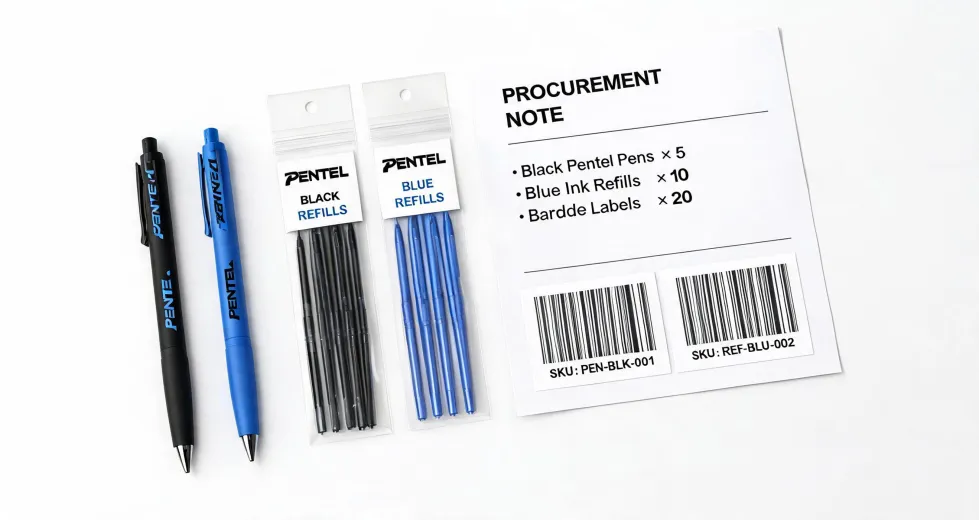
First, we ordered a box of the Pentel Energel needle tip pen in 0.5mm for general writing and a slightly bolder 0.7mm for people who prefer more line weight. The needle-point tip gives a precise line, closer to a technical pen than a standard ballpoint, and the liquid gel ink dries so fast that right-handed and left-handed writers can stop thinking about smudging entirely. The first time I wrote a note and immediately ran my finger across the page, I actually laughed. Nothing. Not a smear.
Second, for the pencils, we went with the Pentel Arts GraphGear 500 mechanical pencil (0.5mm). It's got a knurled metal grip that feels secure without being heavy, and a drafting-style metal lead sleeve that lets you see exactly where your line is going. The lead mechanism rarely breaks or jams, which is more than I can say for the cheap ones. We paid around $13 each, and in two years, not one has gone missing. People treat them like instruments instead of disposable junk.
That last point is worth sitting with. The psychological shift was real. Cheap pens signaled that the work they produced was cheap too. When we started handing out quality instruments, people stopped losing them, stopped breaking them, and stopped complaining about them.
One side note: Pentel markets some products with recycled content, and per the FTC Green Guides (ftc.gov), environmental claims like recyclable have to be substantiated. I mention this because I try to be careful about the claims we trust, and it's nice to see a brand back its labels with actual certifications.
What I'd Tell Someone Who's on the Fence
I only believed in buying quality after I ignored the advice and ate the mistake. Everyone with more purchasing experience than me warned me about the cheap pens. I didn't listen. The third reorder was the deal-breaker, and the stained table was the final straw.
So here's my advice, from someone who has documented his own bad decisions: run your own comparison, but measure more than the sticker price. Track the reorders, the wasted time, the smudged documents, and the supplies that disappear because nobody cares about something that cost less than a stick of gum.
The bottom line is that value beats price. When I put the 2021 supply budget next to the 2023 one—same team, same headcount, different pens—the total spending actually dropped, because the so-called expensive pens didn't need replacing every other month. The $1.20 pen turned out to be the cheap one.
Take it from someone who keeps a ghost stain on a conference table as a reminder. The right writing instrument isn't the one with the lowest price. It's the one that does the job, lasts a reasonable amount of time, and doesn't make you regret the money you saved in the moment.