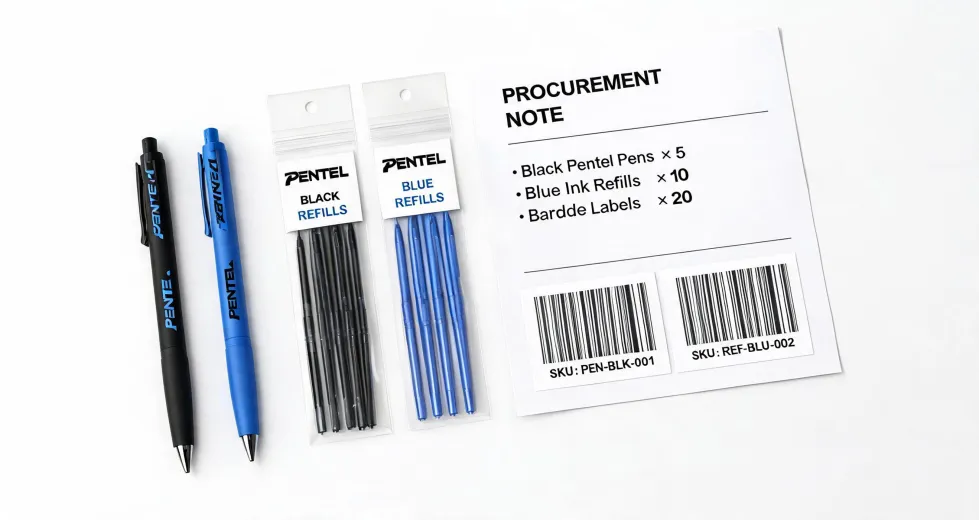
I've been the office supply coordinator at a 32-person company since 2017. That sounds like a small job, but I've placed over 400 orders in that time. I've also made about $3,800 in avoidable buying mistakes, and I kept a log for every one. This guide is the short version of that log.
If you're looking for one universal answer for a home office setup, stop. The right picks depend on how you write, how you label, how you calculate, and how much you print. I'll walk through four scenarios. Choose the one that sounds like your week, then buy accordingly.
Prices noted here are from my order history or a quick retail check in January 2025; verify current rates before you order.
The Four Scenarios That Actually Matter
- Writing-heavy: notes, journals, forms, signatures. You need a reliable everyday pen.
- Labeling-heavy: boxes, jars, plastic bins, art projects. You need something that survives contact with surfaces.
- Math-heavy: homework, budgeting, cost comparisons. You need the right calculator for the task.
- Printing-heavy: assignments, contracts, shipping labels, photos. You need a printer you won't fight.
Scenario 1: You Live in a Notebook
From the outside, a box of twenty-five $0.18 pens looks like a smart budget win. In 2018, I ordered a case of them and watched three leak in the first two weeks. Most of the rest disappeared by month two. The actual cost per useful writing day was higher than the Pentel EnerGel NV gel pen I switched to later.
The Pentel EnerGel NV gel pen is my usual recommendation for anyone who writes more than a page or two a day. The needle tip moves through small handwriting without turning it into a blur. The ink flows without much pressure, so your hand gets less tired. It's still a gel pen, not a magic wand—I wouldn't call it smudge-proof. But it works.
People ask why I don't just buy the cheapest pen that works. Because I've seen the hidden cost. A $0.18 pen that leaks on a client contract costs more than the pen. A $2.12 EnerGel NV that stays in a drawer because the user likes it is cheaper in the long run. That's value math, not price math.
Scenario 2: You Label Everything
I am the person who labels cables, binder boxes, returns, and test samples. Stickers peel. Permanent markers fade on plastic. The tool I keep coming back to is the Pentel Bullet Paint Marker.
The Pentel Bullet Paint Marker is exactly what it sounds like: a marker that holds paint instead of standard ink. It writes on plastic, glass, metal, and dark surfaces. The paint dries opaque, so you can actually read the label later.
There's a learning curve, which people don't expect. You have to shake it and press the tip to get paint flowing. The first time I used one, I thought it was broken. It wasn't. In a rush, your instinct is to drag it like a highlight marker; that's how you get a chalky, empty line. Read the instructions, and you'll be fine.
I have mixed feelings about paint markers. On one hand, they're the most reliable labeling option I know. On the other, they require that little ritual, and in a busy week it's annoying. But a $3.50 marker that labels a plastic bin once and stays readable is more useful than a $20 labeling kit I'd still have to set up.
Scenario 3: You Do Math in Real Life
Let's talk about calculators. If you're a student working through linear algebra, an rref calculator is a handy free check for row-reduction and matrix problems. I used one in 2023 when I reviewed that material, and it saved me on a homework set. If you're an office worker comparing deals during a sale, a percent off calculator is the tool I use constantly.
Why do calculator choices matter in a supply guide? Because the calculator reminds you to compare the right numbers. In November 2024, I almost bought a six-pack of pens at 20% off instead of a four-pack of refills at full price. Using a percent off calculator, the six-pack was clearly cheaper per pen. But when I checked the ink volume, the refill pack contained almost three times as much writing ink. The sale was not the bargain.
That's the core of my entire buying philosophy: total value over sticker price. The cheapest option is only cheap if it actually covers what you need. A calculator is how I stop fooling myself.
Scenario 4: What Is the Best Printer for Home Use?
I have typed that phrase into a search bar more times than I'd like to admit. There is no single best printer for every home, because every home prints differently. Here are the branches I use after eight years of printer mistakes.
A. You Print Mostly Text Documents
If your printing is mostly black text on white paper—homework, contracts, shipping labels, packing slips—a monochrome laser printer is more often than not the best choice. It costs more upfront than a sale inkjet, but the toner lasts dramatically longer. In my own purchase records from 2022 to 2024, a $69 inkjet cost $132 in ink before I gave up. A $109 laser was still on its original toner cartridge fourteen months later. That doesn't make inkjets bad. It makes them wrong for this particular scenario.
B. You Print Photos or Color-Heavy Projects
If you need photos, colored charts, or school posters, an inkjet with separate color cartridges or a refillable tank is a reasonable choice. The key is to check the page yield before buying. I have a one-line spec sheet habit: cartridge price divided by declared page yield. That number comes from the manufacturer's spec sheet. If the cartridge price is high and the yield is low, the printer is not a deal, no matter how low the initial price is.
C. You Print Rarely but Need It to Work When You Do
If you only print once every few weeks, an inkjet can clog from sitting. I've had that exact problem. For intermittent use, a compact laser printer or a tank inkjet designed for low use usually means fewer headaches. If you don't know how often you'll print, wait two weeks and count before you buy. This is not procrastination; it's data collection.
How to Tell Which Scenario You're In
Don't pick a scenario because it sounds productive. Use a short tracking period:
- How many pages do you write by hand per day?
- How many boxes or containers do you label each month?
- How many prints are black-and-white vs. color or photo?
- How many times do you reach for a calculator? For what kind of problem?
After two weeks, you'll have a clear answer. If you write every day, buy the pen. If you label every project, buy the marker. If you're a student, keep the rref calculator handy. If you're comparing supply deals, use a percent off calculator. If you print anything, compare consumable cost before the hardware cost.
The Short Version
From the outside, the cheapest printer, the cheapest pen, and the cheapest refill look like the same victory. From my eight years of order logs, they almost never are.
So glad I finally started tracking cost per page. I almost bought another discounted inkjet during a 2024 Black Friday sale because it looked too good to pass up. Then I checked my own spreadsheet and saw the same mistake waiting to happen.
My final advice is simple: buy for the scenario you're actually in. If that means a Pentel EnerGel NV gel pen, a Pentel Bullet Paint Marker, a simple calculator, and a printer that matches your month, then that's the right answer for you. The bargain that still works six months from now is the one worth keeping.