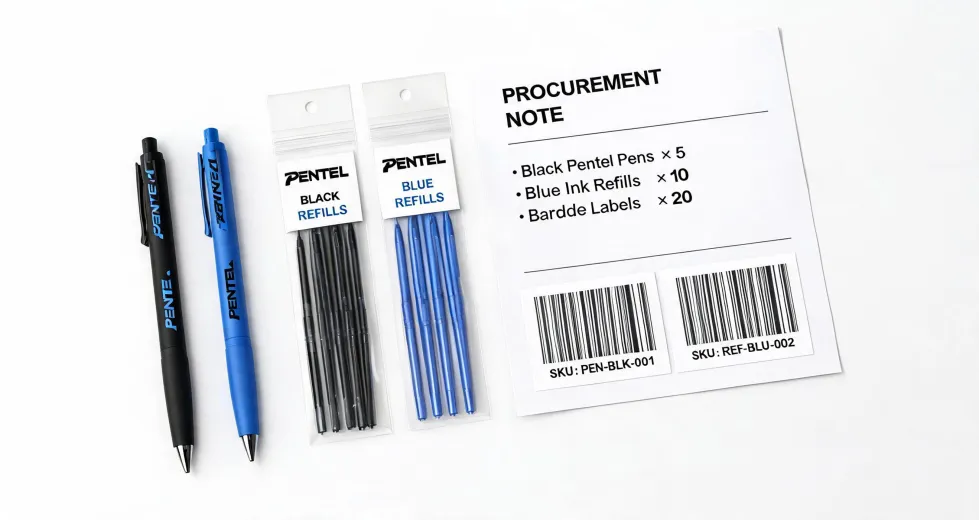
There's no single right answer when it comes to desk supplies. I've learned that the hard way. For the last seven years, I've handled stationery orders for a 14-person team, and I've made about $2,800 worth of avoidable mistakes. If you're searching for 'Pentel Calme ballpoint pens,' 'Pentel purple gel pens,' an 'aft calculator,' a 'pythagorean theorem calculator,' or 'where to put highlighter,' I've got a perspective for you.
One quick note: I'm talking about the fluorescent marker, not makeup. If you landed here because you wanted 'where to put highlighter' for your cheekbones, this article won't help your selfie. It will, however, help you annotate a contract without turning it into a yellow rectangle.
Let's start with the core idea: there's no universal answer. A pen that works in a library is wrong for a warehouse. A calculator that works for taxes may not be right for geometry. And highlighter placement depends on who's going to read the page. So here's the decision tree I use after years of making mistakes.
Pentel Pens: Match the Pen to the Method
Most buyers focus on price per unit and completely miss the actual writing experience. The question everyone asks is 'which pen is cheapest?' The question they should ask is 'will anyone actually use it after the first week?' I've purchased boxes of cheap pens that still sit unopened. That's wasted money, and it's a mistake I've made more than once.
If you're buying for open offices or shared desks: Pentel Calme ballpoint pens
The Pentel Calme line is designed for people who hate the sharp click of a regular pen. The click mechanism uses a cushioned system, so it makes a softer sound. Is it 'silent'? Not completely, in my experience. But it's noticeably less obnoxious. If your team is on calls all day, that's a real improvement.
I remember a trigger event in March 2023: a colleague unmuted herself, clicked her pen for twenty seconds, and the client on the other end asked if she was typing an angry message. That's when I started recommending Pentel Calme ballpoint pens for anyone near a phone.
If you're a color-coder or visual note-taker: Pentel purple gel pens
Purple is the odd color in most stationery drawers. That's exactly why it works for second-level headings, margin comments, or corrections. Pentel purple gel pens—I prefer the Energel line—are probably the most reliable purples I've tested. The ink dries quickly on standard paper, but I won't claim it never smudges. On glossy paper, everything smudges.
And if you need a specific purple for a branded document, don't trust a pen name. Use a Pantone reference. The Pantone Color Bridge guide will tell you there's no exact CMYK equivalent for most spot colors, and the same lesson applies to pens: 'purple' on the label doesn't guarantee a perfect match from batch to batch.
If you're ordering for a department: don't buy one model for everyone
In September 2022, I ordered 500 identical black pens. I checked the price, the quantity, and the delivery date. What I didn't check was whether anyone wanted them. Six months later, more than 300 were still in the supply closet. That's roughly $450 of wasted budget, and it taught me a lesson: ask first, buy second.
Now I do a quick two-question survey before bulk orders: 'Do you prefer 0.5mm or 0.7mm?' and 'Do you use ballpoint, gel, or something else?' Seeing those 300 unused pens next to the survey results made me realize the problem wasn't the product—it was the process.
Calculators: Use the Right Tool Before You Touch a Pen
A pen isn't an assembly line. But every office job involves numbers, and the wrong number can ruin a purchase order. The most frustrating part of calculator mistakes? They're preventable. You'd think a simple formula would be enough, but relying on mental math is how errors happen.
Scenario A: You need the after-tax number fast: use an aft calculator
When I'm budgeting for a new project, I don't estimate taxes in my head. An aft calculator—let me rephrase that—an after-tax calculator is the fastest way to separate gross cost from net cost. You enter the gross amount and the tax rate, and it returns the net figure in seconds. It doesn't replace accounting software, but it keeps me from making obvious errors.
One caveat: not all aft calculators use the same tax assumptions. I learned to check whether the rate is inclusive or exclusive. If you're not careful, the same dollar amount can come out two different ways.
Scenario B: You're figuring out layouts or dimensions: use a Pythagorean theorem calculator
If you're hanging a whiteboard, sizing a poster, or planning a wall installation, you'll need the diagonal: a2 + b2 = c2. A Pythagorean theorem calculator prevents the old 'round to 13 when the answer is 12.8' error. That half-inch might seem small, but it's not when the frame doesn't fit.
For printed signs, remember the industry-standard minimum: 300 DPI for commercial offset. Maximum print size = pixel dimensions ÷ DPI. So a 3000 × 2000 pixel image at 300 DPI gives you 10 × 6.67 inches. A Pythagorean theorem calculator helps you find the diagonal; this rule helps you avoid a pixelated disaster.
For financial projections: don't trust a random online calculator. This might sound obvious, but it's the source of many avoidable mistakes. Some websites have outdated tax tables. Some use rounding that works for a homework problem but not for an invoice. I'm not saying you need a $300 business calculator. I'm saying you should cross-check important numbers in a spreadsheet or with a second tool. Let me rephrase that: a calculator is a tool, not a source of truth.
Where to Put Highlighter: I Was Doing It Wrong
The most frustrating part of old-school note-taking: you highlight a page, close the notebook, and later remember nothing. You'd think the yellow lines would make key facts pop. But when everything is highlighted, nothing does.
I was that person who highlighted kinda everything. A chapter came back looking like a stained-glass window. It wasn't until a colleague showed me a better system that I realized the problem wasn't the highlighter—it was the placement.
If you're highlighting for a quick review: highlight the main idea, not the paragraph
Where to put highlighter? At the beginning of the key sentence. Usually the first sentence of a paragraph contains the point. Highlight only that. If the second sentence is a supporting example, skip it. Your future self won't want to reread fifty highlighted lines.
If you're highlighting for someone else: put highlighter in the margin
A block of yellow on a full paragraph is useless when you're sharing notes with a teammate. Instead, put a vertical line in the margin next to the relevant section, and write one or two words beside it. The text stays readable, and the important part is obvious.
If you're highlighting to memorize: use one color and target unique terms. Highlight the key term, not the whole definition. Then write the term in the margin. When you review, cover the definition and try to say it out loud. This is more effective than creating four colors and rewriting the page.
One physical note: standard 20 lb bond paper is about 75 gsm. Heavy highlighter strokes can bleed through it. If you're printing double-sided, use heavier paper around 90 gsm, or accept a little ghosting.
How to Figure Out Which Scenario You're In
Ask yourself three questions before you buy or annotate anything:
- Who will use this? A noisy office, a color-coded planner, or a shared supply closet?
- What kind of math is involved? Taxes, geometry, or a rough mental estimate?
- Who is the highlighter for? You, a teammate, or an exam?
If you're still not sure, default to the option that wastes the least money. That's the advice I wish I had before the 300 unused pens.
I've made a lot of mistakes. The one constant is that guessing instead of matching the tool to the scenario costs time and budget. Whether you're choosing Pentel Calme ballpoint pens, grabbing a Pentel purple gel pen, pulling up an aft calculator, checking a Pythagorean theorem calculator, or deciding where to put highlighter, start with your situation. Then choose.