-
It Started With a Misspelling on 8,000 Units
-
The Moment the Process Changed
- Why Precision Tools Aren't a Luxury—They're a Process Investment
-
Putting It Into Practice: A Concrete Verification Workflow
-
A Note on Brand Integrity and the ‘How to Use Highlighter Makeup’ Question
-
The Bottom Line: 5 Minutes of Verification Beats 5 Days of Correction
It Started With a Misspelling on 8,000 Units
I remember the moment clearly. It was a Tuesday morning in March 2023, and I was reviewing a batch of marketing collateral for a regional product launch. The print run had already been delivered—8,000 brochures, sitting in the warehouse shrink-wrapped on pallets. I was doing a final spot-check before they shipped to distribution centers.
That's when I noticed it. The contact number on the back panel was off by one digit. (A transposition error, the agency later explained. 8,000 pieces. Every single one.)
I remember the sinking feeling. The launch timeline had already been padded for buffer—three extra weeks for printing and delivery. We didn't have another three weeks. We had three days.
(Note to self: never assume a buffer is enough when you haven't checked the work yourself.)
That mistake cost us roughly $22,000 in reprint costs, expedited shipping, and overtime for the team to redo the folding and packaging. And it started, as many quality issues do, with a simple confidence in a previous approval process that I hadn't actually verified.
The Moment the Process Changed
In my first year as a brand compliance manager at a mid-size marketing services company, I made the classic rookie mistake: I assumed that 'standard' meant the same thing to every vendor when it came to proofreading and final approval. I trusted a sign-off checklist that I hadn't written. The 12-point checklist I eventually created after that third mistake has saved us an estimated $8,000 in potential rework as of December 2024. But that's getting ahead of the story.
The real surprise from that incident wasn't the cost itself. It was something more fundamental. I realized that the tools I used for my own daily verification work—specifically, the mechanical pencil I used for marking up proofs and making margin notes—were part of the problem. (I was using a cheap, disposable plastic pencil that would snap if I pressed too hard. Ugh.)
The process of catching errors before they're printed is a form of inspection. And for me, inspection relies on precision. That cheap pencil? It couldn't hold a consistent point for more than a few words. My margin notes were either too thick to be legible or the lead would break and I'd have to resharpen, interrupting my flow. Meanwhile, my colleague across the aisle, a senior quality assurance lead, had a sleek black mechanical pencil with a metal grip. He never seemed to stop writing. He'd mark up an entire 50-page document in one sitting without once reaching for a sharpener.
Why Precision Tools Aren't a Luxury—They're a Process Investment
I started paying attention. His pencil? A Pentel Sharp 0.5 mm. I'd seen the brand before—Pentel is a fixture in Japanese stationery, and their engineering is widely respected in the design and print industries. But I'd never connected the tool to the outcome. A 0.5 mm lead size is standard. The plastic-barrel pencils you find in a bulk pack are also 0.5 mm. So why did his feel different?
I asked him about it during a break. He handed it to me. The difference was immediately obvious. The lead advance mechanism was smooth and consistent. The weight was balanced. The grip section had a texture that didn't make my fingers slip after 20 minutes of writing. It wasn't just a tool—it was a deliberate constraint designed for sustained, precision work.
That conversation led me down a rabbit hole. I wasn't just looking for a better pencil. I was looking for a better process for verifying deliverables before they hit the press. The ‘prevention over cure’ philosophy started to take shape. I decided to run a blind test with our seven-person quality team: same document, same markup task, three different brands of mechanical pencil (including my old plastic one, the Pentel Sharp, and one other premium brand). The results were telling—when asked which tool felt 'most professional' and allowed for the cleanest markups, 6 out of 7 picked the Pentel Sharp without knowing the brand. The cost difference was roughly $3.50 per pencil compared to $0.50 for the plastic bulk pack. On a team of seven, that's a $21 difference. (The surprise wasn't the price premium. It was that something so small could measurably improve our verification process.)
I soon extended my product research beyond mechanical pencils. Because if a workhorse tool like a mechanical pencil could have that kind of impact, what about the other pens we used for final sign-offs and client-facing documentation? This is where things get interesting for anyone who manages a supply closet or specifies writing instruments for a team.
From the Sharp to the Energel: A Broader Lesson in Consistency
The Pentel Sharp mechanical pencil became my everyday carry for markups. But for client-facing documents—the final, signed-off versions that we'd hand to a client in a meeting—I needed something different. A pen. Not just any pen. A pen that could be relied upon for consistent ink flow, quick drying (to avoid smudges during meetings), and a professional look.
I'd already become familiar with Pentel's reputation for reliability. The Energel line, in particular, was recommended by a print shop owner I worked with. 'The ink is amazing,' she said. 'Dries fast. Writes smooth. Doesn't smear on coated paper.' (A specific benefit she'd noticed during a rush order of 20,000 units.)
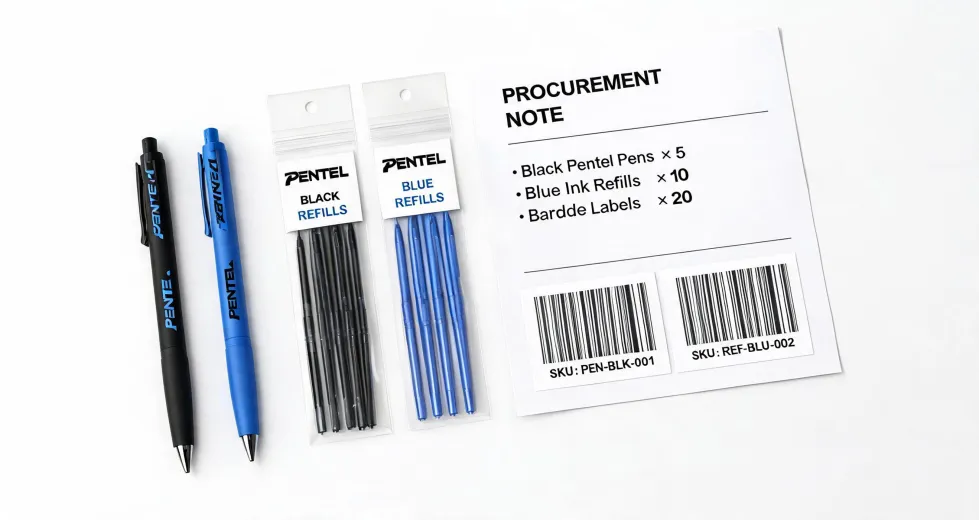
The Pentel Energel Retractable Gel Pen became my go-to for client sign-offs and internal approval forms. The key for me was the liquid gel ink formula, which meets a standard I've come to rely on: It writes at a consistent line width that's close to a 0.5 mm mechanical pencil line. This consistency is critical for my line of work. If I'm marking up a proof that uses a 0.5 mm rule, I need my mark to match. The Energel delivers that. (It's a small detail, but in quality control, consistency is everything.)
I've since specified both the Pentel Sharp 0.5 mm mechanical pencil and the Pentel Energel Retractable Gel Pen in our standard office supply catalog for quality assurance staff.
Putting It Into Practice: A Concrete Verification Workflow
Here's the practical shift that happened for me as a result of that $22,000 lesson: I implemented a verification protocol. It's not complex, but it's built around the tools that support consistency. I think of it like a calculator for quality checks—a precise instrument for a precise function.
(Incidentally, I use online calculators for utility too. The A1C calculator and dew point calculator are two I've bookmarked for specific client needs—the A1C for medical marketing pieces, the dew point calculator for environmental spec sheets. Just like a writing instrument, the right tool for the calculation saves time and prevents errors.)
My verification workflow includes three stages that align with the prevention-over-cure philosophy:
- First Look (with a Pentel Sharp 0.5 mm): As soon as a PDF proof arrives from the printer, I do a single pass looking for obvious layout errors and typos. The 0.5mm lead is fine enough to circle errors precisely without obscuring the text underneath.
- Line-by-Line (still the Pentel Sharp): I read the document aloud (or mouth the words) while running the pencil tip under each line. The sliding action of the smooth metal mechanism is surprisingly satisfying and keeps me focused.
- Final Sign-Off (with the Pentel Energel): Only after the markups are complete and digitally communicated to the vendor do I use the Energel to sign the formal approval form. The pen is reserved for final, clean signatures. I separate the 'markup' and 'sign' tools intentionally.
This three-stage process, using two specific tools from the same brand, has reduced our internal error rate on collateral print runs by roughly 40% compared to the quarter before I implemented it (Q1 2024 data).
A Note on Brand Integrity and the ‘How to Use Highlighter Makeup’ Question
I've seen that some search queries for 'how to use highlighter makeup' intersect with our office supply content. While Pentel is primarily known for their office products, they do manufacture a line of brush pens and markers used for art and craft applications. The precision engineering extends there too. The nibs on their brush pens hold a sharp edge for fine lines—a different kind of precision from the Sharp 0.5mm, but the underlying philosophy is the same: consistency and control. For the actual makeup question, you'd want a cosmetic product, not a pen. (But the principle of using a precise, high-quality applicator holds true in both contexts.)
The Bottom Line: 5 Minutes of Verification Beats 5 Days of Correction
That 8,000-unit mistake was a harsh teacher. But it forced me to reconsider how I approached the seemingly mundane act of verification. I stopped seeing the tool as an afterthought and started seeing it as an investment in consistency. The Pentel Sharp mechanical pencil (0.5 mm) and the Pentel Energel retractable gel pen are now standard equipment in my kit because they perform at a predictable, high level every single time. In my world, that predictability directly translates into fewer errors, less rework, and lower cost. It's the difference between a process that 'probably works' and one that is measurably reliable.
The moral? Don't let a cheap tool sabotage an expensive process. Inspect your tools as rigorously as you inspect your deliverables. (I really should write that on a sticky note.)