I'm the office administrator for a 300-person architecture firm. I manage all office supply ordering—roughly $45,000 annually across 8 vendors—and I report to both operations and finance. For my first two years in the role, I bought the cheapest writing instruments I could find. Boxes of budget ballpoints for $7. Bulk permanent markers at a few cents apiece. My spreadsheets looked great.
Then the complaints started. The warehouse crew's hands ached after labeling inventory all day. The shipping coordinator kept redoing smudged address labels. The admins said half the pens in a new box wouldn't start on the first try.
I shrugged it off. People complain. Right?
Turns out, the complaints were the cheapest part of the problem.
What I Missed: A Pen Is a Tool, Not a Commodity
"Permanent marker strain" is what the warehouse guys called it. It's not a formal medical term. But the mechanics are real.
Cheap ballpoints use oil-based ink with high viscosity—it doesn't flow unless you apply pressure. Every letter becomes a mini arm workout. Multiply that by hundreds of labels in a shift, and the flexor tendons in your hand pay the price. Cheap permanent markers are worse: the tips are inconsistent, the ink is slow-evaporating, and you end up pressing down and tracing over lines twice.
Most buyers focus on per-unit pricing and completely miss the physical cost. The question everyone asks is "what's your best price?" The question they should ask is "what does this tool demand from the person using it?"
The Smudge Problem We Never Solved
We also had a chronic smudging issue. Labels written with cheap markers looked fine right after writing. Touch them fifteen minutes later? Smear city. The ink formula takes too long to cure, especially on coated cardboard.
I said "fast-dry." The supplier heard "dries eventually." Discovered this when an entire pallet of shipments got flagged for unreadable barcodes and addresses. We were using the same words but meaning different things.
The third time we ordered the wrong type of marker, I finally created a specification checklist. Should have done that after the first incident.
The Math That Changed My Mind
It took me 3 years and about 150 orders to understand that the "cheapest option" is rarely the least expensive one. When I finally ran the numbers, the result made me uncomfortable.
- Lost labor: Warehouse team writing labels at roughly 15% slower pace due to hand fatigue. That's about 30 hours per month in lost productivity. At $18/hour blended, that's $540 monthly.
- Rework: 8–12% of labels needed to be redone due to smudging or illegible handwriting. Add in the labeling materials and time, and that's another $200 monthly.
- Replacement pens: We were burning through boxes of cheap pens every month. The "savings" vs. mid-tier brands? About $15 a month.
The cheap route wasn't saving us $7 per box. It was costing us roughly $740 a month in hidden labor losses, offset by $15 in budget savings.
Here's something vendors won't tell you: unit price is almost never the real cost. For any product used all day by every employee, total cost of ownership means labor efficiency, comfort, and reliability—not the sticker price. (A similar pattern shows up in another office commodity, business card printing: budget tiers run $20–35 per 500 cards, while mid-range options $35–60 offer better stock and finish—based on publicly listed prices, January 2025.)
What Actually Fixed It: A Structured Trial
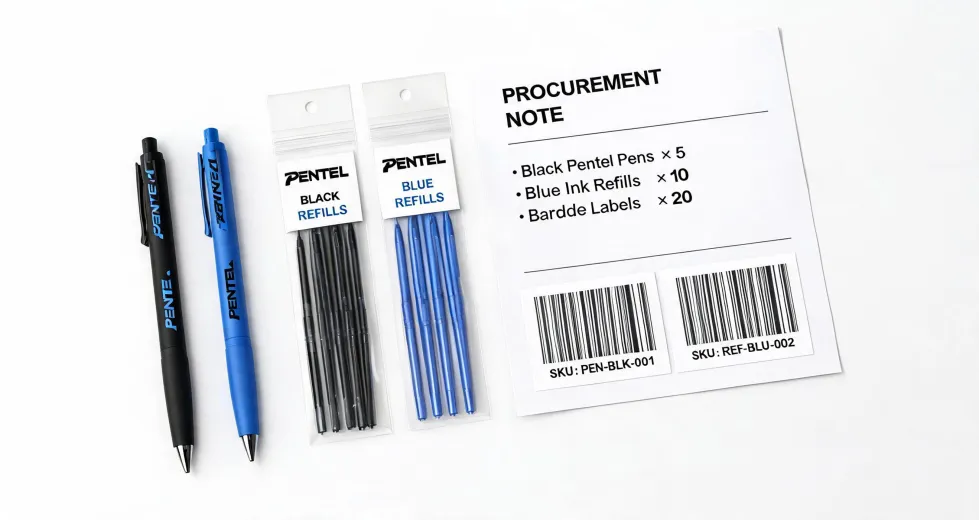
I didn't impulsively switch everything. In 2024, during our vendor consolidation project (we went from 8 vendors to 4), I ran a pilot. I ordered three categories of Pentel products to test against our budget baseline:
- Pentel Energel RTX retractable liquid gel pens for desk staff and front-desk use.
- Pentel permanent markers with textured barrels for the warehouse labeling crew.
- Pentel GraphGear mechanical pencils for the drafting teams who needed precision.
Immediate Differences
The Energel RTX's liquid gel ink flows with noticeably less pressure than the budget ballpoints. I don't have a scientific measurement—don't hold me to exact figures—but the difference was visible within a day. The rubberized grip helps, the retractable mechanism means no lost caps, and the ink dries quickly enough that smudging stopped being a daily complaint.
The permanent markers? Same story. Less hand pressure required, faster ink set, fewer relabeled boxes. The phrase "permanent marker strain" disappeared from our internal vocabulary within a month.
Was it perfect? No. But the frequency of complaints dropped by probably 80–85%. I'm not 100% sure of the exact number, but it was enough that my internal customers stopped mentioning it.
The Digital Whiteboard and the Omni Calculator
Around the same time, someone asked, "what is a digital whiteboard good for?" during an off-site meeting. We installed one in the main conference room to cut down on flip-chart waste. It worked beautifully for brainstorming and design reviews. But it didn't help with warehouse labeling—different job, different tool.
For the accounting team, I also ordered an Omni calculator because they insist on physical devices for audits. (Not that I'd touch one in 2025, but it's not my call.) Different tool entirely, same principle: you pay for reliability.
Why Paying a Premium Made Sense
Here's the thing I now tell anyone who asks: in urgent situations—and every office supply run-out becomes urgent—you're not paying for comfort. You're paying for certainty. Certainty that the marker works the first time. Certainty that a box of pens lasts more than a week. Certainty that you won't be redoing 50 labels on a Friday afternoon.
When I presented the switch to finance, I didn't say "these pens feel nicer." I said: "We're spending roughly $400 more per year on writing instruments, and we're getting back about $4,000 in labor efficiency and reduced rework."
Finance approved it without pushback. The math was that simple.
Pens aren't the place to save money. Neither are markers, or any tool your team touches every single day. Cheap tools make your people work harder for worse results. That's not a paradox—it's physics.
Is the premium option worth it? Sometimes. Depends on context. For writing instruments used daily by 300 people? Yes. The numbers don't lie.
It took me too long to see that. But I keep the spreadsheet now. Some lessons are better documented.