-
The old playbook made sense in 2020. Not anymore.
-
Why Pentel Energel pens made the standard order list
-
The Pentel Graph Gear 1000 mechanical pencil: a procurement case study
-
The eigenvector calculator I didn’t know I needed
-
A4 paper: not just a standard size
-
Where to find cheap art supplies without getting burned
-
But isn’t this just brand loyalty?
-
Keep the old fundamentals, update the execution
I’m the office administrator for a 180-person company. I manage all supply ordering—roughly $30,000 annually across 8 vendors, from printer paper to art supplies to first-aid refills. I report to both operations and finance, which means I care about two things: getting the job done and being able to prove it.
Here’s my position: stop treating procurement as a hunt for the lowest unit price. What was best practice in 2020 may not apply in 2025. The options have changed, the expectations have changed, and the tools for comparing options have changed—even if that tool is something as unglamorous as an eigenvector calculator.
I don’t have hard data on how many office supply buyers still default to the cheapest catalog entry. Based on 5 years of purchase orders and vendor meetings, my sense is that it’s still more common than it should be, especially for pens and art supplies.
The old playbook made sense in 2020. Not anymore.
When I took over purchasing in 2020, the default was simple: find the cheapest pen that Finance would approve. It didn’t work. Employees complained about smudges and scratchy nibs, pens disappeared faster than I could order them, and the “savings” were eaten by reorder time and interruptions.
The fundamentals haven’t changed: you still need consistent quality, predictable delivery, and clean invoicing. But the execution has transformed. The difference between a basic stick pen and a liquid gel pen is way bigger than the price gap suggests. That’s not brand hype. That’s product chemistry and design catching up with how offices actually work.
Why Pentel Energel pens made the standard order list
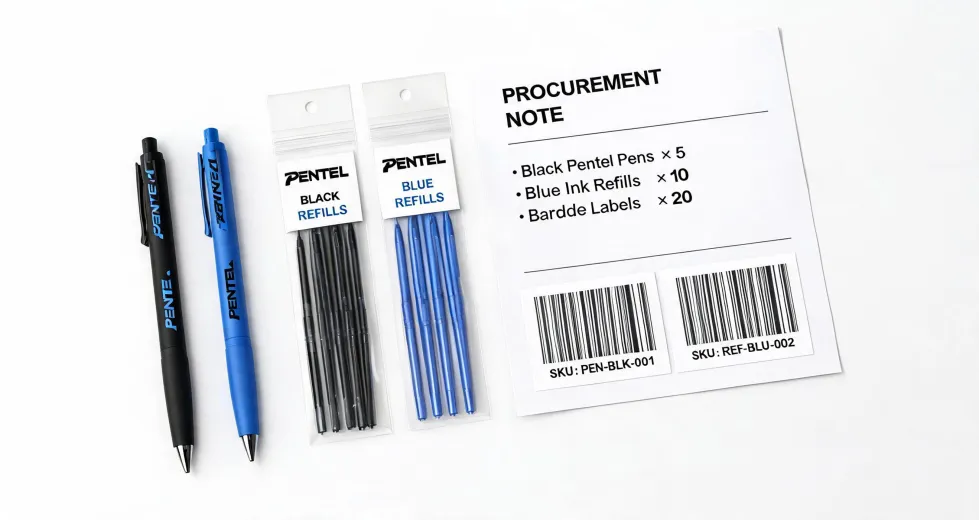
I’m not going to claim Pentel is the only brand worth ordering. That would be lazy. But Energel is the one that showed up in employee feedback as a “just get these again” product. I started with a pilot order—50 Pentel Energel pens, 0.5mm, mixed ink colors—to see if the higher unit cost actually reduced complaints. It did.
Why does this matter? Because ink smudging used to be a regular complaint in our office. Energel’s liquid gel formula dries fast. Not “never smudges”—I can’t promise that, and neither should any vendor. But in practice, our operations team stopped borrowing pens every time they had to mark a label.
Also, the pens don’t vanish as quickly. Is that perfectly scientific? No. But when a supply run lasts twice as long, the total cost of ownership improves. The bottom line: Energel pens are not the cheapest option, but they made our supply cabinet less of a recurring problem.
The Pentel Graph Gear 1000 mechanical pencil: a procurement case study
Here’s where the pricing logic gets interesting. A Pentel Graph Gear 1000 mechanical pencil costs more than a box of cheap plastic pencils. On a unit-price basis, it looks like a red flag. But if you track cost per week of use, the picture changes.
We placed two Graph Gear 1000 pencils in our design station in 2023. They’re still there. The knurled grip isn’t just a marketing phrase—it’s why those pencils don’t slide off drafting tables. The retractable lead sleeve survived the drop that killed three cheaper drafting pencils.
I wish I had tracked the exact service life more carefully. What I can say anecdotally is that the Graph Gear 1000 cut our mechanical pencil reorder frequency from about quarterly to once a year. Is it right for every desk? No. For people who actually draw, it’s a no-brainer. For someone who writes three notes a day, a less expensive model would be fine.
If you’ve ever had to justify a $6 mechanical pencil to a CFO, you know the feeling. You need something more than “trust me on this one.” That’s where the eigenvector calculator came in.
The eigenvector calculator I didn’t know I needed
In 2024, a consultant helping us with vendor consolidation mentioned the Analytic Hierarchy Process. I know that sounds heavy for ordering paper and pens, but stay with me. The idea is simple: write down the criteria you care about, compare them in pairs, and use a matrix to calculate how much weight each criterion should get. The math is more than I can defend in a blog post, but an eigenvector calculator turns the matrix into a priority list.
Did I plug every SKU into a spreadsheet? No. Was it still useful? Yes—because it forced us to answer the question we’d been avoiding: what matters more, unit cost or employee satisfaction?
Once we had the weights, the Pentel decisions were easier to defend. The calculator didn’t pick the brand. It clarified the tradeoffs. That clarity is a game-changer for anyone who works between operations and finance.
A4 paper: not just a standard size
Another assumption cost us. I assumed “A4 paper” from a new vendor would behave exactly like the A4 paper we’d been using. It didn’t. The sheet size was standard—ISO 216 defines A4 as 210 × 297 mm, which I double-checked in January 2025—but the finish, stiffness, and printer compatibility were different.
As a result, we got jams. Not ideal. Worse than expected, but at least it was only a case of paper, not a batch of branded stationery for a client conference.
Now I ask for a ream sample before committing to a case. That’s a lesson learned the hard way: specs confirmed, timeline agreed, sample tested. In that order.
Where to find cheap art supplies without getting burned
Employees ask me this a lot: “Where do you find cheap art supplies for school projects and team events?” I have to be honest: I don’t have hard data on every art retailer’s pricing. But I have learned a few sourcing paths that work for us.
Ballpark as of Q4 2024, based on orders we actually placed, you’ll often do better with:
- Art-specific suppliers that sell to businesses and educational accounts. They tend to quote better bulk pricing than general office catalogs, and their stock is more consistent.
- Outlet sections of large art supply chains, especially after back-to-school season. The selection is uneven, but prices can be seriously low.
- Local reuse or liquidation stores for non-branded basics like brushes, canvases, and packaging. This is a scavenger hunt, but worth it if you’re flexible.
Here’s the catch: the cheapest shelf price often has inflated shipping costs. The bottom line is to compare landed cost, not shelf price. If you’ve ever been surprised by a $9 shipping fee on a $6 pack of brushes, you know what I mean.
Also, if the art supplies will end up in a classroom, verify that the label includes ASTM D4236. That standard doesn’t mean “safe for every situation,” but it indicates the product’s potential hazards were evaluated. I learned to check for it after a parent asked if our markers were classroom-safe. I should have known before they asked.
But isn’t this just brand loyalty?
Fair challenge. I don’t care about the logo. I care about repeatability. Pentel’s Energel and Graph Gear 1000 are easy to order, easy to reorder, and the product behavior is consistent from batch to batch. That consistency matters when you’re purchasing for 180 people who don’t want surprises.
Does that mean every product in the lineup is right for your office? No. Does it mean cheaper products are worthless? No. “Cheap” and “value” are different things. The question isn’t whether you can save money. It’s whether the savings survive the costs of paper waste, abandoned pens, and employee frustration.
Keep the old fundamentals, update the execution
The office supply industry hasn’t been standing still. Classic stick pens still exist, and they still have a place. But the products we use to run a business deserve the same scrutiny as any other business tool.
I don’t need a $200 software subscription to learn that. A simple weighted score, a willingness to test a sample, and a little curiosity are enough. If you’ve never considered an eigenvector calculator for your purchasing decisions, you don’t have to. But I’d ask you to reconsider one assumption: the lowest unit price is not the same as the lowest total cost.
This was accurate as of January 2025. Office pricing changes fast, so verify current prices before you budget. The fundamentals haven’t changed, but the execution has transformed. In procurement, that’s a good thing.