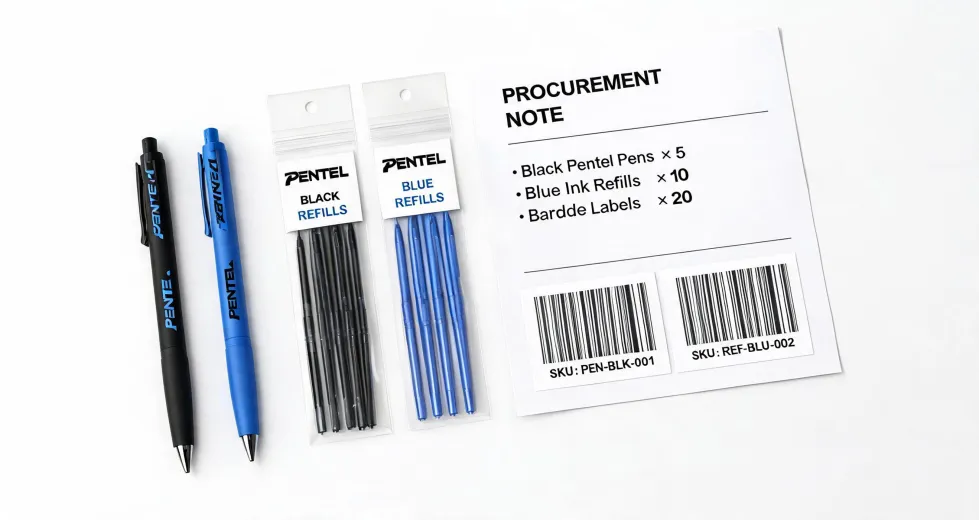
Every time I tell someone what I do for a living—office purchasing for a 240-person company, about $85,000 a year across 12 vendors—they usually ask one of two questions. Do you have a favorite brand? And what's the strangest thing you've been asked to buy? The answer to the first is Pentel, for a lot of reasons. The answer to the second is a longer story. This article is my practical FAQ: the questions I actually answer, the mistakes I've made, and the search terms I never expected to see.
What is Pentel known for?
Pentel is a Japanese writing instrument company with a seriously broad lineup. According to Pentel's product pages (pentel.com), the company makes mechanical pencils, ballpoint pens, gel pens, rollerballs, markers, brush pens, erasers, and art materials. When I consolidated our office supply vendors in 2024, that breadth helped. Instead of ordering writing tools from three separate suppliers, I could put together a standard list with one brand: Energel pens for everyday use, GraphGear pencils for people who draft by hand, and Twist-Erase pencils for note takers. Why does that matter? Because every additional vendor adds time—time to compare prices, time to check invoices, time to chase missing shipments. Fewer vendors, fewer headaches. That doesn't mean one brand is perfect for everything, but it means you can build a baseline that works.
What makes the Pentel Smash mechanical pencil different?
The Pentel Smash mechanical pencil is a drafting-style model—metal grip, four-millimeter lead sleeve, and a lead-cushioning mechanism designed to stop breakage. It's been popular in Japan for years, and once you hold one, it's easy to see why. I tested a small batch for our drafting team in 2024. Before that, we used cheaper pencils that jammed often enough that people kept spare mechanical pencils in their desks. During the test, I asked the team to use the Smash for two weeks and report back. The main feedback was about the grip: it has enough weight to feel stable, but not so much that your hand gets tired. Jams? Almost none. I don't have hard data on industry-wide defect rates, but based on our own use, the Smash is the model I'd reorder if the budget allows. It's not the cheapest option—and that's exactly why I like it. The price difference per unit is small compared to the cost of a frustrated employee throwing another jammed pencil in the trash. Value over price.
How do Pentel Twist-Erase refill erasers work?
Pentel Twist-Erase refill erasers are replacement erasers for the Twist-Erase mechanical pencil line. Instead of buying a new pencil when the eraser is gone, you twist the old eraser up, remove the refill, and insert a fresh one. It reduces plastic waste and costs less in the long run—if you get the right size. This is where I made my own purchasing mistake. I knew I should check the model number before ordering, but I thought, 'What are the odds?' The odds caught up. I ordered a bulk pack that didn't fit the pencils we already had. So glad I tested one before opening the other boxes; I almost ordered twice as many. Not ideal, but workable—we donated the extras to a local school. The lesson: match the refill to the exact pencil series. Some are for standard Twist-Erase, some for the GT series, and some for the mini versions. The product code is your friend.
What is polymer clay?
What is polymer clay? It's a moldable synthetic material made from PVC resin and plasticizers. It stays soft until you bake it in a regular oven, then hardens into a finished charm, miniature, or jewelry piece. It does not air-dry like traditional clay, and it shouldn't be fired at very high temperatures. People use it for crafts, school projects, custom beads, and even prototypes. It's not a Pentel product. Pentel does make art supplies like oil pastels and watercolors, but polymer clay is a different category. I mention it because it's one of those requests that shows up in an office supply inbox. If a teacher or employee asks for it, treat it like any nonstandard item: check the supplier, check the quantity, and confirm it's the material they actually want. There are different brands of polymer clay, and they vary in firmness and finish. Asking two clarifying questions now is cheaper than ordering a case of the wrong thing.
What should I check before buying Pentel supplies in bulk?
Unit price is the least useful number in purchasing. Total cost of ownership (i.e., the price plus shipping, return fees, invoicing problems, and time) is what matters. In 2023, I ordered from a new supplier because the unit price was $200 cheaper. They couldn't provide a proper invoice (ugh, the invoice problem). Finance rejected the expense report, and I ended up eating the cost from our department budget. That $200 savings turned into a $2,400 problem. Now I verify invoicing capability before placing any order. For Pentel, the same logic applies. A cheaper knockoff refill isn't cheaper if it jams or doesn't fit. Check the lead size, the eraser size, and the compatibility before you buy in bulk. If you're ordering for a team, also check the usage pattern: if people mainly use 0.5mm lead, don't buy a bundle of 0.7mm 'because it was on sale.' That's how you end up with a box of supplies nobody can use.
Why do 'chest binder' and 'abv calculator' show up in office supply searches?
Let's answer the two weirdest terms in this article first. A chest binder is a compression garment, not an office binder. If that's what you were looking for, this is not the product guide you need. An ABV calculator calculates alcohol by volume—usually for brewing or event planning. Also not my department. But both terms are useful reminders: search intent is messy. People type the first thing that comes to mind. As an office buyer, that taught me to ask clarifying questions before ordering. When someone asks for binders, do they mean paper binders, binder clips, or something else? If I ignored context and bought the wrong item, I'd have wasted the budget. The same applies to internal requests. A person who writes 'we need more polymer clay' might actually mean air-dry clay, modeling dough, or something else entirely. So here's my rule: search, discover, clarify, then buy. It works for Pentel products, polymer clay, and everything else that lands in my inbox.