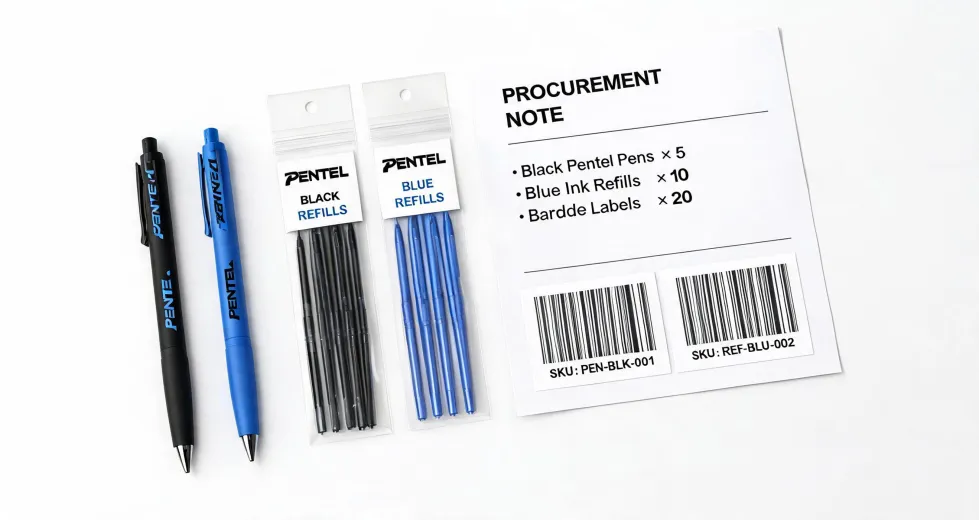
If you're trying to narrow down a Pentel liquid gel pen or a Pentel Energel 0.5mm, you'll find plenty of pages that just say “Energels are great” and leave it at that. That isn't useful. The useful answer depends on your situation.
I've spent seven years handling stationery orders for a small logistics team. In my first year (2017), I made the classic newbie mistake: I standardized on one pen without asking the people who'd use it. We ordered 1,500 pens with a slim barrel grip. About half the office found it uncomfortable. Not because the pens were defective—they were just the wrong answer to a question I hadn't asked yet.
The right pen is not the one with the best price. It's the one that solves the actual problem at a total cost you understand.
Since then, I've documented 11 significant mistakes, totaling roughly $4,000 in wasted budget. That doesn't include the embarrassment of promising a delivery and arriving with miscolored branded pens. The checklist below has caught 47 potential errors in the last 18 months. I'm sharing it because most of those errors were avoidable.
Start With Your Scenario
There is no single product called “the best Pentel.” There are three common scenarios: office stock, branded custom pens, and personal/small-batch buying. Each one needs a different decision process. Mixing them up is how you end up with a drawer full of pens nobody touches.
Scenario A: Office Stock
For office orders, the most common mistake is comparing unit prices and missing everything else. I did this in Q1 2024. A quote looked 15% cheaper than the competition. What I missed: restocking fee, minimum order for refills, and shipping charges that disappeared from the first page. The total was only 2% cheaper, and I still had to pay $85 to return the two boxes that weren't right. (Surprise, surprise.)
My new rule for office stock is to ask three questions before any bulk order:
- What is the delivered price per working pen?
- What's NOT included in the quote?
- Can I get a mixed sample pack for a week of desk testing?
Then I compare “cost per pen that actually gets used.” A Pentel Energel with liquid gel ink can cost more per unit than a generic pen. But if people reach for it, the extra $0.20 per pen is nothing compared to what the office loses when a cheap pen sits in a drawer. On the other hand, if your employees prefer a classic ballpoint grip, no gel pen will fix that. The writing experience is personal.
When you get a quote, ask for a Starbucks calorie calculator style breakdown. The base price is like the drink without add-ons. Once you add tax, shipping, and possible handling fees, the number changes. A $0.89 pen can be $1.10 by the time it reaches the supply closet. That's fine if it's clear. What's not fine is discovering it after approval.
For office stock, I'd start with Pentel Energel in 0.5mm or 0.7mm. Test both. The 0.5mm is cleaner on standard copy paper; 0.7mm is smoother for heavier writers. In my opinion, the exact tip size matters less than whether your team actually uses the pen.
Scenario B: Branded and Custom Printed Pens
This is a different game. The pen is not just a writing tool; it's a carrier for your logo. The moment a logo gets involved, the decision tree changes.
The first mistake people make is picking a pen before looking at the imprint area. I've learned this the hard way. If a supplier asks for a “Pentel Energel 0.5mm pen image” to show logo placement, make sure the image matches the exact model. The 0.5mm and 0.7mm versions look similar in photos, but the barrel shapes can differ slightly. A logo that fits one might be too wide for the other.
If you're printing in-house with a UV printer, test on the actual barrel material before the final run. In September 2022, I thought we'd save $90 by skipping the supervised test print. The production sample came back washed out because the UV ink cured differently on the matte pen barrel. Result: 500 pens with a faded logo, $900 in wasted ink and labor, and a one-week delay. A lesson learned the hard way.
For any branded pen, the logo file needs to be print-ready. The standard minimum is 300 DPI at final size for commercial printing. A 72 DPI image from a website might look okay on screen; it won't look okay on a pen barrel. Also check your brand colors. If your logo uses Pantone 286 C, ask the printer to match it. The usual color tolerance for brand-critical work is Delta E < 2. If the printer says “close enough,” that's not a spec.
People think expensive vendors deliver better quality. Actually, I'd flip that: vendors who deliver quality can charge more. What I care about is whether the vendor gives me the complete number upfront. A quote that lists setup, print proof, packaging, and shipping from the start is easier to trust than a lower quote that adds those items later. The low quote is not low; it's just unfinished.
And if someone offers to cut corners on the print test—or on Pantone matching—walk away. The extra 10 minutes of testing is cheaper than a rejected batch.
Scenario C: Personal or Small-Batch Buying
For personal use, the analysis is simpler. Write with the pen on the paper you normally use. That's it. It doesn't matter if a reviewer calls it “buttery” if the ink ghosts on your notebook pages because you press hard.
I'm not 100% sure why we skip this step, but I've seen it happen constantly: a person buys a 10-pack of a popular Pentel liquid gel pen because the online reviews are positive, and then leaves nine in a drawer. The pen was good. It just wasn't good for that person's hand and paper.
Try a 0.5mm needle tip and a 0.7mm conical tip side by side. Write on your usual paper. Check how fast the ink dries if you're left-handed. If you're using very thin paper, liquid gel ink may show through more than a hybrid ballpoint. That's not a flaw; it's a tradeoff.
How to Figure Out Your Scenario
Use the receipt test:
- Are you expensing this order for a team? Scenario A.
- Does your company logo need to appear on the pen? Scenario B.
- Is this for your own bag? Scenario C.
If you're torn between A and B, ask one question: will the pen be a branded giveaway or a daily-use item? A giveaway with your logo is Scenario B. A communal supply cabinet is Scenario A. If it's both, buy two separate products.
There's a broader habit that saves me more money than any coupon code: don't look for workarounds before asking what the real problem is. I once spent 20 minutes searching for “how to bypass hp printer cartridge error” because I didn't want to replace a cartridge. The cartridge was actually empty. Replacing it solved the job in five minutes. A pen order works the same way: if the real problem is a hidden cost, don't bypass it. Ask for the full cost.
The Bottom Line
The right Pentel pen is not the one with the best review score. It's the one that fits your specific situation at a total cost you understand before ordering. In my experience, the vendor who lists every fee upfront is the one I go back to—even if the quote is slightly higher. The 15% cheaper quote usually isn't that much cheaper after the hidden add-ons. And the pen that actually gets used is the cheapest pen you can buy.
Not a flashy conclusion. But after seven years and a few expensive mistakes, it's the one I trust.