-
What Pentel should I order for everyday office use?
-
Is the Pentel Wow mechanical pencil worth the hype?
-
When should I buy the Pentel Milky Brush?
-
Can journal prompts help me test gel pens?
-
What does a chronological age calculator have to do with school supply orders?
-
How to clean a whiteboard before your next video call
-
When should I not buy Pentel?
I'm the office administrator for a 200-person company. I manage office supply ordering—roughly $60,000 a year across 8 vendors, from copy paper to coffee machine filters. I report to operations and finance, which means I care about three things: does it work, will people actually use it, and will accounting approve the invoice.
This is the FAQ I wish I had when I took over purchasing in 2020. It covers the Pentel products I keep ordering, plus a few random office questions that show up in my search history: journal prompts, a chronological age calculator, and how to clean a whiteboard. You know, the usual Tuesday.
- What Pentel product should be the first order?
- Is the Pentel Wow mechanical pencil worth the hype?
- When should I buy the Pentel Milky Brush?
- Can journal prompts help me test gel pens?
- What does a chronological age calculator have to do with school supply orders?
- How to clean a whiteboard before your next video call
- When should I not buy Pentel?
What Pentel should I order for everyday office use?
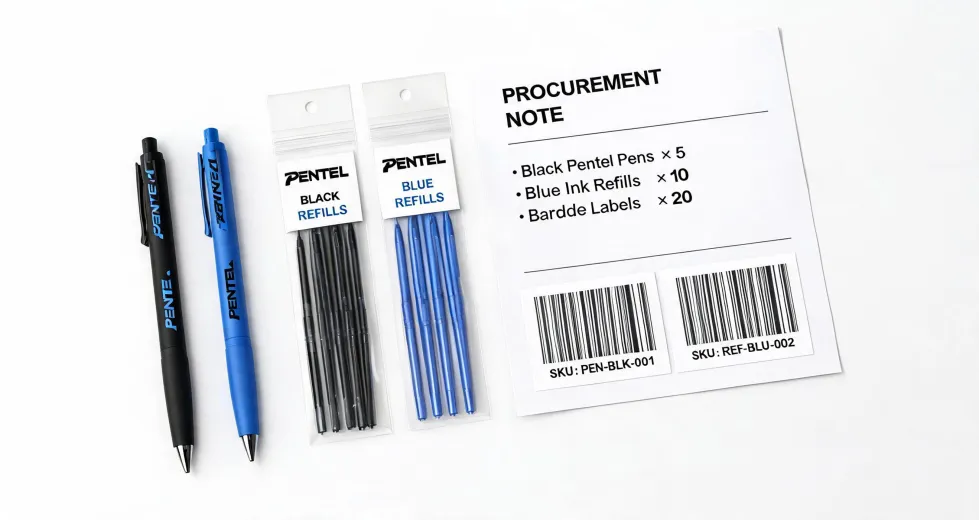
Pentel Energel is my default. The Energel RTX in 0.7 has a liquid gel ink that dries fast—fast enough that left-handed users stop smearing it. I also use the 0.5 for people who write small. The 0.7 is better for general note-taking. In my first year, I made the classic mistake: I bought a no-name bulk pack of gel pens to save money. The quote was cheaper, and the invoicing was fine—or rather, the invoicing seemed fine on paper. But the pens skipped halfway through a page. We put 200 of those pens in onboarding kits. People weren't mad, but they noticed. I still kick myself for not ordering a sample first. Now I order Pentel Energel in black and blue, and I keep extra refills in the supply closet. The ink is vivid enough for signatures. If you need waterproof ink, this is not the line for you—look at pigment-based markers instead. For 80% of office work, Energel is the safe call.
Is the Pentel Wow mechanical pencil worth the hype?
I've bought Pentel Wow mechanical pencils for our warehouse staff and for a local school program. After the first order, the teacher came back and asked for another dozen, which is the highest compliment a supply order can get. The Wow is the pencil with a soft grip and a lead sleeve that protects the tip, which does exactly what it promises: less lead breakage. If you write with a lot of pressure, you'll get along with it. If you're doing drafting work, though, I'd hand you a GraphGear instead—the Wow is more of an everyday jotting tool. One thing I learned from our 2024 supply consolidation project: a mechanical pencil isn't something to overthink. Buy a good one, buy lead refills, and move on. The Wow is not the cheapest or the most professional-looking. It's just the one people don't complain about. That's a big win when you're ordering for a few hundred people.
When should I buy the Pentel Milky Brush?
The Pentel Milky Brush is a brush-tip pen with opaque, pastel ink. It works on dark or glossy paper, which is why it ends up in craft supply orders. I've used it for posters, folder labels, and envelope calligraphy. A quick tip: shake the brush pen before you start and test it on scrap paper. The first stroke is often watery. But for real mail, there's a rule worth remembering: USPS address scanners rely on contrast.
According to USPS (usps.com), the address block should be readable and printed in dark ink on a light background.
So a light milky ink on a dark envelope is not the right tool for a mailing address. Use it for the decorative part, then use a regular dark gel pen for the address. I learned this during our holiday card project, and I had to redo thirty envelopes (ugh). The brush itself is genuinely nice for lettering. Just keep it in the arts-and-crafts bin, not the shipping station.
Can journal prompts help me test gel pens?
Yes, and it's not as odd as it sounds. When I need to evaluate a pen for the office, I write a journal entry using a set of journal prompts. Regular signatures don't tell you if a pen bleeds, smears, or cramps your hand. Journal prompts force you to write for a few minutes—continuous sentences, underlines, shading, crossing things out. Example prompt: 'What did I assume yesterday that turned out to be wrong?' If a pen can survive three pages of that without blotting, it's probably fine for meeting notes. It also gives you a record of how the pen feels over time. In 2023, this test saved me from a bad batch of knockoff refills. I did not order them for the office. If you're a writer, journal prompts are a separate thing; I'm using them as a supply-closet hack.
What does a chronological age calculator have to do with school supply orders?
At first, nothing. But if you manage supplies for a school, a youth program, or even a long client onboarding session, age is a practical specification. A four-year-old and a twelve-year-old do not handle the same tools the same way. A chronological age calculator uses a birth date and today's date to give exact years, months, and days. In 2024, I helped a community center set up an art workshop. The coordinator described ages in months and 'almost' birthdays—'she's eight in March'—so I used a chronological age calculator to group the materials correctly. It was not about being technical; it told me who could handle retractable mechanical pencils safely and who needed rounded crayons. Sure, an experienced teacher could estimate. But when you're ordering for 40 kids, a calculator takes out the guesswork.
How to clean a whiteboard before your next video call
The first step to a clean whiteboard is regular maintenance. Erase after each meeting with a clean felt eraser. If you skip that, marker residue builds up and turns into ghosting. Then follow this: spray a 70% isopropyl alcohol solution on the board, wipe with a microfiber cloth, and dry it with a separate cloth. It handles both fresh ink and old ghost marks. Do not use abrasive pads or general kitchen sprays—those can strip the surface. If your board has severe ghosting, test the cleaner on a corner first. That sounds cautious, but it's better than ruining a $400 whiteboard. The most frustrating part of whiteboard care is when someone writes something, forgets it for a month, and then expects eraser alone to remove it. That's why I added a whiteboard cleaner to our monthly conference room checklist. For markers, I buy Pentel's whiteboard markers. They're not exciting, but they perform like they're supposed to.
When should I not buy Pentel?
Honest answer: there are a few cases where I'd pick something else. If you need professional artist brushes, buy artist-grade supplies—Pentel sells art materials too, but you'd know better than me what your medium needs. If you need archival waterproof pens for checks or shipping labels, choose a certified document ink. If you're looking for premium desk status symbols, there are fancier options. And if you only need pens for a one-time event, a supermarket value pack might be fine. But for the office basics that people use dozens of times a day, I don't have to monitor Pentel orders. That's the value. You do not need the 'best' at everything. You need products that act the way people expect. The stuff I order should not make someone stop mid-task to find a different pen. That's why I keep going back.