-
Step 1: Confirm the model number before the purchase order
-
Step 2: Ask for a real photo with scale
-
Step 3: Verify the assumptions behind the calculator
-
Step 4: Condition the material before blaming the tool
-
Step 5: Pay for certainty when the deadline matters
- Common mistakes that waste time and money
I review writing instruments for a living. As a quality/compliance manager at a stationery distribution company, I check every incoming batch before it reaches customers—roughly 200 unique items a year. In Q1 2025 alone, I rejected 12% of first deliveries. Most were small: a clip that caught on shirt fabric, a refill barrel with the wrong imprint, a lead size that didn't match the label.
This is the checklist I use for Pentel products, but it also works for anything you need to verify before a deadline. Whether you're ordering a Pentel automatic pencil, checking a 'pentel energel 0.5mm pen image', trusting a water intake calculator, using a breeding calculator palworld, or looking up how to soften polymer clay, the logic is the same: know the spec, test the real thing, and don't let a pretty photo save a bad batch.
Step 1: Confirm the model number before the purchase order
'Pentel automatic pencil' is a search phrase, not an SKU. A Pentel P205 is not a P207. A GraphGear 1000 is not an Orenz. If you order by category name instead of model number, you invite a mismatch.
A few years ago, we ordered 2,000 'Pentel automatic pencils' for a school district. The vendor delivered 2,000 P207s in 0.7mm. The client wanted 0.5mm. The shipment had to be returned and re-tested. The cycle took two weeks longer and doubled the freight cost.
It's tempting to think 0.5mm is the safest choice because it's the most common. But that advice ignores writing pressure and grip. Heavy-handed users often prefer 0.7mm; light sketchers often prefer 0.3mm. The 'best' lead size is the one that survives contact with the user.
According to ISO 9177-1, 0.5mm is one of the standard mechanical pencil lead diameters. That's useful for technical drawing specifications, but it doesn't tell you which lead your users can handle.
Checkpoint: Compare the model number on the packing slip with the model number on the product. Do this before opening the whole carton.
Step 2: Ask for a real photo with scale
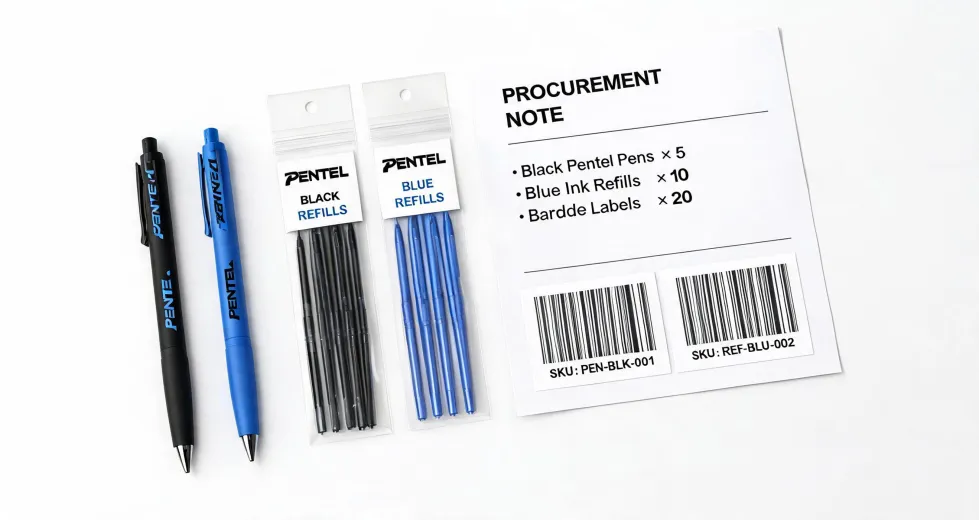
Marketing photos are not quality documents. A 'pentel energel 0.5mm pen image' can show you barrel color and overall design, but it won't tell you whether the pen is top-heavy, how long the tip is, or whether the refill is current or previous generation. I've seen retailer product images that were two generations behind the actual item.
One time, we approved a catalog page based on a stock photo. The client's printed brochure showed a pen that had been discontinued two years earlier. We should have compared the clip shape and barrel imprint with a physical sample. Treat every product photo as a lead, not a fact.
Checkpoint: For any 'pentel energel 0.5mm pen image' in your marketing or purchase order, ask for a current photo next to a ruler. Compare the model number imprint and clip shape.
Step 3: Verify the assumptions behind the calculator
This might sound off-topic for a stationery article. It isn't. The same quality instinct applies when you use a water intake calculator or a breeding calculator palworld. You're making a decision based on an output. If you don't know what goes into the formula, you're guessing.
The U.S. National Academies of Sciences, Engineering, and Medicine recommends about 3.7 liters of total water per day for adult men and 2.7 liters for adult women (Source: NASEM, 2020). A generic water intake calculator that uses only body weight and ignores activity level or climate gives you a number that looks precise but isn't tailored.
For Palworld, the situation is less standardized. There is no official breeding calculator from Pocketpair; community tools differ in how they handle inherited passive skills. If you use the first result without checking its assumptions, you may plan for a Pal that can't actually be bred that way.
Checkpoint: Before relying on any calculator, find the explanatory notes. If you can't see the formula, don't treat the output as a spec.
Step 4: Condition the material before blaming the tool
When someone searches for 'how to soften polymer clay,' the answer almost never is 'buy a more expensive tool.' It's to condition the clay. A hard block of polymer clay becomes workable after kneading, rolling, and warming. Sometimes a few drops of mineral oil help. The point is that the material determines a large part of the result.
Writing instruments are the same. If a Pentel automatic pencil's lead keeps breaking, the problem is often the lead grade, the surface, or the amount of pressure, not the pencil. If a Pentel Energel 0.5mm pen skips, check the paper quality and whether the pen was stored horizontally for a few weeks. The 'pen is defective' conclusion is an oversimplification.
Checkpoint: Before reporting a quality problem, test the sample on three surfaces: printer paper, notebook paper, and the user's typical paper. Note the lead grade and ink storage conditions.
Step 5: Pay for certainty when the deadline matters
I have mixed feelings about rush fees. On one hand, paying extra to get the same product faster feels like a penalty. On the other, I've seen the chaos rush orders cause in a warehouse. The fee is justified because the certainty is the product.
In March 2024, we paid $400 extra for rush delivery of a miscounted batch. We needed it before a $15,000 client event. Missing the date would have cost us the client. The $400 wasn't a cost; it was insurance.
The same math applies when choosing between a reliable brand and a no-name alternative. Pentel automatic pencils typically range from about $5 to $28 depending on model and retailer (based on major online retailer quotes, January 2025; verify current pricing). They are not always the lowest-priced option. But if a two-week delivery delay costs more than the price difference, the premium is the cheaper choice.
Checkpoint: Before submitting the order, estimate the cost of a two-week delay. If the delay costs more than the premium, choose the option with the guaranteed specification.
Common mistakes that waste time and money
Only inspecting the outside of the box
Open one unit and write with it. The click should feel solid. The ink should start within the first few strokes. This takes 30 seconds per product line.
Trusting the screenshot instead of the spec sheet
A 'pentel energel 0.5mm pen image' can be color-corrected. Ask for a video if possible. In video, you can see the refill, the spring, and the actual click action.
Skipping the carton-level count
We didn't have a formal process for verifying partial cartons once. We trusted the label. The third time a carton was short, I created a count-and-date-stamp checklist. It caught a 10% shortage on a 50,000-unit order.
Assuming the most common answer is the right answer
'Use a water intake calculator' sounds simple, but your activity level matters. 'Use the first breeding calculator palworld' sounds simple, but its mechanics may be outdated. The first 'how to soften polymer clay' tutorial may say to microwave the clay—that can burn it or make it crumbly. Kneading is safer. The simplest answer is not always the most accurate.
The value of a checklist isn't that it catches every problem. It's that it forces you to look at the product, the process, and the context before you spend money or time. For a Pentel order, that means a model check and a writing test. For a calculator, that means reading the formula. For polymer clay, that means checking the material's condition. If you do those steps, you'll be the person who doesn't get burned.