-
Step 1: Stock the writing tools that disappear first
-
Step 2: Know which calculator you need before you need it
-
Step 3: Know who invented the modern ballpoint pen
-
Step 4: Order like every supply order has a deadline
-
Step 5: Pressure-test the tools before the heat is on
-
Step 6: Build a last-minute kit and label it
-
Standard Mistakes That Sneak Up on You
I’m a procurement coordinator at a mid-sized design agency. I’ve handled 400+ rush orders in eight years, including same-day turnarounds for event clients. In March 2024, 36 hours before a conference, a client called because every marker in the prep room was dried out. We found a vendor with a next-day option, paid $180 in rush fees, and the event went out on time. The client’s alternative was missing their booth placement.
That’s why I use this checklist. It’s not about owning every gadget. It’s about having writing tools and calculators that don’t make you think twice when the clock is loud. Here are the six steps I actually follow.
Step 1: Stock the writing tools that disappear first
The two items I order more than any other are Pentel Side Click mechanical pencils and Pentel Brush Sign Pens.
- Pentel Side Click mechanical pencil – The side-click advance means you can push out more lead without moving your hand. That matters when you’re scribbling notes in a meeting or sketching a layout before someone says “can you make it bigger?” It’s also comfortable to hold for long writing sessions.
- Pentel Brush Sign Pen – This is the one I grab for signs, labels, and anything that needs a human touch. The flexible brush tip creates thick and thin lines, and the water-based ink works on paper and card. It’s not a fancy calligraphy marker; it’s a dependable brush pen.
These aren’t expensive picks. They’re the ones I don’t have to think about when everything else is on fire (and it often is).
Step 2: Know which calculator you need before you need it
People rarely put calculators on an office supply checklist. I think they should. Specifically, two types that solve real problems:
- Coast FIRE calculator – If you’ve ever wondered whether you can stop adding money to investments and still retire on schedule, this calculator answers the question. It asks for your current savings, expected return, target amount, and retirement age. Then it shows whether your money can “coast” to that goal. I use it before any conversation about workload, salary, or “can I take a step back?”
- Board foot calculator – This one is for estimating lumber. One board foot is 12 × 12 × 1 inches. The formula is (thickness in inches × width in inches × length in feet) / 12. A 2x6x8 board is 8 board feet. When you’re quoting a display shelf or a shipping crate, this prevents the classic under-buy by 20 percent.
Coast FIRE calculators are for the question “can I stop saving aggressively?” Board foot calculators are for the question “how many boards will this take?” Both are better than guessing.
Step 3: Know who invented the modern ballpoint pen
Ask who invented the modern ballpoint pen and the common answer is László Bíró. That’s mostly right. Bíró, a Hungarian-Argentine journalist, patented a working ballpoint in Argentina in 1938 because he was tired of fountain pens smudging and refilling. His design used a tiny ball in a socket to roll quick-drying ink onto the page. John Loud had an earlier patent in 1888, but his version never became practical. Bíró’s did.
Why is this on a supplies checklist? Because a good writing instrument is the result of someone solving a real problem. The Pentel Side Click lead advance and the Brush Sign Pen’s flexible tip? Same idea. They make the tool fit the job, not the other way around.
Step 4: Order like every supply order has a deadline
When you’re ordering, start with one question: “What’s NOT included?” before “What’s the price?” Setup fees, shipping cutoffs, rush surcharges, and reorder costs can appear after you already feel committed. The vendor who lists all fees upfront—even if the total looks higher—usually costs less in the end.
In my role coordinating supply orders, I’ve learned that the most expensive estimate is the one that misses the delivery date.
Last quarter alone, we processed 47 rush supply orders with 95% on-time delivery. The three that went sideways all had the same issue: nobody checked the shipping cutoff before ordering. On one project, we paid $800 extra in rush fees on top of a $12,000 base. The alternative was losing a contract. I kept asking myself: is saving $400 on a slower shipment worth the risk of missing a client’s event? It wasn’t. After that, we implemented a 48-hour buffer on all custom supplies.
Step 5: Pressure-test the tools before the heat is on
The step that saves the most money is also the easiest to skip. If you only test a pen or pencil when you’re already behind, you’ll accept anything. Spend two days using each tool before you order a case of them.
In my first year, I made the classic specification error: assumed “standard” meant the same thing to every vendor. I ordered 60 Brush Sign Pens based on a photo. They were calligraphy tips, not signage tips. Cost me $350 and three days. If I had tested one first, I would have seen the difference in about thirty seconds.
The same goes for mechanical pencils. If a lead keeps breaking, it doesn’t matter how great the body feels. Move on to the next model before you commit to a bulk order.
Step 6: Build a last-minute kit and label it
Take five minutes and make an emergency desk kit. Put it in a drawer or a clear zip pouch. Include:
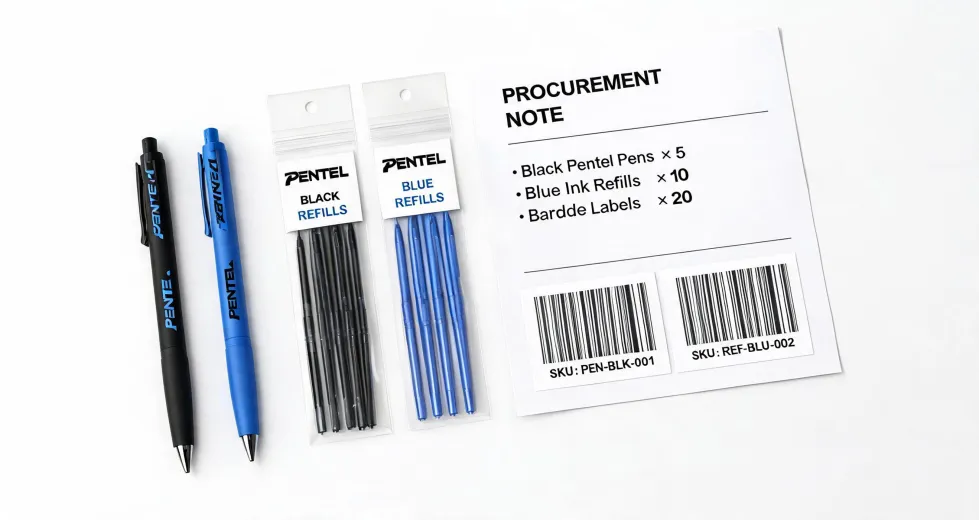
- One Pentel Side Click mechanical pencil with a spare lead case
- One Pentel Brush Sign Pen
- One reliable ballpoint pen (yes, the Bíró-style one)
- A small notepad
- A phone with the Coast FIRE calculator and board foot calculator bookmarked
Label it “Emergency Desk Kit.” Check it once a month. When someone asks if you have anything to write with, you can point there instead of interrupting your own flow.
Standard Mistakes That Sneak Up on You
Three things I still see go wrong:
- Storing brush pens tip-down. Water-based ink settles and makes the tip too wet. Keep them horizontal when you can.
- Waiting until the last pencil runs out. Buy the refill when you buy the pencil.
- Treating “estimated delivery” like a guarantee. Ask whether the countdown starts when you click pay or when the carrier picks it up.
Take it from someone who keeps a drawer labeled “do not ignore”: the tools you don’t think about until you need them are exactly the ones worth a checklist.