Here's an unpopular take from a guy who lives on deadlines: cheap office supplies are the most expensive thing in your office. That's not a metaphor. It's a calculation—one I wish more procurement teams would actually make.
In my role coordinating rush orders for a print and events services company, I've handled 200+ emergency jobs in six years. Same-day turnarounds for clients who need 300 welcome packets by noon. Twelve-page programs that have to ship by 4:30 or the whole project collapses. I know what failure costs. And the lesson I keep coming back to is that the tools we use daily don't just affect our comfort—they affect our timeline.
What I Learned From a Pen That Stopped Writing
In March 2024, a client called at 9am with a last-minute deck revision. The print version had to go out by 2pm. I was proofing their marked-up page—the one where “FUTURA BOLD” was scrawled in red ballpoint ink along the margin, complete with a double underline.
I grabbed the nearest pen from the bulk box next to my desk and started marking corrections. Thirty seconds in, it skipped. I scribbled test loops. It skipped again. Shook it. More loops. It wrote for exactly three strokes, then surrendered.
I grabbed another pen from the same box. Same problem.
Fifteen minutes later I'd burned through four pens, my frustration was compounding, and the client's deadline hadn't moved any closer. I finally pulled out a mechanical pencil—a Pentel .5 model I'd loaded the week before—and finished the markups without another thought.
The incident didn't ruin anything. But it made me think: how many times had I wasted fifteen minutes on bad tools before this? Thirty? Fifty? What does that actually cost a company over a year?
Here's where my head went next: the industry has evolved, but most of us haven't updated our habits. What was acceptable in a pen in 2015 isn't acceptable in 2025. The fundamentals haven't changed—you still need a reliable writing instrument—but the execution has transformed.
Why I Stopped Being a Brand-Agnostic Cheap-O
I'm not a brand loyalist by nature. I buy whatever makes sense for the job. But in this line of work, I've learned that some brands simply work better under pressure.
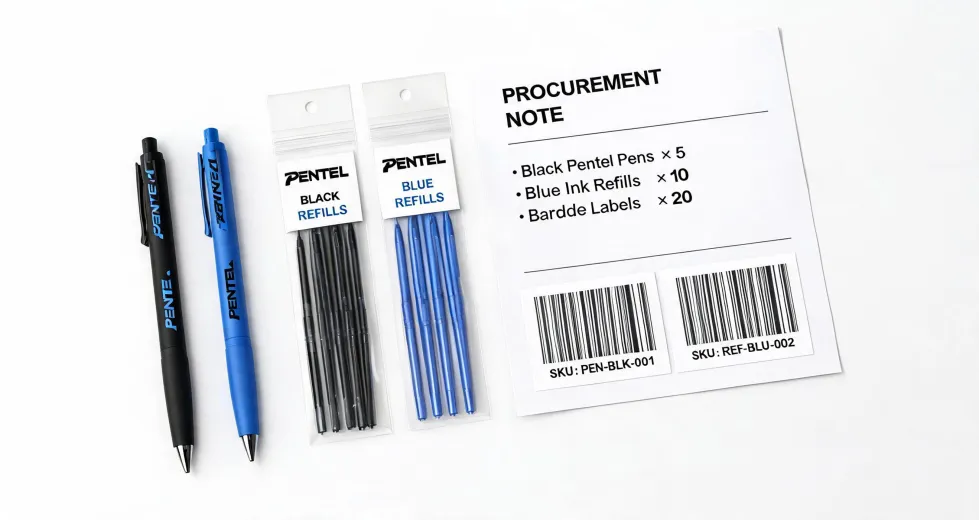
Pentel is a prime example. Their Twist-Erase mechanical pencils have been around for a while, but the twist erase refill system is genuinely smart engineering. When you use a refill designed for the pencil it goes into, you don't get the wobble, the weird clicking friction, or the eraser springing out mid-word. It seems minor. But in a business where clients hold your work in their hands, small flaws are the ones they notice.
Same for the Pentel .5 pencil. For proofreading, marking up documents, and jotting notes on glossy paper, that thin 0.5mm lead gives you clean, precise lines without the smudge and smeer you get from liquid ink. It's not a luxury item. It's a utility upgrade that costs a little more and delivers a lot more predictability.
And yes, equipping your office with these instead of the cheapest alternative will add a few dollars to your order. But you know what adds a few hundred dollars? Rework. Miscommunication. The downtime that comes from tools that don't do what they're supposed to.
- A pen that skips → an illegible correction → a wrong revision → a $100+ reprint.
- An eraser that doesn't erase → a messy mark → an awkward conversation with the client.
- A non-permanent marker that's not actually removable → a ruined surface → replacement costs.
The Percent Off Calculator Trap
Here's a scenario so common it hurts. Someone decides to buy pens in bulk for their department. They open a percent off calculator, type in the list price, apply the 25% discount, and proudly look at the savings.
I did this too—for years. Then I realized I was calculating the wrong equation.
Say Vendor A offers 30% off a 50-pack of generic gel pens. Vendor B offers 10% off a 10-pack of quality pens that you'll actually keep for a year. The percent off calculator says Vendor A wins. But the calculator doesn't see the other variables:
- How long does a cheap pen last before it dries out? Three weeks, if you're lucky.
- How much time does the user spend digging through a drawer to find one that works? Probably a few wasted minutes each time.
- What happens when a pen leaks and ruins a binder, a shirt, or a client's printed brochure?
Suddenly, Vendor A isn't cheaper. It's cheaper to start with.
Per FTC guidelines (ftc.gov), companies can't make misleading claims about their products. But value is a different story. The true cost of a tool is its reliability in context. A percent off calculator tells you what you pay. It can't tell you what a failure costs.
The Bulletin Board and the Permanent-Marker Lesson
Let me tell you about a day when I became the unlikely hero of a client's office—for something that had nothing to do with print production.
In 2023, I walked into a client's conference room and found that someone had drawn a complete process diagram on the fabric of their brand-new bulletin board. In permanent marker. Large. Bold. Not accidentally.
The client's face went pale. “We need this board for an event in three days. Can we get another one?”
Sure, you can. But a quality fabric bulletin board isn't cheap, and the replacement might not match the rest of the office. So I told her: let me try something.
I grabbed 91% isopropyl alcohol from the supply closet, poured a little onto a clean cloth, and gently dabbed at the marker. The pigment started lifting within seconds. The trick is not to rub—dabbing is key because rubbing pushes the ink deeper into the fabric. Ten minutes later, the board looked almost new.
That lesson was a game-changer for my professional mindset. Most people assume that permanent marker is a permanent disaster. It's not. The materials and solvent chemistry have changed, and the old “well, it's ruined” response is outdated. Knowing how to get rid of permanent marker on a fabric board, a whiteboard, or a plastic binder is a core skill for any office manager—not a parlor trick.
I also learned a communication lesson that day: I said “mark up the board with something temporary.” They heard “use whatever marker you find.” Result: permanent ink on a $200 board. We were using the same words but meaning different things. Now I always specify the tool, not just the outcome.
But What About the Budget?
I'm not going to pretend that price doesn't matter. If your department has $50 a month for office supplies, you're not buying a box of premium pens. I've been there. I get it.
But even on a tight budget, the math isn't as simple as picking the lowest sticker. It's about finding the smallest number of reliable items that do the biggest amount of work. A few pens that work every time. One good mechanical pencil. A refill that fits without wrestling. That's not luxury. That's infrastructure.
And keep the cheap pens for guests and sign-in sheets. Just don't use them when the outcome is important.
One more thing about total cost. In January 2025, USPS raised the First-Class Mail letter rate to $0.73 per ounce (source: usps.com/stamps). People who ship client materials notice that increase quickly. But guess what? The cost of postage is tiny compared to the cost of a missed deadline. The same logic applies to office supplies. It's not the $5 pen that should keep you up at night—it's the $500 reprint, the $200 rush delivery, the $300 in overtime labor for your team. Those are the numbers a percent off calculator can't show you.
My Bottom Line
Look, I'm not saying that office supplies are the only variable between your team and a successful deadline. There's communication, planning, weather, traffic, and the stubbornness of printers. Plenty can go wrong.
But as someone who lives in the gap between “impossible” and “done,” I've learned to reduce the variables I can actually control. The pens. The pencils. The boards. The markers. They're not gadgets. They're time tools.
The industry has evolved. So should you.