-
Step 1: Check the clutch, not just the barrel: Pentel 0.7 mechanical pencil
-
Step 2: Test smear resistance on the paper you'll actually use
-
Step 3: Verify refill availability before you fall in love with a pen
-
Step 4: Use a p-value calculator to make the call
-
Step 5: How to write with a fountain pen without damaging the nib
-
Three mistakes that keep happening
If you're responsible for buying or checking writing instruments for an office, classroom, or client order, this one's for you. I'm a quality/compliance manager at a stationery company, and I review roughly 200 unique items a year—from mechanical pencils to fountain pens to markers. In Q1 2024, I rejected 9% of first deliveries because of lead retention issues alone. This is the checklist I actually use. It's five steps, and most of them take less time than reading a product spec.
Here's what you need to know: the stuff that looks good in marketing photos isn't always the stuff that survives a week in production.
Step 1: Check the clutch, not just the barrel: Pentel 0.7 mechanical pencil
Most buyers focus on exterior finish and per-unit price. They completely miss the clutch—the internal mechanism that holds the lead in place. If the clutch is weak, the lead slides backward when you press down. You don't notice that in a quick in-store test. You notice it after you've distributed 50 boxes.
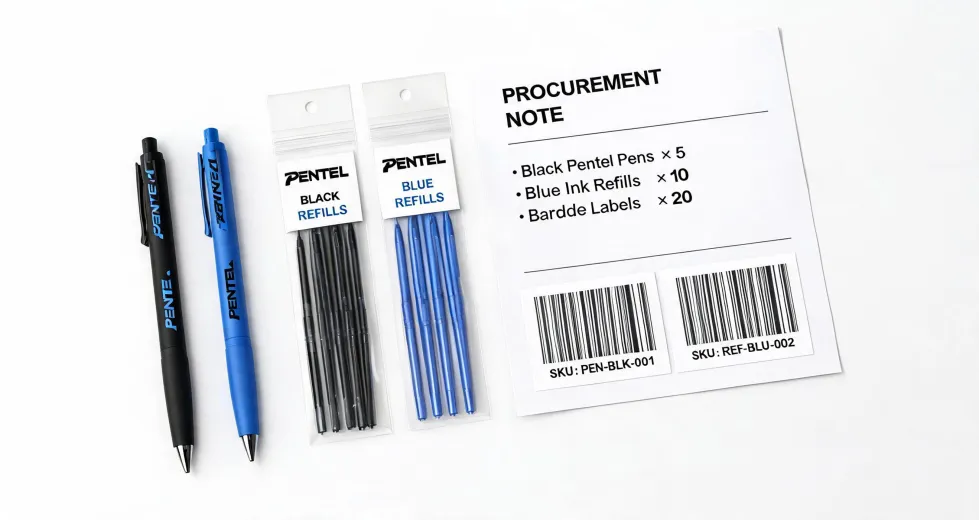
For this reason, my go-to test sample is a Pentel 0.7 mechanical pencil. It's not about hype; it's about consistency. We tested several 0.7 mm pencils in 2024, and the Pentel 0.7 mechanical pencil models in the Twist-Erase and GraphGear lines held their lead after 50 continuous writing strokes with moderate pressure. The GraphGear has a metal grip that feels more secure, while the Twist-Erase is better for people who push hard. If I had to pick one for office use, it'd be the Twist-Erase, honestly. But that's a preference, not a quality conclusion.
A lot of 'pentel mechanical pencil review' content talks about weight and style. That's fine for consumer blogs. For a quality gate, you need to test three things: lead retention, the advance mechanism, and whether the lead sleeve stays aligned after repeated drops. If the sleeve gets bent, the pencil becomes a scribble tool, not a writing tool. For a quick acceptance test, click out about 3 mm of lead, write a line, then press down with moderate pressure. If the lead slides back into the sleeve, that's a fail.
Step 2: Test smear resistance on the paper you'll actually use
Another buyer blind spot: 'quick-dry' doesn't mean anything until you define the paper. Gel ink that dries in 2 seconds on copy paper can still smear after 10 seconds on coated stationery. So we run a simple test. Write a line, wait ten seconds, and run your thumb across the end. If it smears, it fails for that use case.
This applies to fountain pens too. In fact, the biggest myth I keep hearing is that fountain pens are too fussy for modern offices. That thinking is a leftover from an era when inks were less predictable and nibs were brittle. Today, with modern cartridge inks and better manufacturing, a well-set fountain pen is actually pretty reliable. But it still isn't a ballpoint. You have to use the right technique, and I'll get to that in Step 5.
Step 3: Verify refill availability before you fall in love with a pen
A beautiful pen body is useless if the refill is impossible to find. This sounds obvious, but trust me on this one: it gets skipped. In 2023, we ordered a custom-branded pen from a promotional products broker. The unit price was great. The refills? They had to be imported, and the lead time was 11 weeks. We ended up paying rush shipping on every restock. That's a textbook 'saved $40 on the upfront cost, spent $400 on expedited freight' situation.
For mechanical pencils, this is where the Pentel 0.7 shines. Standard 0.7 mm lead refills are stocked by virtually every office distributor we use. Same for the erasers on Twist-Erase models. If I'm comparing two vendors, refill availability is a bigger factor than the color options.
Step 4: Use a p-value calculator to make the call
Here's where I sound like a quality nerd. When a vendor says 'our quality is basically the same,' don't take their word. Run a small comparison. Take 20 units from the current batch and 20 from the proposed batch. Count defects. Then put the numbers into a p value calculator online.
We did this in 2024 with two mechanical pencil suppliers. The first had 3 defects out of 20. The second had 5. The first thought they'd won. I plugged the numbers into a p-value calculator and got a p-value of 0.42. In plain English: that difference was not statistically significant. We couldn't justify a switch based on that sample. We needed a larger batch, or a more sensitive test.
People assume quality decisions are binary. They assume one data point is enough. A p-value calculator doesn't make the decision for you, but it stops you from paying a premium for a difference caused by random luck.
We've also started using a Bambu Lab 3D printer to print test fixtures for these checks. The fixture holds a pencil at a fixed 60-degree angle so we can drop it from the same height every time. It takes an hour to print and eliminates a lot of human variation in testing. That's the kind of small efficiency that saves real money on large orders.
Step 5: How to write with a fountain pen without damaging the nib
If you're adding fountain pens to a product lineup or you just landed a client who uses one, don't skip this. It's the most overlooked step in our own onboarding. Most people grip a fountain pen like a ballpoint, press hard, and wonder why the nib scratches.
Here's how to write with a fountain pen correctly:
- Hold the pen at a 40- to 45-degree angle to the paper. Almost never vertical.
- Use light pressure. The nib should ride on the paper, not dig into it.
- Let the ink flow do the work. If you feel the tines spreading, you're pressing too hard.
- Move from the forearm, not just the fingers. This keeps the angle steadier and reduces hand fatigue.
If you've ever used a fountain pen and felt scratchy feedback, there's a good chance the angle was too steep or the pressure was too high. That's not a product flaw. It's technique.
And before I move on: no, fountain pens aren't obsolete. They're not the most efficient tool for every task, and I'm not going to argue they are. But for signature lines and long handwritten notes, they offer a different feel under the hand than a ballpoint. That said, the efficiency argument cuts both ways. If someone needs to write a quick note in a warehouse, give them a Pentel 0.7 mechanical pencil or a retractable gel pen. If they need a deliberate writing experience, a fountain pen is a reasonable choice. The point is to match the tool to the job.
Three mistakes that keep happening
- Confusing a good sample with a good batch. A vendor can send you a hand-picked perfect sample. If you're ordering large quantities, specify your own defect-rate threshold. Use a p value calculator on the receiving inspection data. It's not bureaucracy; it's a hedge.
- Putting 'recyclable' on packaging without proof. Per FTC Green Guides (ftc.gov, 16 CFR Part 260), environmental claims need to be substantiated. If you claim a pen or its packaging is recyclable, check that at least 60% of consumers in the area have access to recycling facilities. This one creates legal exposure, not just reputational risk.
- Ignoring shipping constraints. If you're mailing samples or small orders, remember that USPS First-Class Mail letters cost $0.73 per ounce as of January 2025, and large envelopes start at $1.50 (usps.com/stamps). Oversized packaging can push you into a more expensive class. We check dimensions before we buy packaging, not after.