-
The comparison that isn't one
-
Who invented the modern ballpoint pen, and why that matters
-
Dimension 1: Writing experience - precise vs. live
-
Dimension 2: Cost, refillability, and shipping
-
Dimension 3: Failure modes and my $890 mistake
-
The calculator test: choose the right tool for the question
-
What I'd order, and what I wouldn't
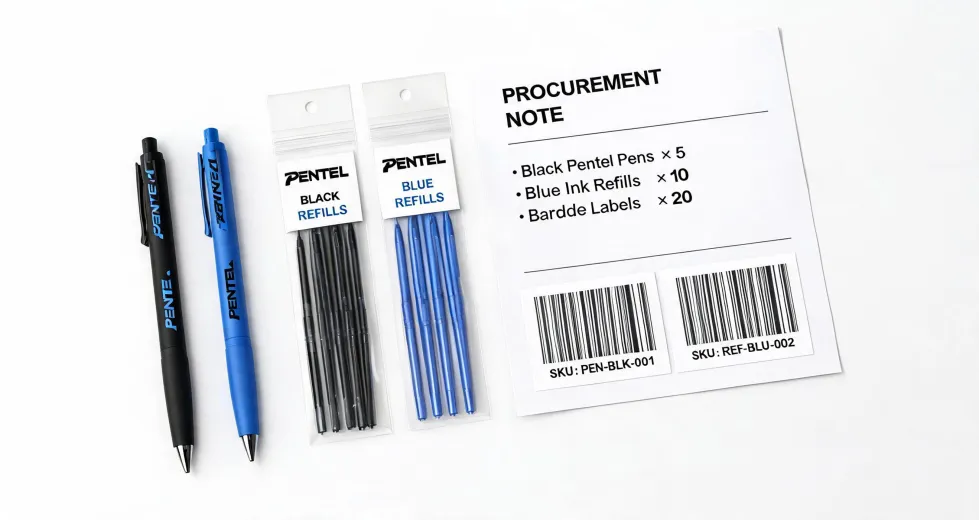
Take it from someone who has messed this up more than once: the difference between a Pentel BL407 refill and a Pentel brush pen is not a minor detail. It's the difference between signing thirty forms in a row and creating a line that actually looks like something. I know, because I've ordered the wrong one. Twice.
I'm a purchasing manager handling office supply orders for six years. I've personally made (and documented) 14 significant mistakes, totaling roughly $3,100 in wasted budget. Now I maintain our team's checklist to prevent others from repeating my errors.
The comparison that isn't one
People think this is a 'which pen is better' question. It's not. The BL407 is a ballpoint refill. The Pentel brush is a brush pen. One is for consistent, everyday writing. The other is for expressive, variable strokes. They're not competitors. They're neighbors.
Think about it this way: a p value calculator and a coast fire calculator are both calculators. But you wouldn't use a coast fire calculator to test statistical significance, and you wouldn't use a p value calculator to plan your retirement. Same logic here. The BL407 and the Pentel brush answer different questions. Get the question right first. Getting it wrong costs a ton of time.
Who invented the modern ballpoint pen, and why that matters
Before you compare refills, it helps to know where ballpoints came from. Who invented the modern ballpoint pen? A Hungarian journalist named László Bíró, in 1938. He wanted a pen that didn't smudge like fountain pen ink. That's the whole point of a ballpoint: reliable, quick, low-mess writing. The BL407 refill sits in that tradition.
The Pentel brush, on the other hand, is closer to a paintbrush. Pressure changes the line. You get thin-to-thick strokes in a single word. That's not a flaw. It's a different category. Comparing them directly feels wrong because they come from different lineages.
Dimension 1: Writing experience - precise vs. live
With a BL407 refill, you know what you're getting. The line is consistent, the ink dries fast enough for most paperwork, and the tip doesn't bend. On cheap copy paper, it's predictable. Serviceable. That's exactly what an office wants.
With a Pentel brush, the line is alive. Press lightly and you get a hairline. Press harder and the stroke swells. It's expressive. It can be beautiful. But it's also less forgiving for small text on forms. If your handwriting shakes, the shake shows.
Which is 'better'? Depends. If you're filling out compliance forms, you don't want line variation. If you're lettering a banner or sketching, a uniform ballpoint is boring. Different jobs, different tools.
Dimension 2: Cost, refillability, and shipping
The cost picture is not as obvious as it looks. A BL407 refill is cheaper than replacing the whole pen. That's the idea: you refill the R.S.V.P. pen and keep using the same barrel. Pretty simple.
A Pentel brush can be refillable or disposable depending on the model, and the tip can dry out if you leave the cap off. If that happens, it's a repeat purchase, not a refill. That's not a defect. It's a maintenance responsibility.
Honestly, I'm not sure why Pentel uses the code BL407 instead of a simpler name. My best guess is it's an old part number that stuck. Once you know the code, though, it's easy to reorder.
When I price an order, I don't just look at unit price. I look at cost per use. A coast fire calculator won't help you here. That calculator is for long-term financial independence, not department spend. Use it if you're planning to quit and become a full-time lettering artist. Otherwise, a spreadsheet is enough.
Shipping is another thing I learned the hard way. According to USPS Business Mail 101, a standard letter can't exceed 6.125 x 11.5 inches and 0.25 inch thick. A brush pen often pushes against that. A BL407 refill slips into a standard envelope easily. If you're mailing Pentel brush pens, you need a padded mailer.
Dimension 3: Failure modes and my $890 mistake
Ballpoint refills are forgiving. You can leave them in a drawer for months. They might skip on slick paper, but they don't dry out as fast. Brush pens are the opposite. They need caps, care, and sometimes cleaning. Same brand, very different failure modes. I'm not a product engineer, so I can't explain every polymer in the ink. What I can tell you from a procurement perspective is that maintenance matters more than marketing.
People think expensive pens are expensive because they're better. Actually, they're priced for a narrower use case. The causation runs the other way.
The worst mistake in my first year (2017) was ordering 300 BL407 refills for pens that needed a different refill. Looked fine in the catalog. It wasn't. The order was for $3,200. When we realized the refills didn't match, we had $890 in redo plus a one-week delay. Straight to the trash.
That's when I learned to check the existing refill before ordering. A smaller issue happened in September 2022: I ordered refills again without noticing the packaging had changed. The model number was different, and the fit was wrong. 600 units, $450 wasted, plus embarrassment. A lesson learned the hard way.
Since then, we've caught 47 potential errors using a pre-check list. After the third rejection in Q1 2024, I made that list a requirement for every office supply order. If someone tells me a checklist is overkill, I point to the $890.
The calculator test: choose the right tool for the question
This is where the two calculators come back in. If you're trying to prove that one pen performs 'better' than another in a small trial, you can run a p value calculator. But honestly, with a sample of 20 users, the p value won't tell you much. The assumption is that a p value calculator gives you certainty. The reality is it gives you a probability, and only if your trial was designed properly.
Same with a coast fire calculator. It's basically a great tool for a specific question: how much do I need invested before I can coast to retirement? It is not the tool for 'can I afford a box of Pentel brush pens this quarter?' People grab whichever calculator is familiar. Familiar isn't the same as right.
What I'd order, and what I wouldn't
Here's my honest recommendation. If you run an office where people write on forms, take meeting notes, and need a pen that works every day, order the BL407 refills. They're reliable, budget-friendly, and compatible with a pen your team probably already has. I recommend that for 80% of my own orders.
But if you have a creative team, an art class, or a client presentation that needs more than a straight line, the Pentel brush is the one. Just be ready to care for it. If you're in the other 20% and need both, don't force a choice. Keep a BL407 in your drawer for admin work and a Pentel brush in your sketch kit for the stuff that matters.
One note on claims: I get nervous whenever a brand says 'never smudge.' Per FTC guidelines (ftc.gov), claims must be truthful and not misleading, but smudge depends on paper, ink, and time. We test on the actual paper we use. Both the BL407 and the Pentel brush pass our daily-use test. They just do different jobs.