The Budget Line That Wouldn't Stay Put
It was October 2023 when I realized our office supply budget was in real trouble. The dashboard showed 82% of the annual allocation already committed—with two full months plus a holiday event still ahead. My first instinct was to blame inflation. Everyone I knew was complaining about prices, so why wouldn't office supplies be part of that?
Then I pulled the data. Six years of procurement records, roughly $180,000 in cumulative office spending, every line item documented. The price tags weren't the problem. The problem was how we were purchasing.
Why Small Purchases Add Up to Big Leaks
Office supplies share a sneaky trait: nearly every line item is under $50. That's why so few people question them. A $48.50 order for gel pens doesn't trigger a review. But when you're placing 30 of those orders a month across every department, it becomes real money. And most of that money was leaking through four specific habits.
The through-line running under all four habits was simple: we were optimizing for sticker price instead of cost per use. A $1 marker that dies in a week costs more than a $1.70 marker that lasts three months. A $1.50 pen you throw away costs more than a $2.50 pen you refill for a year. That single mindset shift changed everything.
Habit #1: Replacing Instead of Refilling
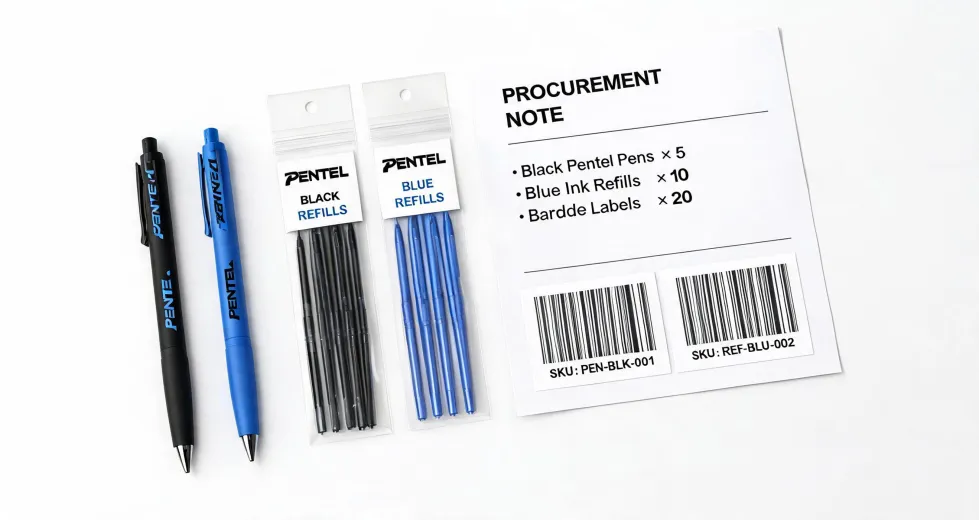
This one stings because it's so obvious in retrospect. We had a standing order for gel pens—about $24 per quarter for a 12-pack. Each pen lasted a few weeks, then got tossed. Meanwhile, the same pens had refills that cost roughly $1.10 each. One of my analysts ran the numbers: $96 a year on whole pens versus about $52 on refills. That's a 46% difference in a single category.
I checked current prices before writing this. As of January 2025, a Pentel Energel RTX runs about $2.50 at major office retailers, and a two-pack of Energel refills costs around $3.30. Verify that at your usual vendor—promotions move the numbers—but in our tracking, refills have consistently come in 30-40% cheaper than whole pens.
Mechanical pencils were worse. We kept buying a box of cheap plastic pencils that nobody actually wanted because the clutches broke under normal use. So we switched to Pentel GraphGear drafting pencils and stocked Pentel refill leads instead. The upfront cost was higher—around $150 for 10 pencils—but ongoing lead supply ran about $60 a year. The old system cost us close to $200 a year, and half those pencils ended up snapped in a drawer before being fully used.
Looking back, I should have made this switch in 2022. At the time, the bigger upfront number scared me. I'm the cost controller—I'm supposed to be the one saying “let's not drop $150 on pencils.” But honestly, the data was already pointing the other way. The refill path was cheaper by month seven, and the pencils actually worked.
Habit #2: The Word “Markers” Means Different Things to Different People
I have a classic procurement story on this one. Last spring, I told my assistant we needed more markers in the supply closet. She heard “get the cheapest ones.” I didn't specify. So she ordered a 12-pack of store-brand markers for $8.99. By the end of the month, seven of them had dried out. Not because they were defective—because cheap markers dry out fast. The Pentel equivalent, at roughly $1.79 per marker, lasted months longer.
We were using the same word but meaning different things. I meant quality markers that hold up. She meant whatever fits the budget. The result was double the long-term cost, a cabinet full of dead markers, and a team that couldn't find a working one when they needed it.
Habit #3: Using the Wrong Tool for the Job
This is where costs hide in time rather than invoices. At least twice a month, someone grabbed a permanent marker when they needed a whiteboard marker. Or they used a regular pen on fabric and ruined a prototype. The immediate fix is usually a cleaning session.
I first dealt with this at home, actually. My son drew on his Bentgo lunch box with a permanent marker, and I spent a solid 20 minutes researching how to get permanent marker off plastic. Rubbing alcohol worked, in case you're wondering. But the same accident plays out at work constantly, and when you multiply those 20-minute cleanup sessions across a team, you lose a full workday per month to marker mishaps.
The supply-side fix is simple in theory: keep the right tool in the right place. When we needed to label fabric for event banners and uniform samples, we bought a Pentel fabric pen. It costs more than a generic marker, but it holds up through washing, so the cost per successful labeling task is actually lower. That's a trade worth making.
Part of me wants to say every office just needs a labeled storage system and better discipline. Another part knows that in a 40-person team, someone will still grab the first marker they spot. So we stopped fighting human nature:
- Whiteboard markers stay in a separate holder in conference rooms, not in the general supply closet.
- Permanent markers live in a labeled drawer near the shipping station, where package labels get written.
- The fabric pen sits with event supplies, not with everyday writing instruments.
Habit #4: The Supply Budget Became a Dumping Ground
During the 2023 audit, I found $8,640 in avoidable spending. About a third of it wasn't office supplies at all. A Bentgo lunch box meant as a client gift ended up on a supply order because it was in the same online cart. Snacks for a team meeting got charged to office supplies. A power strip for a new hire—also office supplies.
I'm not against any of those individual purchases. I'm against them hiding in a category that's supposed to track one specific thing. When categories blur, the budget stops giving reliable signals.
You can't manage what you can't see.
What This Actually Cost Us
After the audit, I split avoidable spending into two buckets: direct waste and time waste.
Direct waste was stuff we bought and never used. Dried-out markers, dried-out pens, knockoff leads that jammed in our drafting pencils. Total for 2023: $3,120.
Time waste was harder to measure but bigger. Our operations person spent about three hours a week reordering common supplies because nobody tracked what was actually in stock. Employees burned another 15 combined hours per month cleaning up marker incidents and hunting for working pens. At a conservative fully-loaded rate of $40 per hour, time waste alone came to roughly $8,900 per year. I still kick myself for not building a proper stock count sooner. The information was sitting in my spreadsheets the whole time. I just wasn't looking at it the right way.
Four Rules That Saved Us 18%
None of this took a heroic overhaul. We implemented four rules in Q1 2024, and by the end of the year, supply spending dropped 18%—about $11,000—with the same headcount and the same work getting done.
- Refill first. If a Pentel refill exists for the pen, we stock the refill. Whole new pens only for new hires or actual losses. Same logic applies to mechanical pencils and markers with refill options.
- Buy for the job. Fabric projects get the Pentel fabric pen. Whiteboards get whiteboard markers. Permanent markers stay separated in a labeled workspace. The right tool beats a cheap tool, even when it costs more per unit.
- Track the remainder. I built a “remainder calculator” tab in our procurement spreadsheet. At the start of each month, I enter what's been spent, subtract committed purchase orders, and the calculator shows exactly what's left. It's basic arithmetic, but it turned budget conversations from “do we have enough?” into “we have $2,180 remaining, and here's what's already earmarked.” That visibility is what stopped the bleeding.
- Keep categories honest. Client gifts, team snacks, and equipment go in their own budget lines. The Bentgo lunch box story still makes me laugh, but it's exactly the kind of category drift that clouds the numbers. If you can't trust the label on the line item, you can't trust the budget review.
If your supply budget keeps running dry for reasons you can't pinpoint, don't assume the price tags are the whole story. Look at what you're buying, how you're buying it, and where you're recording it. For us, the fix wasn't squeezing suppliers or cutting purchases nobody cared about. It was buying refills instead of replacements, matching tools to tasks, and tracking what was actually left. You might not need a bigger budget. You probably need to stop leaking the one you have.