-
Step 1: Label every supply as Practice or Final
-
Step 2: Test cheap pens before buying a box
-
Step 3: Ask more from acrylic paint than from pens
-
Step 4: Do the true cost-per-use math
-
Step 5: Treat paper as a spec, not as a surface
-
Step 6: Divide your order among the right kinds of stores
-
Notes from a supply closet
I order supplies for a 140-student visual arts program. I started doing this in 2018, and I've made enough mistakes to fill a recycling bin with apology notes. The most expensive single mistake was a $317 order of cheap acrylic paint that looked like a deal and behaved like tinted glue. That was part of a longer education that cost roughly $2,800 before I changed my checklist. This guide is for anyone trying to find cheap art supplies for a classroom, a small studio, or a home setup. It has six steps. If you only follow one, make it step four.
Step 1: Label every supply as Practice or Final
Before you compare prices, take the whole shopping list and put a P or an F next to each item. P is practice, meaning you can accept a failure and try again. F is final, meaning the work has to survive critique, a client, or a wall. This step feels childish. It matters because the word cheap means different things in these two rows.
Practice items can come from the discount bin. Final items should not. If more than a third of your list is marked F, you are not in the market for cheap art supplies; you are in the market for fewer, better materials. Same total budget, longer list, less waste.
Step 2: Test cheap pens before buying a box
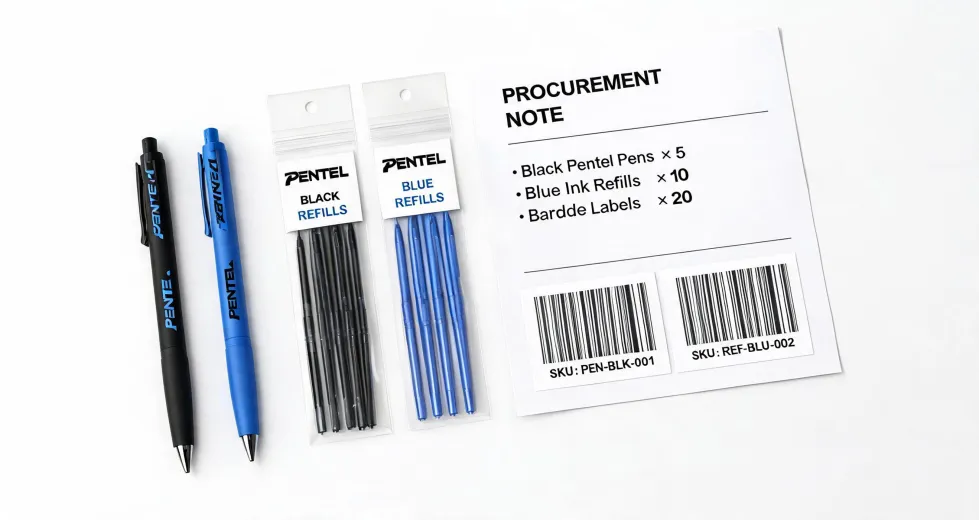
Cheap is safe when the failure is annoying but not destructive. For student line work, the Pentel RSVP fine point pen is the reference in my cabinet. It is not a luxury drawing tool, but it is consistent, and consistency matters when a whole class is using the same kind of pen. In 2018, I bought 400 discount pens because the price per pen was impossible to ignore. On the third page of a test drawing, they skipped so often that students switched back to pencils. Those pens did not run out; they went to the back of a shelf.
Before ordering any quantity, test the pen on the exact paper students will use. If it blobs, skips, or bleeds through, the lower price is not a saving. You can find reliable cheap art supplies in the office supply aisle; the art store version of a basic writing tool is sometimes the same thing with a higher price.
If you are here because you searched for Pentel fountain pen, I don't have a clean verdict. Pentel's regional lineup varies, and I have no idea which products are available in your country. The useful advice is the same: decide what the tool needs to do before you chase a product name. If you want line variation, a brush pen might satisfy that urge better than a fountain pen anyway.
Step 3: Ask more from acrylic paint than from pens
Acrylic paint is where I still get nervous about cheap art supplies. A cheap tube is acceptable for a practice palette that no one keeps. The same tube can ruin a final piece if the pigment load is weak or the binder is mostly filler. The label should tell you something. Look for a color index number and a lightfastness rating. If neither appears on the package, treat that paint as temporary practice material, not as a professional medium.
The $317 mistake happened because I bought a bulk set of acrylic paint from a discount supplier who could not provide a technical data sheet. The colors looked bright in the bottle and washed out on paper. Some dried rubbery, some cracked, and one never really dried flat. I replaced it with a smaller set of student-grade acrylic paint from a proper art supplier. The smaller set cost more per ounce, but it worked, and none of it ended up in the trash.
Checkpoint: if the paint has no pigment information and no lightfastness rating, do not buy a classroom set.
Step 4: Do the true cost-per-use math
This is the reverse-bargain step. I keep an old calculator watch in my supply bag, not for the look, but because it makes me type out the real math while I'm standing in an aisle. The question is not price per unit. The question is price per unit that will actually get used before it expires, dries out, or gets forgotten.
A 24-jar acrylic set selling for $18 is not automatically cheaper than 8 jars at $14. If you need six colors, the other eighteen jars are storage problems, not savings. Punch the numbers into a calculator watch, divide by the number of jars you will open this term, and compare that number instead.
Checkpoint: count only half of an unproven item as usable. A bargain with a 50% usable rate is not a bargain anymore.
Step 5: Treat paper as a spec, not as a surface
Paper is the quiet killer in cheap art supplies. It looks okay in the store, then buckles under acrylic paint or bleeds through with markers. If a drawing pad does not list a gsm or basis weight, I assume the worst. Standard copy paper is about 75 gsm. Many budget pads are in that same range, and that is too thin for wet media. A useful mixed-media pad starts around 120 gsm. Heavy sheets for wet media usually go to 150 gsm or higher.
For quick reference: 20 lb bond paper is about 75 gsm, 80 lb text is about 120 gsm, and 100 lb text is about 150 gsm. These numbers are approximate, but they are a better guide than the words smooth or heavyweight.
In 2022, I bought a whole case of cheap drawing pads because the per-pad price made sense. The pads were close to copy-paper weight. Every marker drawing went through to the next page, and the class went through twice as much paper. The real cost was not the pad price; it was the doubling of the supply list.
Step 6: Divide your order among the right kinds of stores
The honest answer to where to find cheap art supplies is not one magic store. It's a network. Office supply stores are strong for Pentel pens, standard erasers, and paper clips. Art supply stores are strong for pigment-based materials like acrylic paint, and for people who can answer technical questions. Reuse centers and thrift shops are strong for frames, wooden models, and storage containers. They are not strong for sealed paint because the risk of contamination is too high.
I have mixed feelings about second-hand supply shops. On one hand, they are genuinely cheap and environmentally smarter. On the other hand, an unsealed bottle of paint or an old jar of medium can ruin a clean studio. I compromise: tools and containers can come from used markets; anything that goes into a finished painting should be new and sealed.
Pay attention to vendors who tell you their limits. One office store manager told me their acrylic paint was fine for classroom experiments but not for portfolio work, and she sent us to a pigment specialist. That honest boundary made me trust that store for the items they do well.
Notes from a supply closet
Cheap art supplies are not automatically bad. They are bad when they fail in the middle of a process or fail after the work is done. A cheap pen that skips halfway through a drawing is different from a cheap pad used for pencil thumbnails. Skip-pen makes you redo the work. Thin-pad only matters when you choose the wrong media.
I am not an artist, and I am not a paint chemist. I am the person who buys supplies and pays for mistakes. Honestly, I am not sure why some low-cost items are completely fine while others waste your time. My best guess is that binder and pigment chemistry leave no room for shortcuts, while a simple mechanical writing tool can be made reliable for cents. That is why I keep coming back to the same basic brands and the same checklist.
The real win in the hunt for cheap art supplies is not a secret coupon code. It is knowing which materials can be safely cheap, and which ones will charge you interest later.