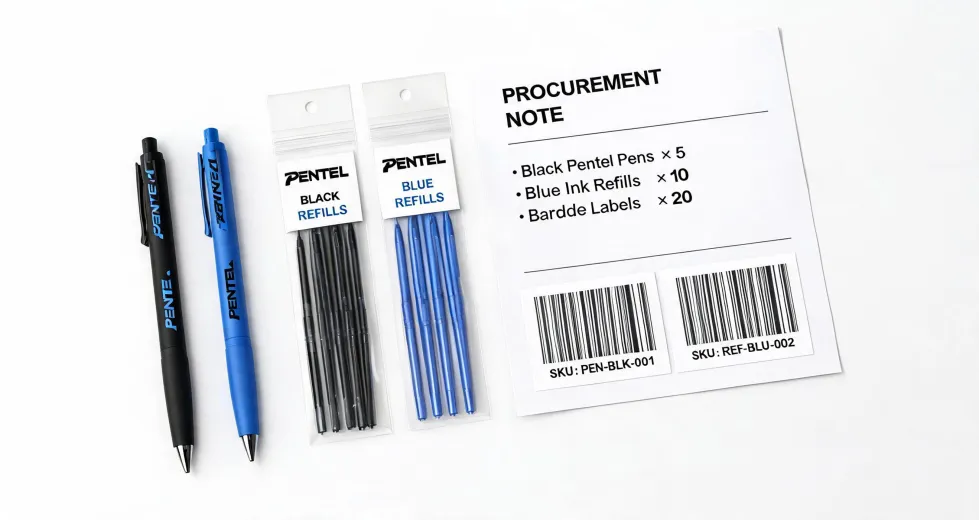
I get the call after something's already gone wrong. In 2024, a tutor called with a fresh box of pens that skipped. A month later, a center director was staring at dried-up markers and a class starting in 12 hours.
In my role coordinating supplies for a network of tutoring centers, I've handled about 300 rush orders in four years—including same-day turnarounds for teachers who needed classroom materials by the next morning. That experience changed how I buy. On a shelf, the cheapest thing looks like the obvious choice. In a busy room, cheap can cost more than the price tag shows.
This isn't a sponsored review, and I don't side with every premium brand. But when I compare supplies, I use Pentel as the benchmark because of what happens when a deadline is involved. Not because it's the most expensive, and not because it's the cheapest. It's the line I keep choosing after tracking failures and reorders.
The comparison framework
I look at four things:
- Upfront price vs. real cost per use
- Reliability when a deadline is on the clock
- Disposable habits vs. refillable systems
- Highlighter technique vs. highlighter marketing
If that sounds like an argument for pricier supplies, wait until the end. Sometimes the cheap option is the one I pick on purpose.
1. Upfront price vs. cost per use
Here's the thing: the total cost of a pen doesn't appear on the receipt. Fifty generic ballpoint pens may cost less than one Energel Pentel pen. If those pens are going to be lost or dropped in a giveaway basket, the cheap option often makes sense. If someone writes with that same pen for hours a day, the comparison flips.
I learned this the hard way. In 2023, I approved a bulk order of no-name pens because it was about $22 cheaper than our usual supply. Within a month, I was reordering better pens. The replacement and lost time cost much more than $22. I still kick myself for comparing only the purchase price.
You don't need a rounding calculator to see the difference. The better question is: what is the cost per completed page? A refillable pen that works through heavy use can end up cheaper than a pack of budget pens that stops working halfway through the term.
2. Deadline reliability vs. good enough
In March 2024, 36 hours before a weekend test-prep event, a tutor found that the supplies she ordered had dried out. The pens skipped, the printed pages were already made, and the usual vendor couldn't deliver in time. We paid for same-day delivery and switched to Pentel Energel pens in the room. The rush fee hurt. The alternative was a room full of students and trainers with materials they couldn't use.
That experience created my policy: if I can't tolerate a failure, the backup cost is part of the purchase price. Cheap supplies can be perfectly reliable. But if there are zero spare minutes to test them or replace them, I don't bet an event on them.
3. Disposable habits vs. refillable systems
The biggest hidden cost in a supply room is replacing an entire object when only one part is gone. Erasers are the clearest example.
A block eraser disappears with use, and the next one is a whole new purchase. A Pentel Clic eraser works differently. The body stays useful, and when the eraser part runs out, you buy the refill instead of throwing away the holder. In our supply closet, we order Pentel Clic eraser refills in bulk. They take less space, they reduce plastic waste, and they make the per-eraser cost lower over time.
The same logic applies to pens. Many Pentel Energel pens take refills, so the barrel doesn't become trash when the ink runs out. For someone who keeps the same pen in a pencil case or at a desk all term, that makes a big difference. If pens disappear every week, a disposable version may be the smarter buy.
4. How to use highlighter: the forgotten comparison
If you're searching how to use highlighter, a more expensive highlighter probably isn't the answer. The answer is to change your method.
The weak pattern is to highlight as you read. That turns a page into a yellow blanket and makes it impossible to find the key point. The stronger pattern is to read a short section first, decide what matters, and highlight only that. A highlighter is for visible decisions, not decoration.
Paper changes the result too. Standard office copy paper is typically 20 lb bond, which is about 75 gsm. Heavier 24 lb bond is about 90 gsm. A wet marker that sits fine on 90 gsm paper can bleed through 75 gsm paper. If you don't know the paper weight, test a small corner before highlighting an entire page.
In our centers, we keep Pentel highlighters in the cabinet because they are predictable in daily use. But I still teach students how to use highlighter before handing it out. Product and method work together.
When buying cheap is the smarter move
This comparison would be dishonest if I told you to always buy quality. For four use cases, I buy the cheaper option without guilt.
Giveaways. If a pen will be taken by someone who doesn't need it to survive a deadline, durability doesn't matter. A functional budget pen is the correct purchase.
Backup-only bins. If something sits in a drawer for months and is rarely needed, a budget model is acceptable. Wait until it fails before upgrading.
Binder decisions. When a child needs a binder for school, a plain economy binder looks like the smarter buy. But if a $9 Pokemon binder gets used all year and a $2 plain binder stays in the bottom of a closet, the Pokemon binder can be cheaper per week of real use. Check the seams and rings before paying for the character print, though. A Pokemon image printed on a weak binder doesn't make it durable.
Calculator decisions. Suppose the school list asks for a calculator—sometimes it's even called a rounding calculator, depending on the grade. A basic model is enough if a student only needs to check answers. But for years of daily math work, the calculator with solid buttons and a dependable power source is usually cheaper per use. The deciding fork is use case, not brand.
Bottom line
Pentel is not always the right answer, and cheap supplies are not the enemy. The enemy is ignoring total cost.
Compare cost per use, not cost per unit. If the tool has to perform under a deadline, reliability is part of its value. If it can take a refill, that's part of its value. Knowing how to use highlighter well is part of the value too.
For our tutoring centers, this usually means buying Energel Pentel pens, stocking Pentel Clic eraser refills, and teaching students how to use highlighter effectively. It also means skipping premium versions of one-time use items. It took a few bad bulk orders to get here.
This comparison comes from my own purchase logs from 2021 through early 2025, not from a paid review. Prices change, suppliers run different deals, and a one-person office may get different results than a tutoring network. That's fine. The useful habit is to keep asking: what does this actually cost per use?