You Think You're Saving Money on Pens. You're Probably Not.
I've been managing office supply procurement for a mid-sized engineering firm for over six years. Our annual budget for writing instruments and related supplies hovers around $4,200—a line item most people don't think twice about. It's small potatoes compared to software licenses or hardware, right?
Wrong. Looking back, I should have paid more attention to this category much sooner. At the time, I thought the biggest challenge was getting the lowest unit price. The $0.73 stamp cost from USPS (as of January 2025) seemed like a bigger deal than a few boxes of pens. But after auditing our 2023 spending, I found a pattern that made me rethink everything.
I still kick myself for not catching it earlier. If I'd run the numbers on total cost of ownership instead of just unit cost, I could have saved us around 17% of that budget—about $700 annually. That's a lot of coffee runs.
The Surface Problem: 'My Staff Keeps Buying Expensive Pens'
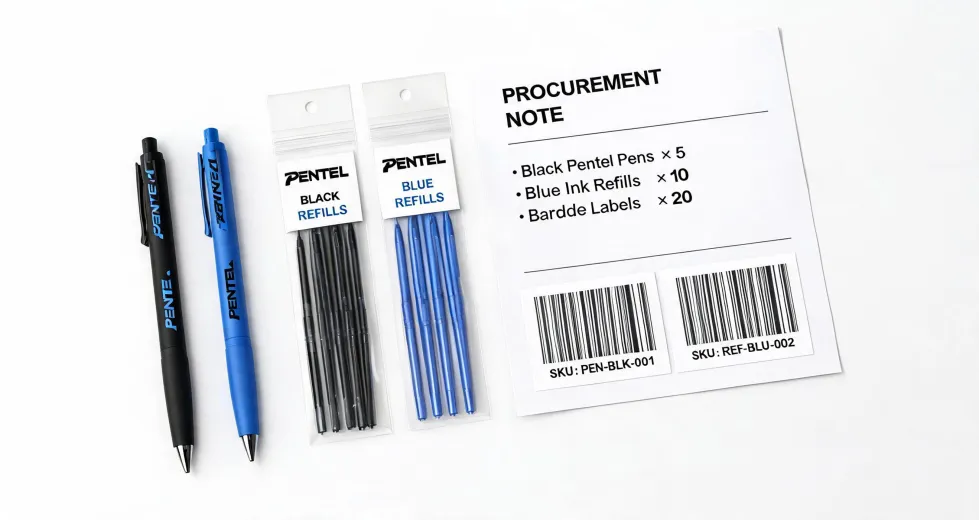
The initial complaint I heard from our finance team was straightforward: 'People are ordering the expensive pens again.' We had a preferred vendor list with a budget-friendly option—let's call it 'Vendor A'—that offered a generic ballpoint at $0.15 per unit. But our engineers and designers kept requesting Pentel Energel Pro pens, which are closer to $2.00 each. The procurement system flagged the cost difference immediately.
It seemed like a discipline problem. I almost implemented a policy to restrict ordering to the budget option. But I hesitated. Something felt off.
Had 2 hours to decide before the deadline for our quarterly restock. Normally I'd get multiple quotes and survey user satisfaction, but there was no time. I went with my gut and held off on the restriction, deciding to dig deeper first.
The Deeper Issue: What Does a Pen Really Cost?
Here's where it gets interesting. I started tracking not just the purchase price, but the entire lifecycle of a pen in our office.
The cheap ballpoint ($0.15):
- Average lifespan in use: 2-3 days (they get lost, discarded, or break).
- Re-order frequency: Every week. That's administrative overhead—someone has to process the order, stock the supply closet.
- User productivity cost: This is the killer. I estimated that each engineer spent roughly 15 minutes per week looking for a functional pen. That's $15 in lost hourly wage per person, per week. With 20 people, that's $300 a week in hidden salary cost.
The Pentel Energel Pro ($2.00):
- Average lifespan in use: 4-6 weeks (the metal clip and professional look makes people less likely to lose it. The refill lasts longer).
- Re-order frequency: Every other month. Less admin work.
- User productivity cost: Near zero. People kept their pens.
The math was sobering. The 'cheap' option actually cost us more in hidden costs—and this is before you factor in the frustration tax. I built a simple cost calculator after getting burned on this twice. The total cost for 50 employees: the cheap pen route was costing us nearly $4,000 annually in lost productivity alone. The Pentel route? About $1,200 in pens and refills. To some extent, it's not even close.
Oh, and I should add that we also had to deal with the occasional smudge issue with the cheap ballpoints—not a huge deal for general notes, but a serious problem for engineers marking up blueprints. The Energel Pro's liquid gel ink dries fast, reports of smudging dropped to zero.
In hindsight, I should have started tracking this data from day one. But with the pressure to hit budget targets, I did the best I could with the information I had.
The Cost of Getting It Wrong
You might be thinking, 'So you spent a bit more on pens—big deal.' But the real cost isn't just the pens. It's the behavior you're incentivizing:
- Distrust: When you force a cheap option on a team that prefers a quality tool, you signal that their needs don't matter. That's a morale cost, and it's very real.
- Inferior output: A smooth-writing pen that doesn't skip or smudge matters for people who write all day. Our designers' final drawings with the Energel RSVP looked noticeably cleaner than with the cheap alternatives.
- Replacement costs: Cheap pens get tossed. The $2 pen gets kept and refilled. The cost of the Pentel RSVP refill pack is a fraction of buying a whole new pen.
For our quarterly orders of around $1,000 in writing instruments, switching to Pentel as our primary brand increased the line item by about 40% initially. But when I compared quotes for that $4,200 annual contract, factoring in the hidden costs, the Pentel option saved us roughly 12% in real terms.
Per FTC guidelines (ftc.gov) on advertising, I need to be clear: I'm a procurement manager, not a brand ambassador. My job is to find the best total cost solution. In this case, the TCO analysis was clear.
The Solution (Short Version)
I didn't ban cheap pens. And I didn't make Pentel the only option. Instead, we did three things:
- Transparent pricing: For our inventory system, we now show the 'True Unit Cost'—the purchase price plus estimated admin and productivity overhead. The cheap pen suddenly looked like the expensive one.
- User choice with guardrails: Each department gets a budget for supplies. They can choose any pen within that budget. No one has complained about the cost of top-tier pens since we switched to this model.
- Refill-first policy: We now buy Pentel Energel Pro refills in bulk. The pens themselves are a one-time purchase. This cut our per-unit writing cost by over 50%.
I've learned to ask 'what's NOT included' before 'what's the price.' In procurement, the most expensive choice is often the one that looks cheap on paper. The vendor who lists all costs upfront—even if the total looks higher—usually costs less in the end.