You know that moment. It's 3 PM, your biggest client presentation is in four hours. You grab your favorite drafting pencil—the one with the perfect weight, the one you've used for every project for the last six months—and click the top. Nothing. The lead sleeve is empty. You open your drawer, and all you find are loose, unidentifiable graphite fragments from a dozen different brands. You start sweating. You start texting the office manager. You're now in the grip of what I call 'permanent marker strain'—not the kind from a Sharpie on a whiteboard, but the anxiety that comes from realizing your critical writing instrument is a dead stick.
In my role coordinating supply logistics for a mid-sized engineering firm, I've handled over 200 rush orders for stationery and writing instruments in the last four years. Based on our internal data from those rush jobs, basically every last-minute panic for a 'Pentel Energel LR7 refill' or a 'GraphGear 1000' from Staples has a deeper, more expensive root cause than just 'we ran out.'
The Surface Problem: The 'Empty Pen' Panic
On the surface, the problem is simple. You needed a specific pen, and you didn't have it. You run to the supply closet, find a box of cheap stick pens, and they skip, or they bleed, or they just feel wrong. So you head to the internet, searching for 'Pentel Energel LR7 refill' because the body of the pen is fine, you just need the ink source. But it's not in stock at the usual vendors. You end up paying $12 for expedited shipping on a $3 refill. The project gets done, but the cost and drama leave a bad taste.
This is the surface problem: the emergency procurement of a consumable. And it's a pain. But it's not the real problem.
The Deeper Reason: The 'One-Pen' Vulnerability
The real issue isn't that you ran out of ink. The real issue is that you built your entire workflow—your muscle memory, your precision, your creative confidence—around a single point of failure. You became dependent on one specific tool: a specific pentel mechanical pencil lead size (0.5mm, 0.7mm), a specific grip feel, a specific ink color. When that single point fails, your entire process stops.
I remember a case in March 2024, about 36 hours before a massive proposal submission. One of our lead designers had a meltdown because her preferred pentel brush pen ran out of ink. She had been using it for all her hand annotations. She couldn't work with anything else—the flow was wrong, the stroke weight was off. We had to scramble a courier to a specialty art store that had a single unit in stock. Total cost of that 'simple' refill? About $80 in logistics and lost productivity over two hours.
It's not just about liking a brand. It's about creating a vulnerability propped up by a fragile supply chain. We love pentel for its consistency, but that consistency can create a blind spot. We assume the refill will always be there. It's not.
The True Cost: The Hidden Math of the Panic Buy
Let's talk about the numbers. A single 'Pentel Energel LR7' refill retails for about $2.50. A standard pack of 12 is maybe $15. If you plan ahead, you pay retail. But the 'permanent marker strain' panic buy? Here's the actual cost breakdown from my experience with about 200 mid-range orders:
- The Direct Cost: Expedited shipping for a $3 refill. Average: $8–$15.
- The Labor Cost: Your time (or the office manager's time) searching, ordering, approving the rush. 20-30 minutes. For an office manager earning $25/hour, that's $10–$12.50.
- The Productivity Cost: The 30–60 minutes you spend without your preferred tool, trying to work with a substandard replacement. For a billable employee at $75/hour, that's $37.50–$75.00.
- The 'Net Loss': Saved $2.50 by not buying a backup refill. Lost $55+ to get one in an emergency.
The 'budget vendor' choice looked smart until we saw the quality difference on a critical print job last quarter. Reprinting cost more than the original 'expensive' quote for the right pen. The logic is identical.
The Solution: Building a 'Prevention Buffer' (It's Boring, It Works)
So here's the thing. I've never fully understood why we treat stationery like it's a one-time purchase. We implement multi-year IT asset management plans, but we run our pen supply like it's the Wild West.
The solution isn't sexy. It's a checklist. After my third 'dead pen' emergency in Q1 2023, I created a 12-point consumables audit. Seriously, a checklist is the cheapest insurance you can buy. The core of it is basically this:
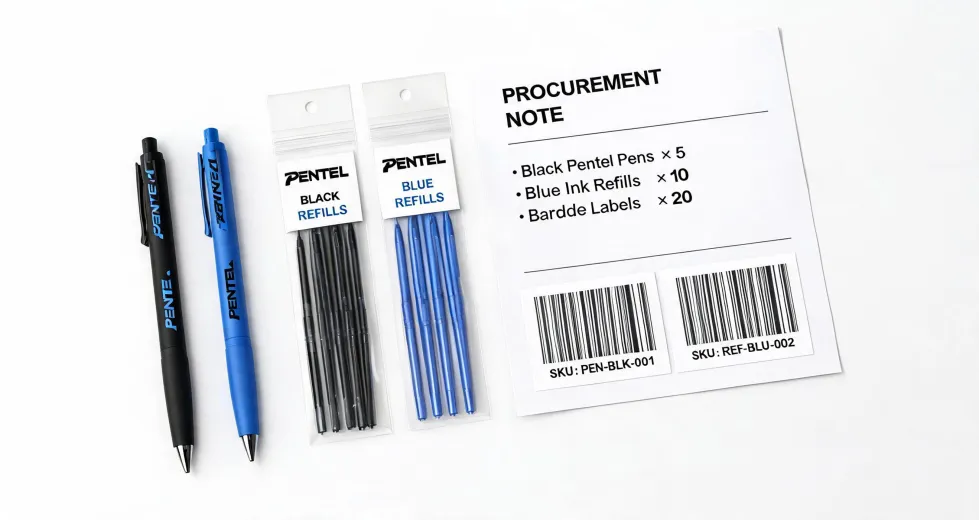
- Identify your weapon of choice. What specific pentel product is your team dependent on? Is it the GraphGear 1000? The Energel BL107? The Orenz? Name it.
- Calculate the burn rate. How long does one refill last your key users? Track it for one month.
- Buy a 2x buffer. For every two units in active use, have one unit in a 'reserve' drawer. Not a shared closet. A specific drawer. Labeled. Thought of the 'Twist-Erase' eraser refills? They run out too.
- Standardize (within reason). You don't want everyone using the same pen—people have preferences. But you can standardize the refill type for the company. If you know you're a 'pentel Energel' shop, you buy bulk LR7 refills. End of story.
My experience is based on about 200 mid-range orders for an engineering office. If you're working in a massive enterprise or a tiny solo practice, your experience might differ. But the math on the panic-buy premium is pretty universal.
Bottom line? 5 minutes of verifying your refill stock beats 5 hours of dealing with the consequences of a dead pen. That's not just a theory. It's a lesson I had to learn the hard way, one rush order at a time.