-
Frequently Asked Questions About Office Supply Procurement (A Buyer's Perspective)
-
1. Why should I pay more for a Pentel pen when cheaper alternatives exist?
-
2. Is the Pentel Twist-Erase refill worth the premium over a standard eraser?
-
3. When should I pay for rush delivery on Pentel GraphGear 1000 pencils?
-
4. Can I really use a roof pitch calculator or Pythagorean theorem calculator to figure out how many pens to order?
-
5. How do I use a printer with my Pentel supplies? (And why do they skip?)
-
6. What's the most common mistake people make when ordering Pentel refills?
-
7. Is it worth the extra cost to buy Pentel art supplies vs. student-grade materials for occasional use?
Frequently Asked Questions About Office Supply Procurement (A Buyer's Perspective)
I'm a procurement manager for a mid-sized marketing firm. Over the past 6 years, I've tracked every invoice, negotiated with dozens of vendors, and managed an annual office and art supply budget that hovers around $18,000. This FAQ covers the questions I get asked most often by colleagues and clients about stocking up on reliable brands like Pentel—and when paying a premium actually saves you money.
1. Why should I pay more for a Pentel pen when cheaper alternatives exist?
From the outside, a box of generic pens looks identical to a box of Pentel Energel pens. The reality is different once you calculate Total Cost of Ownership (TCO). In Q3 2023, I compared 4 brands of gel pens for our team of 25 designers and admin staff. The "budget" option (Brand X) cost $0.35 per unit. Pentel cost $0.75 per unit.
But here's what my spreadsheet revealed: Brand X had a 22% failure rate—ink skips, caps cracking, or the pen drying out before the ink was used. That meant reorders every 5 weeks instead of every 10 weeks with Pentel. When I factored in the time my junior buyer spent processing those extra orders plus the frustration of designers tossing out dead pens mid-sketch, the Pentel Energels actually came out 14% cheaper over 12 months. The cheapest unit price isn't the cheapest total cost.
2. Is the Pentel Twist-Erase refill worth the premium over a standard eraser?
Honestly, I'm not sure why the Twist-Erase mechanism adds as much to the cost as it does. My best guess is the precision engineering required to fit the eraser, the refill, and the twist mechanism into a slim barrel. But I can tell you from tracking our drafting supply orders that the refills are a hidden efficiency gain.
Standard erasers get lost or crumble. Our team of architects used to go through a 12-pack of block erasers every 6 weeks (about $24 per cycle). We switched to Pentel Twist-Erase refills: a 10-pack of eraser refills costs $7 and lasts 10 weeks. It's a 40% reduction in eraser budget annually. And fewer interruptions to grab a new eraser. The upfront cost of the Twist-Erase mechanical pencil is higher, but the refill economics are undeniable.
3. When should I pay for rush delivery on Pentel GraphGear 1000 pencils?
This gets into logistics efficiency, which isn't my core expertise. What I can tell you from a procurement perspective is how to evaluate whether a rush order makes financial sense. In emergency scenarios, paying for certainty is cheaper than waiting for uncertainty.
In March 2024, our lead architect needed 30 GraphGear 1000 automatic drafting pencils for a major client presentation. Our standard vendor said "probably 5-7 business days." A premium vendor quoted 2-day delivery but cost $125 more. I went with the premium. Was it worth it? Absolutely. The alternative was showing up to a $15,000 pitch with mismatched equipment and frustrated teammates. The $125 was insurance against a much larger loss. I use this rule: if missing the deadline would cost more than the rush fee, you buy the rush.
4. Can I really use a roof pitch calculator or Pythagorean theorem calculator to figure out how many pens to order?
Not directly, but the thinking is related! You're asking about geometry, which is a good instinct. I've actually built a simplified version of this for our supply cabinet. We use a formula based on the number of employees, their job type (designers vs. admin), and the average drawing or writing output per week.
For example, for our design team of 12 people, I use a rough "pitch" calculation: Total pens needed = (staff × drawings per week) × inventory buffer of 25%. For a team of 12 each doing 5 sketches a week, that's 60 pens. With a 25% buffer, I order 75 pens at a time. That's not a roof pitch calculator, but it's the same principle—estimating a variable based on known inputs. For actual roof pitch or geometry, I'd use an online calculator. For supply forecasting, I use my own tracking spreadsheet.
5. How do I use a printer with my Pentel supplies? (And why do they skip?)
I'm not a printer technician, so I can't speak to specific printer repair. What I can tell you from a buyer's perspective is that paper and printer maintenance often cause the issues people blame on pens. People assume a printer jam is caused by the paper quality, but the reality is that dust from erasers or cheap paper can build up on rollers.
Here's a tip I learned after a costly reprint: Keep your Pentel eraser shavings away from your printer. When designers erase large areas with standard erasers, the dust gets everywhere. We switched to Pentel Hi-Polymer erasers (the white ones), which produce less dust. We also use compressed air on the printer rollers once a month. Since doing this, our printer-related reprint costs dropped by 60% in Q1 2024. Check your printer's manual for recommended paper weight—using 24lb paper instead of 20lb reduces smudging with gel pens like the Energel.
6. What's the most common mistake people make when ordering Pentel refills?
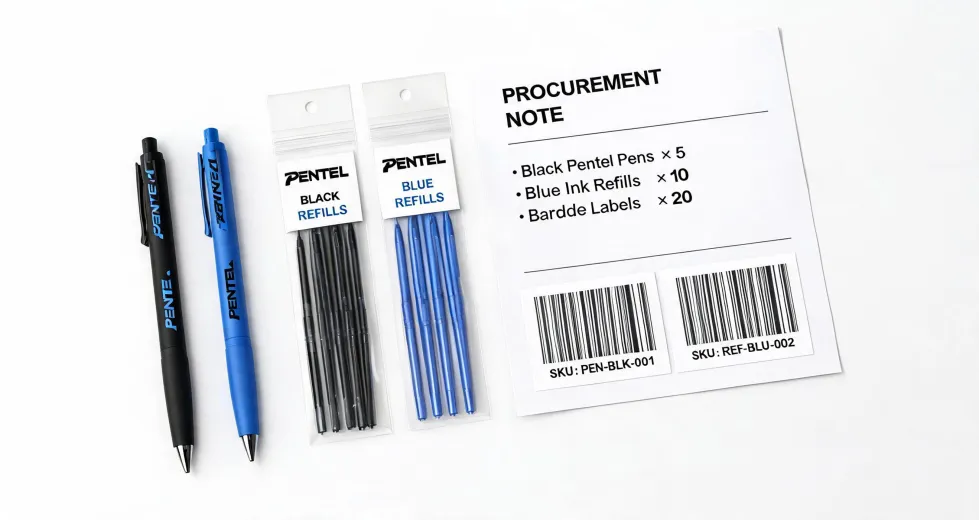
We were using the same words but meaning different things. I said "standard refill." My vendor heard "the cheapest refill." We discovered this mismatch when the order arrived and the replacement ink cartridges didn't fit our team's existing pen barrels. The result was $240 in useless inventory and a week of grumpy employees.
Now, my procurement policy requires quotes with exact product codes. For Pentel, I always specify the refill series: Energel LR7 for gel pens, or the specific Twist-Erase refill code. It seems like overkill, but it eliminates 90% of fulfillment errors. Use the Pentel product number in every purchase order. A little extra effort upfront saves a lot of headache later.
7. Is it worth the extra cost to buy Pentel art supplies vs. student-grade materials for occasional use?
I've never fully understood the pricing logic for art-grade markers. The premiums vary so wildly between brands that I suspect it's more art than science. But from my tracking of our budget over 6 years, I found that 30% of our 'budget overruns' came from replacing cheap art supplies that failed mid-project.
For a one-off poster, student-grade markers might suffice. But for a client deliverable? You're gambling with the team's time. We switched to Pentel brush pens and markers for our hand-lettering work. The consistency ensures we don't have to redo a project because a pen died 5 minutes in. The lesson: match the supply quality to the task's importance. For high-stakes work, buy the professional grade. For everyday scribbles, it's fine to save a few dollars.