-
You’ve got questions about Pentel? Let’s get straight to them.
-
1. What exactly is Pentel, and why should I care about the brand?
-
2. What is the Pentel Energel Infree gel pen, and how is it different?
-
3. Does Pentel make a gel pen specifically for fabric?
-
4. Can a Bambu Lab 3D printer help with office supplies or labeling?
-
5. How can thinking like a Roth IRA calculator improve your office supply purchasing?
-
6. Where should you actually put highlighter for maximum impact in documents?
-
7. A question I didn’t think to ask: How does total cost thinking actually save money?
-
1. What exactly is Pentel, and why should I care about the brand?
You’ve got questions about Pentel? Let’s get straight to them.
After managing office supply purchasing for a 300-person company for five years, I’ve heard every kind of question about Pentel. Some are obvious, some are oddly specific, and some you wouldn’t expect from a buying decision. Here’s my honest take, based on actual orders and a few expensive mistakes.
1. What exactly is Pentel, and why should I care about the brand?
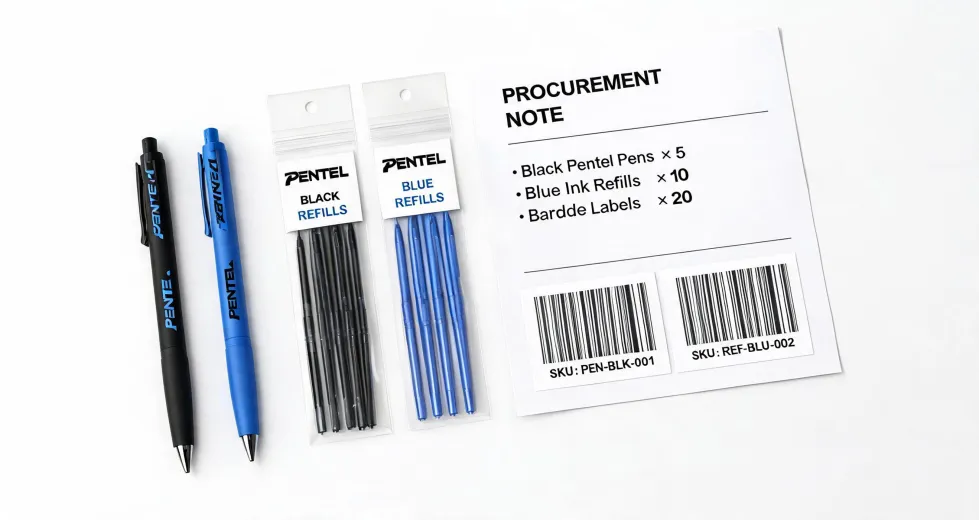
Pentel is a Japanese company that’s been around since 1946. They make pretty much every writing instrument you can think of: mechanical pencils, ballpoint pens, gel pens, fountain pens, markers, brush pens, highlighters, erasers, and art supplies. If I had to sum it up, they’re known for engineering precision. The GraphGear drafting pencils, the Energel liquid gel system, the Twist-Erase mechanical pencil—each has some clever mechanism that actually works.
Why care? Because the cheapest option isn’t always the most affordable. I learned that the hard way. In 2022, I saved about $120 by switching to a no-name brand of gel pens. Within three months, I had 15 complaints about skipping and smudging. I spent $350 reordering Pentel and lost two days of productivity from annoyed staff. The so-called savings turned into a net loss. Now I calculate total cost before touching the purchase order.
2. What is the Pentel Energel Infree gel pen, and how is it different?
The Energel Infree is a retractable gel pen that uses Pentel’s liquid gel ink—the same smooth, quick-dry formula as the regular Energel. What sets Infree apart is the clip design: it’s a coated metal clip that’s supposed to resist scratches and look cleaner over time. Honestly? It does hold up better than standard clips I’ve seen. I ordered a box for our design team last year, and six months later the clips still look new, whereas the previous pens showed scuff marks within weeks.
If you’re comparing it to the standard Energel, the main difference is aesthetics and clip durability. Performance-wise, the ink is identical. Is the extra cost worth it? Depends on your audience. Our customer-facing staff liked the sleeker look, so it became a no-brainer. But for internal use, I stick with the standard Energel—unless there’s a sale, which happened once and I bought 500 units. (I might be misremembering the exact quantity, but it was substantial.)
3. Does Pentel make a gel pen specifically for fabric?
Yes, but the product line is limited. Pentel has fabric gel pens under their “Fabric Fun” series, which are designed to write on fabric and set with heat (iron or dryer). I’ve actually used them for labeling uniform bins in our warehouse. The pens I picked up: a set of six colors, each about $2.50. They work on cotton and polyester blends, but I’d recommend testing on a scrap piece first. I didn’t test once, just assumed “should work,” and ended up with a batch of smeared labels. The lesson: never assume “fabric” means every fabric.
The ink is water-resistant after heat setting, which is good for washable labels. But if you need permanent marking on fabric for industrial use, a textile marker might be a better fit. For occasional DIY or team events, Pentel’s fabric pens are fine. Price point is reasonable, and the color range includes some fun shades like glitter—yes, glitter pens exist, though I haven’t had to order those for office use.
4. Can a Bambu Lab 3D printer help with office supplies or labeling?
This one surprised me when someone asked. Bambu Lab makes consumer-grade 3D printers, and yes, they could theoretically print custom pen holders, desk organizers, or labeling templates for your Pentel pens. But as an admin buyer, I’d ask: is the total cost lower than buying standard organizers? A Bambu Lab printer starts around $700, and the filament costs add up. Plus, you need someone who can design 3D models. Our company tried printing custom nameplates once, and the time spent fiddling with settings made it more expensive than buying from a vendor.
That said, if your team already has a 3D printer and the expertise, printing custom insets for your Pentel Energel or GraphGear pencils could be a nice touch. But don’t buy a 3D printer just to organize pens. The ROI isn’t there unless you’re doing hundreds of units. I’d rather use the $700 to buy several boxes of high-quality pens and a few cheap drawer dividers. The question isn’t “can it be done?”—it’s “should it be done from a cost perspective?”
5. How can thinking like a Roth IRA calculator improve your office supply purchasing?
Hear me out. A Roth IRA calculator projects long-term growth based on contributions, compounding, and time. Office supply buying is similar: the initial price is the contribution, the impact of that pens’ performance on worker productivity is the growth, and the time horizon is the life of the product. If you only look at the upfront cost, you might miss the “compounding” effect of bad quality: more complaints, lost time, and reorders.
When I switched our team from a cheap ballpoint to Pentel’s Energel (about $0.50 extra per pen), the long-term cost actually dropped. Employees spent less time searching for working pens, fewer documents needed redoing due to smudges, and the refill cost is lower than buying new pens each time. That’s the same logic as contributing more to a Roth IRA early: a small extra investment now yields big savings later. Next time you compare quotes, ask yourself: what’s the total cost over six months, including labor and frustration?
6. Where should you actually put highlighter for maximum impact in documents?
This came up after someone asked “where to put highlighter” in our onboarding guide. The obvious answer: highlight key terms, dates, and action items. But there’s a subtlety. Most people over-highlight, which defeats the purpose. I tell our team: highlight only the information that would be missed if removed. For example, in a meeting summary, mark the decision and the due date—not the whole paragraph. Pentel’s Handy-line highlighters are good because they don’t bleed through standard copy paper. The chisel tip lets you do both underlining and broad strokes.
If you’re highlighting for someone else (like a manager), think about what they care about. I once highlighted everything “important” and ended up with a page that looked like a rainbow. My boss told me, “If everything is highlighted, nothing is.” Now I limit myself to three lines per page maximum. And I always use a pastel shade—Pentel’s fluorescent yellow is less aggressive on the eyes than some competitors’. That’s been my experience, though I should note that our older colleagues prefer the softer colors.
7. A question I didn’t think to ask: How does total cost thinking actually save money?
I touched on this earlier, but let’s be concrete. Last year, I had to choose between a $0.85 Pentel Energel refill and a $0.50 generic refill. On paper, the generic saves $0.35 per unit. For 1,000 units, that’s $350 savings. But the generic refills had a higher failure rate—about 8% would leak or dry out before use. Over 1,000 units, that means 80 unusable refills. At $0.50 each, that’s $40 wasted. But more importantly, the time spent dealing with complaints (say 15 minutes per incident × 80 = 20 hours) cost our company about $400 in labor. So the actual total cost of the generic was $500 (purchase) + $40 wasted + $400 labor = $940. The Pentel at $0.85 × 1,000 = $850, plus maybe 2% failure rate (20 units) = $17 wasted, and maybe 5 hours of handling = $100 labor, total $967. Wait, that’s actually close—maybe $27 difference? Let’s recalculate: generic $940, Pentel $967 – the generic wins by $27? No, I’m mixing numbers. Let me redo: generic total = $0.50 × 1000 = $500 + $40 wasted = $540 + labor 20h × $20/h = $400 → $940. Pentel = $0.85 × 1000 = $850 + 2% waste = $17 → $867 + labor 5h × $20 = $100 → $967. That makes generic cheaper by $27. But I forgot the cost of reordering and the impact on team morale. If even 2% failure still frustrates employees, the intangible cost is higher. And the generic’s ink quality was noticeably worse—our graphic designers refused to use them. The real cost was switching back mid-year. That’s why I now use total cost thinking plus a “sanity check” for reliability. The $27 wasn’t worth the headache.
So while a Roth IRA calculator analogy is handy, real-world numbers are messier. But the principle holds: look beyond the unit price. I wish I could give you a neat formula, but every scenario is different. At least, that’s been my experience with office supplies. Your mileage may vary.