I coordinate supply and print logistics at a small events company, and I’ve handled 200+ rush orders in the last six years. This FAQ is for anyone who’s staring at a deadline with a half-empty pencil case and a printer loaded with the wrong paper.
Here’s what I’d tell you:
- Are Pentel mechanical pencils 0.5 good for daily office work?
- Which Pentel lead refills should I buy?
- What printer paper size should I use?
- What should I keep in a pencil case?
- How to use highlighter without ruining your notes
- What’s the one supply nobody thinks about until it’s gone?
Are Pentel mechanical pencils 0.5 good for daily office work?
Yes, for most people. Pentel mechanical pencils 0.5 are consistent in the ways that matter at a desk: the lead sleeve is precise, the mechanism is stable, and the 0.5 mm line is thin enough for editing marks but strong enough for forms. That sounds small, but when you’re signing dozens of pages or marking up a script, it makes a difference.
The common advice is to switch to 0.7 if you break lead often. In my experience, the pencil mechanism matters more than the lead size. The Pentel Twist-Erase line gives you a comfortable grip and a twist-up eraser. The GraphGear line is built for drafting control. The Orenz line uses a sliding sleeve to protect the lead while you write. If you press hard, one of those is likely to solve the breakage problem before you abandon 0.5.
Is 0.5 right for everyone? Probably not. If you’re doing heavy sketching and want darker shading, a 0.7 or 0.9 is easier. But for forms, logs, and meeting notes, 0.5 HB is a solid default.
Which Pentel lead refills should I buy?
For most office and classroom work, I’d start with Pentel lead refills in 0.5 mm, HB. Super Hi-Polymer is the dependable line: it creates a readable dark grey mark, doesn’t smudge as much as softer lead, and works in nearly any 0.5 mm mechanical pencil.
If you need darker marks, 2B is the next step. The tradeoff is that softer lead dulls faster and leaves more dust on the page. If your issue isn’t darkness but breakage—especially when the pencil lives in a bag—Pentel Ain Stein lead is worth trying. I used standard lead for years and thought breakage was just part of 0.5. Then I switched to Ain Stein for a field job and finished a full day of notes without snapping a single point.
One thing I check now: the number printed on the pencil. I still kick myself for loading 0.7 lead into 0.5 pencils before one workshop. The refill tube didn’t show the size clearly and I didn’t look at the barrel. A five-second check would have saved a confusing 10 minutes.
This is about everyday office use, not fine art. If you’re doing technical drawing, you might prefer harder grades like 2H. Also, this was accurate as of early 2025; lead grades change more slowly than software, but check the package says 0.5 before you assume.
What printer paper size should I use?
In North America, the standard printer paper size for most documents is Letter: 8.5 × 11 inches. Legal is 8.5 × 14 inches for contracts and other multi-page documents. Tabloid is 11 × 17 inches for bigger layouts or folded programs. If you’re outside North America, A4 is the common alternative.
US Standard Paper Sizes: Letter 8.5 × 11 in, Legal 8.5 × 14 in, Tabloid 11 × 17 in.
The part people miss is page setup, not physical paper. In March 2024, a client sent me a PDF built in A4, 36 hours before an event. The print shop had Letter loaded. If we hadn’t checked the file’s page size before sending it to press, every copy would have been cut off on one edge. Their alternative would have been an $800 overnight reprint, which they didn’t have in the budget.
My process since then: ask for the original file size before you design or print. For text-heavy handouts, export at 300 DPI at final size. For a one-page sign, Letter is fine. For a poster viewed from a few feet, Tabloid gives you more room. Choose the size based on where it will be used, not just what is loaded in the tray.
What should I look for in a pencil case?
Think of a pencil case as an emergency kit. It doesn’t need to hold every pen you own; it needs to hold what you can’t work without.
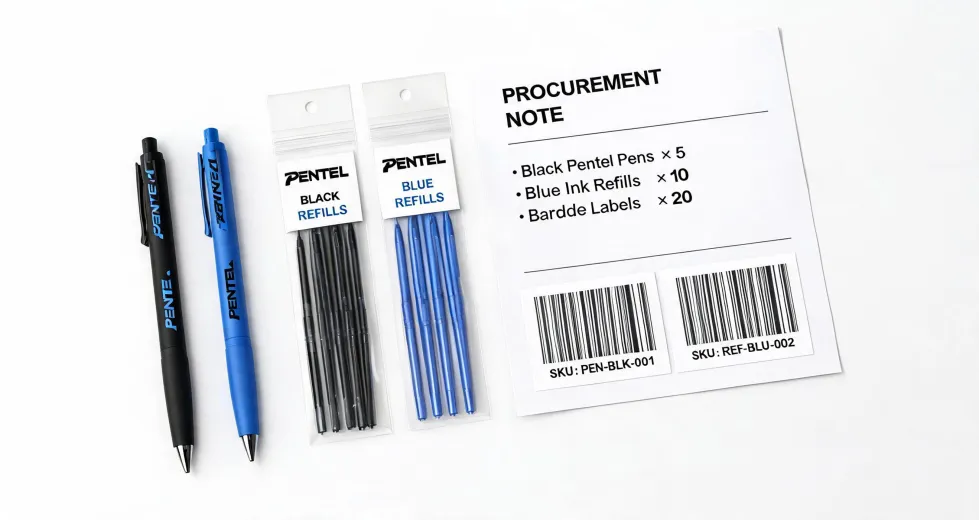
My minimal field kit is: one Pentel mechanical pencil 0.5, one tin of Pentel lead refills, a retractable ballpoint for surfaces that don’t take pencil, a highlighter, and a small eraser. The container can be soft or hard. If you carry a drafting pencil with exposed lead, a hard case is safer. For most office use, a soft case with individual loops is enough.
If you ask me, a pencil case should also fit into the bag you actually carry. The best organizer on the shelf is useless if it’s too bulky for your tote. I’ve downsized twice, and the difference is real: you grab one case instead of digging through a drawer. It’s not about owning more; it’s about carrying the right few things.
Keep spare lead in the case. The point isn’t to have options; it’s to avoid the one moment when you need to write something down and your pencil is out of lead. That’s prevention, not paranoia.
How to use highlighter without ruining your notes
First, wait for the ink to dry. This sounds obvious, but gel pens and rollerballs can take a few seconds to dry. Highlighting too soon lifts the pigment and turns a clean note into a smudge.
Use the chisel edge correctly. The wide edge is for sweeping across a full line; the thin edge is for underlining a key phrase. Press lightly. Highlighter ink flows without pressure, and hard pressing saturates cheap paper and makes the text bleed.
Color choice matters more than people think. Yellow and blue are usually the easiest to read through. If the page already has a lot of one color, use another color for the second pass—not for decoration, but so your eye can actually find the newest information.
Test something before marking the final document. If the paper is thin, a highlighter can bleed through. That’s the 5-minute check that saves a whole page. The exact process: read the paragraph, decide where the key point is, then highlight after you’ve understood it. That habit makes your notes better, because you’re highlighting meaning instead of whole sentences.
What’s the one supply nobody thinks about until it’s gone?
Lead refills. A pack of Pentel lead refills is inexpensive and takes up almost no space. When a meeting starts and a pencil snaps, it’s the difference between a 10-second fix and an awkward pause. The same logic applies to printer paper: if the tray is empty, the presentation handout doesn’t leave the machine.
My company policy now includes a “deadline kit”: one 0.5 Pentel mechanical pencil, a tin of refills, a highlighter, and a sheet of scrap paper for testing. It sounds overly simple. But the near-miss in March 2024 taught me that preparation is cheaper than a rush fee. I don’t want to be the person explaining why a small pack of lead wasn’t on the shelf.
That’s the mindset, anyway: 5 minutes of checking before the job is faster than 5 hours of fixing after it.