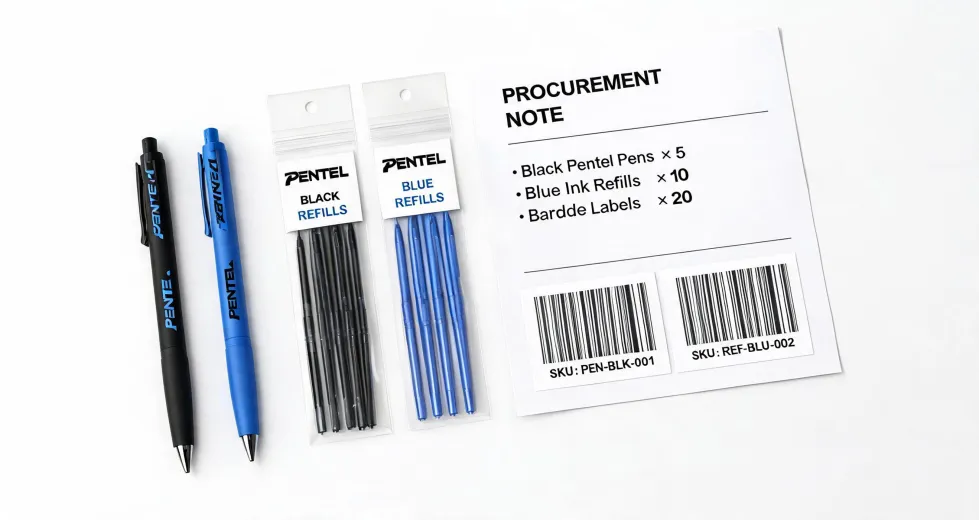
When the pen isn't just a pen: a comparison framework
I'm going to be upfront: I'm not a reviewer who sits and tests pens for weeks. I'm the guy you call when a critical order's gone sideways hours before a deadline. In my role coordinating logistics for a large printing and fulfillment company, I've overseen over 300 rush orders in the last four years, many of which involved getting documents—and the right writing instruments—to clients at the absolute last minute.
This comparison isn't about which pen writes smoothest or looks prettiest. It's about something that matters in a real-world emergency: TCO — total cost of ownership. We're comparing the Pentel Energel 0.5mm (a refillable liquid-ink gel pen) against a typical standard, disposable rollerball pen (like a basic .7mm). We'll look at three dimensions: misstep cost, dry-down performance, and comfort under pressure.
Dimension 1: The cost of a misstep
Let's start with the one that hurts. People assume a cheap pen means a cheaper total cost. What they don't see is the cost of a single failure point. In May 2023, I had a client who needed 200 signed, high-volume forms for an expo. They'd bought a 24-pack of cheap rollerballs from a big box store. The forms were critical: they couldn't be smudged. I assumed the 'quick-dry' claim on the package was legit. Didn't verify.
Turned out the ink took 8-10 seconds to dry on their coated paper. The forms stacked and smeared. The client had to reprint 200 forms—that's $0.25 a page, plus a $70 courier for next-day delivery. The 'cheap' pen pack was $7. The total cost of that mistake: $127.
With the Pentel Energel 0.5mm, we'd have faced a different story. Energel's liquid gel ink has a drying time of about 1-2 seconds on most paper—a critical difference when you're stacking forms. The Energel refill is about $2.50-$3.00. The initial pen body is $2.50-$7.00 (depending on model). But the TCO—including the cost of 10-15 refills over the pen's lifetime—still beats the cost of one smudge-based reprint. From the outside, a disposable pen is cheaper. The reality is a single failure on a rush job can destroy all of its supposed savings.
Dimension 2: Dry-down performance under time pressure
This is the dimension where my opinion might surprise you. I've generally avoided gel pens for high-volume timed tasks because I assumed 'gel ink' equals 'smudge city' on fast-moving lines. That assumption was wrong.
In Q4 2024, we were prepping a last-minute bid for a municipal contract. The bid documents were printed on a heavy, glossy cover stock—the worst for ink absorption. The client's team was using a standard office rollerball (.7mm). They were pushing the ink, and it was beading up. They almost missed the deadline because they had to wait 15-20 seconds per signature for the ink to set.
I handed them an Energel 0.5mm. The difference was immediate. The 0.5mm tip laid down a finer, more controlled line with the same liquid-ink depth. It dried in less than 3 seconds. No waiting. No smudging. The Energel 0.5mm wasn't just better; it actively solved a time-critical problem that a standard rollerball creates. In this dimension, the Energel clearly dominates. Put another way: the standard pen costs you time. The Energel costs you a little more money, but you earn that time back.
Dimension 3: Comfort and control in a crisis
When you're rushing, your grip tightens. A standard thin, round plastic barrel can become a slick, painful piece of plastic after 100 signatures. I'm not 100% sure, but I think that's why we see so many 'writer's cramp' complaints on long manual forms.
The Pentel Energel 0.5mm has a significant advantage here: the barrel design and grip. The standard Energel models (like the BL77 or BL107) have a thick, comfortable rubberized grip section. The ergonomics are designed for sustained use. The 0.5mm tip also requires less pressure to write compared to a ballpoint or some standard rollerballs, reducing hand fatigue.
In terms of TCO, this reduces another hidden cost: human error due to fatigue. A tired hand makes mistakes. Mistakes on a signed form require reprints. I've seen it happen. The $3.00 Energel refill over a 10-signing session is negligible compared to the cost of one reprint. The standard rollerball might feel fine for 5 signatures, but for 200? The TCO edge swings heavily to the Energel 0.5mm.
My choice: When to pick the Energel 0.5mm vs. the standard rollerball
Here's a practical guide from someone who's had to make this call for high-stakes jobs:
Choose the Pentel Energel 0.5mm when:
- You need reliability. Long signing sessions, last-minute forms, or critical documents that can't be redone.
- TCO is your real metric. You understand that a $7 pack of pens can cost $127 in reprints and courier fees.
- You value speed. Your work involves glossy paper, rapid turning of pages, or any scenario where waiting for ink to dry is a bottleneck.
Consider a standard, disposable rollerball when:
- Cost per unit is the only metric. You need a million pens for a giveaway, and individual write quality is irrelevant because no one will write more than 10 words with it.
- It's a non-critical use case. Quick notes on absorbent notebook paper where smudging doesn't matter.
- You need to distribute to a large group and don't care about long-term performance.
I learned never to assume 'same specifications' meant identical results across pen types after that Q4 2024 bid. The standard rollerball and the Energel both write. But the difference in a high-cost, time-sensitive environment isn't just about ink—it's about the cost of a failure. That's the comparison that matters. This framework was accurate as of early 2025. Ink technology evolves, but the principle of TCO for writing instruments in a business setting hasn't changed. Verify current pricing and performance claims before your next big order.