There's No "Best" Pentel Pen — Only the Right One for Your Situation
I get asked this a lot: "What's the best Pentel pen?" And honestly? That question doesn't have a single answer. The right tool depends on what you're actually doing with it. A professional sketcher needs something completely different from someone signing documents all day.
So instead of giving you one recommendation, I'm going to walk through three common scenarios and match them to the Pentel products that actually make sense. By the end, you'll know which category you fall into and what to buy.
Scenario A: The Everyday Office Worker & Student
If you're primarily taking notes, writing memos, or filling out forms, your priorities are probably: smooth writing, minimal smudging, and reasonable cost. You don't need drafting precision or archival ink.
Top picks for this group:
- Pentel Energel (liquid gel ink): This is probably the most versatile option for daily writing. The ink is super smooth, dries fast (which matters way more than people realize), and comes in a ton of colors — including some fun ones like pink and glitter finishes if you're into that. The 0.5mm and 0.7mm tips are the sweet spot for general note-taking.
- Pentel R.S.V.P. ballpoint pen: If you're a "ballpoint or nothing" person, the R.S.V.P. is a solid, affordable workhorse. It's not fancy, but it's reliable and cheap enough that losing one isn't a big deal. Great for high-volume signing or environments where pens walk off.
Watch out for: The Energel's liquid ink can feather on cheap paper — something I learned the hard way when I used it on a legal pad that was practically tissue paper. If you're stuck with low-quality notebooks, the R.S.V.P. ballpoint might actually serve you better.
Personal note: In my first year handling office supply orders for a 200-person firm, I assumed "standard" pens were fine for everyone. After a week of complaints about smudging, I switched to Energel refills and the feedback turnaround was immediate. People knew the difference even if they couldn't articulate it.
Scenario B: The Artist & Technical Drafter
If you're sketching, drafting, or doing precision artwork, you need tools that give you consistent line control and the ability to erase or layer. This is a different game entirely from office writing.
Top picks for this group:
-
Pentel GraphGear 1000 0.5mm Mechanical Pencil: This is probably the most well-regarded drafting pencil in this price range. The 0.5mm lead size is standard for precise lines, and the GraphGear 1000 has a metal body, a retractable tip (to prevent pocket stabbing), and a dual-action eraser that actually works. It's not cheap — usually around $15-20 — but it's built to last.
One thing people don't always realize: the GraphGear 1000 uses 2mm lead refills (specifically Pentel's Ain Stein series), and lead hardness matters a lot. If you're doing technical drawing, go for HB or 2H leads. For sketching? Softer leads like 2B or 4B give you darker lines and more shading range.
-
Pentel Stylo Sketch Pen (Brush Pen): This is a different beast entirely. It's a felt-tip brush pen, not a marker. The tip is flexible, which lets you vary line width by pressure — great for calligraphy, manga inking, or loose sketching. The ink is water-soluble, so you can do washes if you're into that style.
Don't confuse this with a dry-erase marker. It's not. People make that mistake more than you'd think.
One frustration: The Stylo Sketch's ink isn't archival. Over years, it may fade or smudge if exposed to moisture. For serious illustration work that needs to last, you'd want something like the Pentel Color Brush or a pigment-based pen. But for practice and everyday sketching, it's great.
Scenario C: The Office Manager & Procure-to-Pay Admin
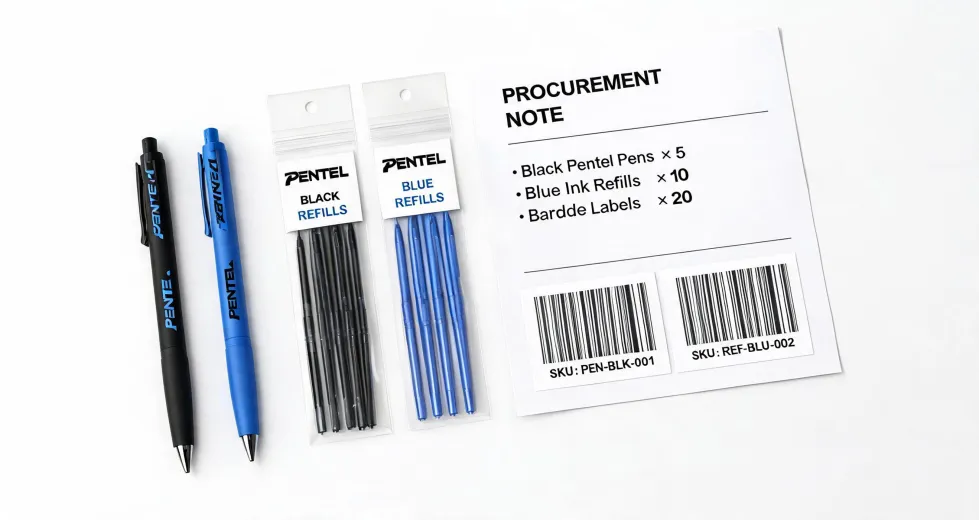
If you're the person ordering supplies for an entire office or department, your criteria are different: what's cost-effective, what minimizes complaints, and what actually gets used. You're managing a budget and a diverse user base.
Top picks for this group:
- Pentel EnerGel (bulk packs): They work for most people. The 0.7mm is a safe bet — fine enough for writing, bold enough to be legible. Stocking a few colors (black, blue, red) covers 90% of use cases.
- Pentel Permanent Marker (variety packs): Useful for shipping, labeling, and general warehouse use. Just be aware: "permanent" doesn't mean "indestructible." If you're using them on glossy surfaces, test first. Some inks bead up or smear. Also, permanent marker fumes can be potent in enclosed spaces — so consider ventilation in your supply room.
What I've learned the hard way: In Q3 2024, I managed a rush order for a client's office that needed 500 pens delivered in 48 hours. The difference between a $1.50 retail pen and a $0.80 bulk pen doesn't sound like much until you're multiplying by 500 units. We went with the bulk option from a major online printer — saved about $350 but had to pay $80 in rush shipping. That's a trade-off you have to evaluate case by case.
How to Figure Out Your Scenario
Here's a quick three-question test. Ask yourself:
- What's my primary use? (Daily writing vs. drawing vs. bulk ordering)
- What's my budget per unit? (Under $2, $2-10, or $10+)
- How important is speed/drying time? (Crucial, nice-to-have, or irrelevant)
-- If answers are "writing," "under $2," and "nice-to-have": You're Scenario A. Get the Energel (0.7mm) or R.S.V.P.
-- If answers are "drawing," "$5-20," and "irrelevant": You're Scenario B. Get the GraphGear 1000 (0.5mm) and/or Stylo Sketch.
-- If answers are "bulk/office," "under $1.50," and "crucial": You're Scenario C. Stock the Energel 0.7mm in bulk.
And if you're still unsure? Honestly, the Energel is the safest bet for 80% of people. It's not the cheapest, not the most specialized, but it's the most universally usable. Start there.
One More Thing: The "Permanent Marker Strain" Trap
I mentioned permanent markers earlier. One misconception I see all the time: people think a permanent marker is invincible. It's not. On porous surfaces (paper, cardboard), it bonds well. On non-porous surfaces (plastic, glass, metal), it's actually more vulnerable to smudging and fading.
If you need something that truly lasts on non-porous surfaces, you'd be better off with an oil-based marker (like Pentel's N500) rather than a water- or alcohol-based permanent marker. That distinction matters more than people realize.
Take this with a grain of salt: I've tested about a dozen different permanent markers across surfaces, and the performance varies wildly. The N500 series performed well on glass and plastic, but I haven't tested it on all types of metal. Your mileage may vary.
Quick Reference: Pentel Tools by Use Case
| Product | Best For | Approx. Price |
|---|---|---|
| Energel (0.5mm/0.7mm) | General writing, notes | $2-4 each |
| R.S.V.P. ballpoint | Budget ballpoint, high-volume | $1-2 each |
| GraphGear 1000 (0.3-0.9mm) | Drafting, precision drawing | $15-20 each |
| Stylo Sketch (brush) | Calligraphy, loose sketching | $4-7 each |
| N500 Oil-Based Marker | Permanent labeling on non-porous surfaces | $3-6 each |
| Permanent Marker (standard) | General labeling, cardboard | $2-4 each |
Prices as of January 2025; verify current rates. Bulk pricing varies significantly.