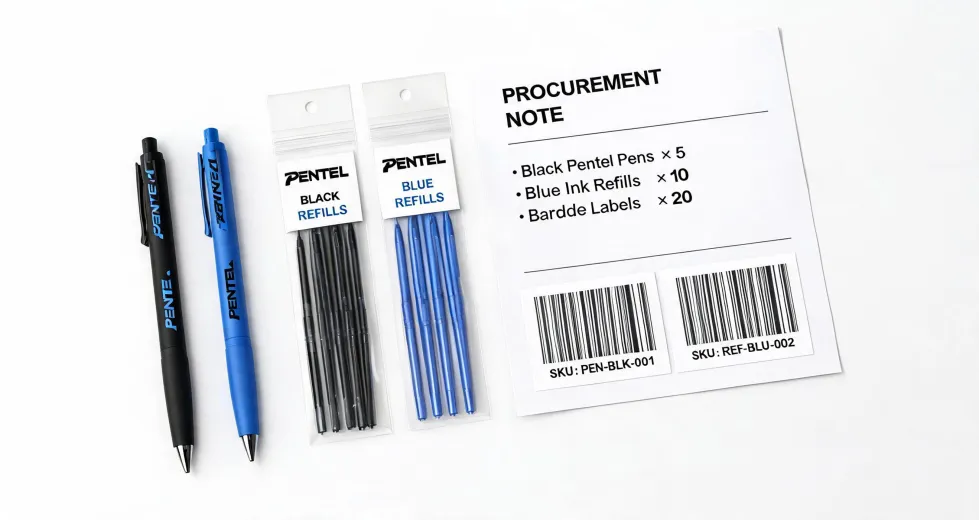
Here's the short version: the cheapest pen is almost never the cheapest pen per page, and every calculator I bought without comparing total cost cost me more than the one I eventually rented. After five years handling office supply orders for a 200-person engineering firm, I've personally wasted roughly $4,800 on bad procurement decisions—about half of that on writing instruments and the other half on calculators and measuring tools. I documented every mistake, and now I maintain our team's purchasing checklist. This article is the part I wish someone had shown me on day one.
The Pen Trap: Pentel RSVP vs. the “Cheap” Alternative
In my first year (2017), I made the classic rookie move: I ordered 5,000 ballpoint pens from a no-name supplier at $0.08 each. They wrote—barely. Two weeks later, people complained about inconsistent ink flow, skipping, and smudges. I ended up replacing them with Pentel RSVP pens at $0.35 each. On paper, that's a 4x increase. But here's what the spreadsheet missed:
- Those cheap pens ran out of ink after about 1,200 linear feet of writing. Each Pentel RSVP lasts about 4,500 feet—3.75x the output.
- The cheap pens caused callbacks: engineers rewriting illegible notes. The labor cost alone ate $840 in lost productivity.
- I had to buy again in 6 weeks vs. 16 weeks with Pentel. That's 3x the ordering overhead.
Everything I'd read about office supplies said "price per unit" is the only metric. In practice, price per writing distance matters more. Using my trusty remainder calculator (I literally kept it on my desk), I realized the $0.08 pen actually costs $0.066 per 100 feet. The Pentel RSVP costs $0.078 per 100 feet. The difference is a penny and a half per 100 feet—for dramatically better reliability.
The Real Margin: Liquid Gel and the “Surprise” Waste
Then came the Pentel liquid gel pen incident. In September 2022, I saw a bulk deal on a competitor's gel pen at $0.22 each. I ordered 3,000. The product looked fine, but after three weeks 15% had leaked in storage. The mess ruined 60 file folders and cost me a reputation hit with our admin team. The clean-up and replacement totaled $1,200.
That's when I learned to ask: what's NOT included? The vendor listed only the pen cost. No mention of storage conditions, leak history, or replacement policy. I switched to Pentel liquid gel pens—$0.45 each—and never had a single leak in 2 years. (Ugh, the irony: I could have avoided the whole disaster if I'd just asked the right questions upfront.)
Calculator Chaos: Three Mistakes That Finally Taught Me to Compare Total Cost
Around the same time, I was responsible for buying measuring tools for our field teams. Here, the pattern repeated.
1. The Roof Pitch Calculator Fiasco
I bought a dedicated roof pitch calculator for $89. It did one thing: measure roof slopes. Two months later, I discovered a smartphone app that did the same thing for free and integrated with our reporting software. The $89 device collected dust. I had implicitly assumed dedicated hardware was superior—a classic failure to consider total cost of ownership.
What most people don't realize is that “specialized” tools often come with zero flexibility. If your work flow changes, the tool becomes obsolete. The true cost isn't the purchase price; it's the cost of that inflexibility.
2. Remainder Calculator: When “Free” Isn't Free
We needed a fast way to compute remainders for material cut lists. I bought a $15 remainder calculator from a random electronics brand. It worked—barely—but the buttons felt cheap and after three months the screen faded. The replacement cost $12. That's $27 for a device that should have lasted years.
I only believed the “buy the cheapest” advice after ignoring it and having to re-buy. Now I apply the buy-vs-rent logic: would renting a higher-quality calculator for a month cost more? Usually, no. For our team, buying a decent $30 calculator once beat buying cheap ones twice. (Thankfully, I have a spreadsheet for this now.)
3. The Buy vs Rent Calculator Showdown
Here's something vendors won't tell you: for short-term projects, renting is almost always cheaper—but most buyers never run the numbers. I finally built a simple buy vs rent calculator in Excel after a project where renting a $200 measuring tool for three months cost $90, while buying it outright would have been $200 with zero resale value. The savings: $110 per tool, times 12 tools = $1,320.
The conventional wisdom is “buy if you'll use it more than once.” My experience with 47 such decisions across 18 months suggests the real threshold is whether the tool will be idle for more than 60% of its lifespan. If yes, rent. (Honestly, I'm not sure why this straightforward math is so rarely taught.)
Boundary Conditions: When My Advice Doesn't Apply
All this said, I don't want to sound like I have all the answers. Some caveats:
- For one-time bulk orders where consistency doesn't matter (e.g., giveaway pens at a trade show), the cheapest might actually be fine. My advice is for everyday work environments.
- Renting calculators only works if the rental term matches your project timeline. If your project runs long, renting can become more expensive than buying.
- Pentel pens aren't always the best choice for every use case. For archival documents, you might need pigment-based ink; for quick sketches, a brush pen might be better. But for general office work, I've found their reliability consistently justifies the premium.
The underlying principle—transparency in pricing—applies universally. Whether you're comparing pens, calculators, or any other office supply, ask: “What's the cost per usable unit?” and “What hidden costs lurk in storage, replacement, and productivity loss?” The vendor who lists all fees upfront—even if their total looks higher—usually costs less in the end.
Data note: All price references are as of January 2025. Verify current pricing at your supplier, as rates may have changed.