I'm an office administrator for a mid-sized marketing firm—about 200 people across two floors. I manage all the office supply ordering, roughly $80,000 annually across a dozen vendors. My job is to keep things running smoothly without anyone noticing. And honestly, that's how I like it. But every now and then, a simple decision turns into a lesson I won't forget.
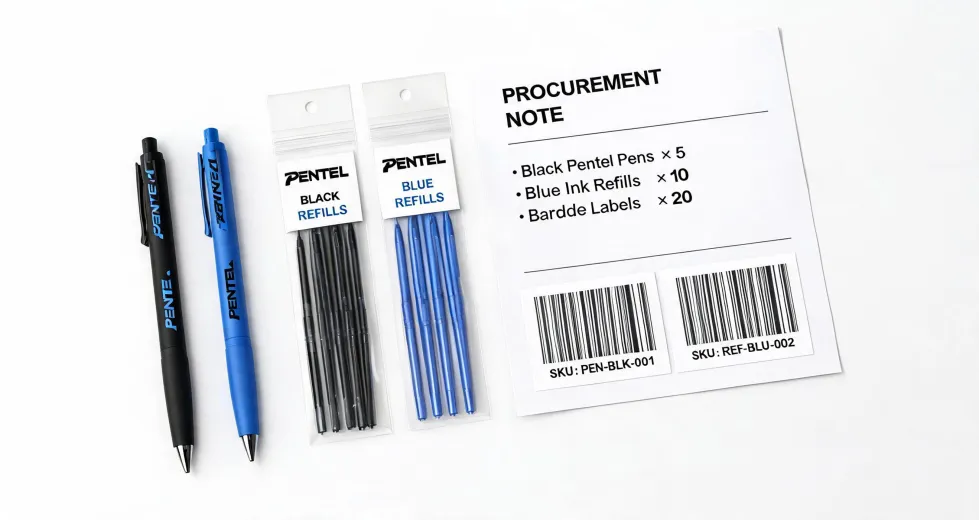
This is the story of how I learned that paying a bit more for a reliable workhorse—specifically, the Pentel Side Click mechanical pencil—saved us from a very avoidable disaster.
The Setup: A Company Event and a Checklist
In late 2024, we were planning our annual all-hands meeting. The theme was "Back to Basics," and the CEO wanted tangible takeaways—notebooks, branded notepads, and nice pens for everyone. The brief was simple: something professional, something reliable, and something that wouldn't run out of ink mid-sentence.
I had a budget of about $1,200 for all the attendee kits. The event was scheduled for a Friday. Orders had to be in by Tuesday afternoon to make the Thursday delivery window.
The printer we worked with—a local shop—was also handling the notebooks. I'd placed the paper order a week prior (letter size, 8.5 × 11 inches, nothing fancy—just good, crisp copy paper for the meeting agenda). But the pens were my responsibility.
I went with a no-name brand of mechanical pencils. Why? They were $0.45 each versus $0.85 for the Pentel 0.7 pencil. I figured: for a giveaway, who would care? I ordered 300 units. Total savings: $120.
"The 'budget vendor' choice looked smart until we saw the quality. Reprinting cost more than the original 'expensive' quote."
The Twist: A Week Before the Event
Wednesday afternoon, I got a panicked call from our marketing coordinator. The pencils had arrived, and they were… not great. The lead was inconsistent. The click mechanism was sticky. One of the testers broke on the second try. She said, "I'm not 100% sure, but I think about 10% of them are unusable."
(Ugh. I really should have checked the reviews before ordering.)
We had two options: distribute junk pencils and hope no one noticed (not happening), or scramble to find a replacement by Friday. We had 36 hours.
I called our regular office supplier, hoping they could drop-ship 300 Pentel Side Click mechanical pencils—0.7 mm, my go-to recommendation for events because they're forgiving for people who push too hard when writing—and they said yes, but it'd cost a rush fee.
The price? $0.85 each ($255 total). The rush shipping? $110. The total for the replacement: $365.
Versus the $135 I'd spent on the junk pencils that I now couldn't use.
Net loss: $230, plus the stress of a last-minute scramble. I ate the cost out of my department's contingency fund (note to self: build that buffer into every event budget).
The Result: A Smooth Event, but a Painful Lesson
The Pentels arrived Thursday morning. They were exactly what I should have ordered in the first place. The Pentel Side Click is a workhorse—the side-button mechanism is intuitive, the 0.7 mm lead is standard and easy to find refills for, and the grip is comfortable enough for note-taking through a two-hour keynote. Everyone at the event liked them. I even overheard one VP say he'd "take a few extra for the office."
But here's the thing: If I had just spent the extra $120 upfront, I would have saved $230 in reprint costs and avoided a stressful two-day crisis. That's not even counting the time my coordinator spent testing the bad pencils and coordinating the rush order.
In March 2024, we paid $110 extra for rush delivery to save a $15,000 event. The alternative was handing out broken pencils and looking unprepared. The certainty of the Pentel product was worth the premium.
The Replay: What I Learned
This experience solidified my belief in what I call the "time certainty premium." When the deadline is tight, you don't pay for speed—you pay for the assurance that it will work. A cheap unknown product might be fine for the warehouse, but for a public-facing event? The risk isn't worth it.
Here are the takeaways I now apply to every procurement I manage:
- Test before you commit. We didn't have a formal sample-approval process. When we finally tested the cheap pencils, they failed. Now, I always request a sample before ordering more than 50 units of anything.
- Budget for the certainty. I now allocate 10-15% of event supply budgets for a "premium choice"—whether that's a better pen, a higher-gsm paper, or a faster turnaround. It's a hedge against the headache of a last-minute fix.
- Know your workhorses. The Pentel Side Click is now on my shortlist for any corporate event. It's not flashy, but it's dependable. For the price, it's hard to beat. I'd rather have 300 of those than 350 of something that might break.
I don't have hard data on industry-wide defect rates for budget pencils, but based on my experience, my sense is that when you're buying at scale, you can expect 5-10% of low-cost items to be unusable. That's a hidden tax on cheap procurement.
This also applies to other office staples. When I order printer paper, I don't mess around with off-brands—standard sizes (8.5 × 11, 20 lb bond) are a given, but I go for a reliable supplier because a jammed printer on a Monday morning is no joke. And when someone asks, "Is acrylic paint washable?" I don't pretend to be an expert—I check the label. (Note: Most are water-based and clean up with soap, but professional-grade acrylics may require special care. I rely on the manufacturer's specs, not my memory.)
"The lowest quoted price often isn't the lowest total cost."
The day of the event, standing at the registration table, watching attendees pick up their bags with those Pentel 0.7 pencils peeking out of the pockets, I felt a small but real sense of relief. No one complained about the pencil. No one had to. That's the goal of good procurement: making things go so well that no one notices the process at all.
I now have a spreadsheet tracking supplier reliability, lead times, and defect rates. It's not glamorous, but it saves me from repeating my own mistakes. And next time I'm tempted to save a buck on pens, I'll remember the $110 rush fee and order the Pentels from the start.
— An office administrator who now pays for certainty.