When I took over office supply purchasing in 2020, I thought I had one job: keep the supply closet stocked without blowing the budget. Five years, 400 employees, and roughly $80,000 in annual orders later, I've learned something that took me way too long to figure out.
The problem was never "finding affordable pens." The problem was that we kept paying for the same mistakes, over and over.
Employees weren't asking for luxury. They just wanted pens that worked past the first paragraph. And I kept gravitating toward whatever quote came in lowest, because that's how my performance was measured.
The Surface Problem: Pens Cost Too Much
Here's what happened when I actually dug into the data: between 2021 and 2023, our writing instrument spending went up 22% even though headcount stayed flat. We weren't buying more pens. We were buying the same pen twice—once for the cheap option, once for the replacement, and occasionally a third time to fix whatever mess the cheap pen caused.
The obvious villain, in my mind, was rising supply costs. In January 2025, USPS raised First-Class Mail letters to $0.73 per stamp. For us, that added roughly $146 per 100-piece mailing. Same logic applied to pens: unit prices everywhere were creeping up, so of course the budget was hurting.
Except it wasn't the unit price. It was the failure rate.
The Deep Cause: We Were Buying Commodities, Not Tools
A pen is not a commodity. It's a precision instrument we've collectively decided to treat as disposable. And the moment you treat it as disposable, you forget that it has to perform its core function every single time: delivering ink to paper smoothly, without skipping, without smearing, without ruining the document in your hand.
From the outside, it looks like a pen is a pen. The reality is the engineering differs dramatically between a $0.30 promotional pen and a $2.50 Pentel Tradio pen. The difference isn't marketing. It's the roller design, the ink formulation, the weight balance, and the materials in the body.
I'm not an ink chemist, so I can't break down the molecular differences between gel and ballpoint inks. What I can tell you from a procurement perspective is that the failure rate tells a clear story. In 2022, I sampled five budget pens from a vendor who quoted 60% below our usual supplier. Out of 100 pens, 14 failed in the first week—skipping, leaking, or cracking. We projected that failure rate across a year and realized we'd spend more on replacement procurement and employee time than we saved on unit price.
In hindsight, that sampling exercise was the moment I started changing my approach. I remember sitting at my desk with 20 failed pens spread out in front of me, trying to explain to my assistant why we should stick with a vendor whose prices were higher. The failed pens didn't care about my budget narrative. They just didn't work.
The other thing I missed early on: different employees need different tools. I spent nearly a year trying to standardize the whole office on a single pen type. That's like trying to feed 400 people the same meal, every day, forever.
Drafting engineers need mechanical pencils that survive real pressure—nobody wants a lead sleeve snapping on the fourth use. Marketing needs fast-drying gel ink because they're signing client documents and writing on coated stock. The education side of our company works with students who spend hours on exam prep, tapping away at AP score calculators and filling in bubbles. They need something that feels comfortable over long sessions, not a pen that cramps your hand by question 40.
People think expensive pens cost more because they're a premium indulgence. Actually, it's the reverse: reliable pens are cheaper over time because they reduce the number of times someone stops, walks to the supply closet, finds nothing useful, and then spends $10 on a pack from the convenience store.
The assumption is that buying quality means paying more. The reality is that buying garbage means paying twice—and also paying for the consequences.
The Cost: What Cheap Supplies Actually Did to Us
Let me get concrete. First, reorders. In 2021, our budget pens ran out twice as fast as the previous brand. Employees grabbed four at a time because they knew three would die before lunch. That's roughly $400 extra per quarter in pens alone.
Second, rework. Smudged documents, leaked ink on report covers, signature lines that looked terrible in front of clients. Doesn't sound like much, right? Across 400 people, that becomes hours every week.
Third, the wall problem. There's a reason "how to get permanent marker off wall" is a recurring search in this office. Someone grabs a permanent marker from the shipping station, uses it on the whiteboard, then spends twenty minutes scrubbing with rubbing alcohol—sometimes damaging the paint in the process. That's maintenance time and materials we never budgeted for.
And here's a comparison I use in my own head: people will happily spend $40 on a Yeti lunch box because it reliably keeps food cold for 12 hours. Then they'll complain about spending $2 on a pen that has to perform thousands of precise tasks. It's a strange mismatch in how we value reliability.
The Dollar Figure
I went back and forth on whether to publish this number. But here it is: after tracking 60–80 orders per year, around 12% of my office supply spend was waste—lost, broken, or incorrectly specified items. On an $80,000 annual budget, that's roughly $9,600 a year. Not catastrophic. But it's the kind of number that draws uncomfortable questions during annual review.
What Actually Fixed It
I didn't switch everything to one brand, because one brand isn't the answer for every use case. But I did standardize on Pentel for several key categories. In my experience, the engineering is consistent. Not flashy. Consistent.
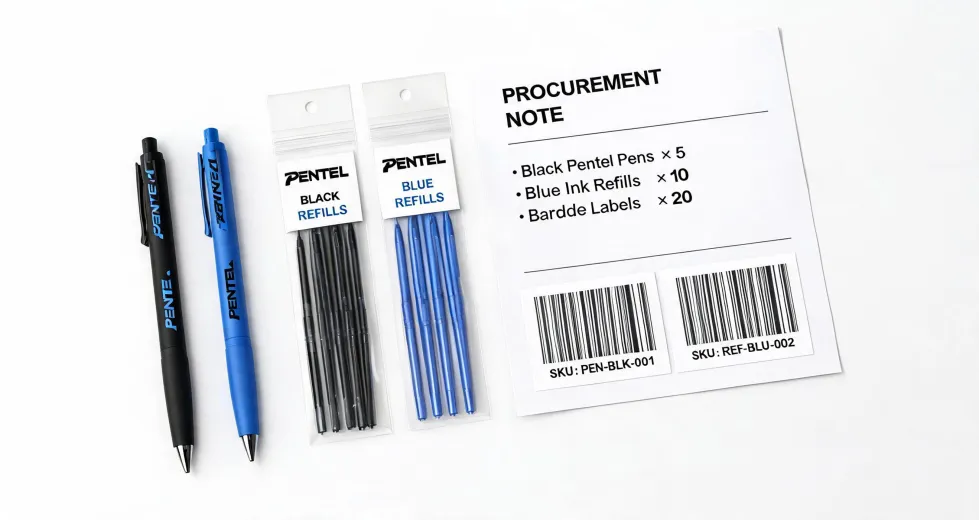
For everyday ballpoint writing, the Pentel Tradio pen is our default. Comfortable weight, smooth ink flow, and—the feature I care about most from a procurement standpoint—it takes refills. We buy the cartridge, not the whole pen. When I evaluate "eco-friendly" claims, I keep the FTC Green Guides in mind: a product is only genuinely "recyclable" if it's actually recyclable in the areas where it's sold. Refillable beats disposable on almost every metric that matters to us.
For fast-drying gel ink, the Pentel Energel pen 0.5 became our standard. It writes cleanly, dries quickly on most paper, and the 0.5 tip works for both signing and note-taking. We keep 0.7 on hand for users who prefer a bolder line.
For drafting, we stock Twist-Erase mechanical pencils with extra lead refills. For presentations, whiteboard markers stored separately from the permanent markers.
The deeper fix wasn't the brand, though. It was designing the supply closet around tasks instead of around unit price. We set up stations: gel pens here, ballpoints there, markers in a bin labeled "whiteboard only." We moved to online ordering with tracked usage, which cut our monthly ordering time from about six hours to two.
Consolidating to fewer vendors also helped with invoicing, which had been a recurring pain when we dealt with eight different suppliers. Fewer invoices meant fewer late payments, fewer accounting follow-ups. I hadn't planned on that side effect, but it's been one of the best parts of the change.
You don't need to spend a fortune to get reliable writing instruments. You need to stop underestimating the cost of unreliability. Buy enough quality per employee, keep backups simple, and audit what you actually use.
That's the advice I'd give my 2020 self. It took five years and $9,600 in waste to learn it.