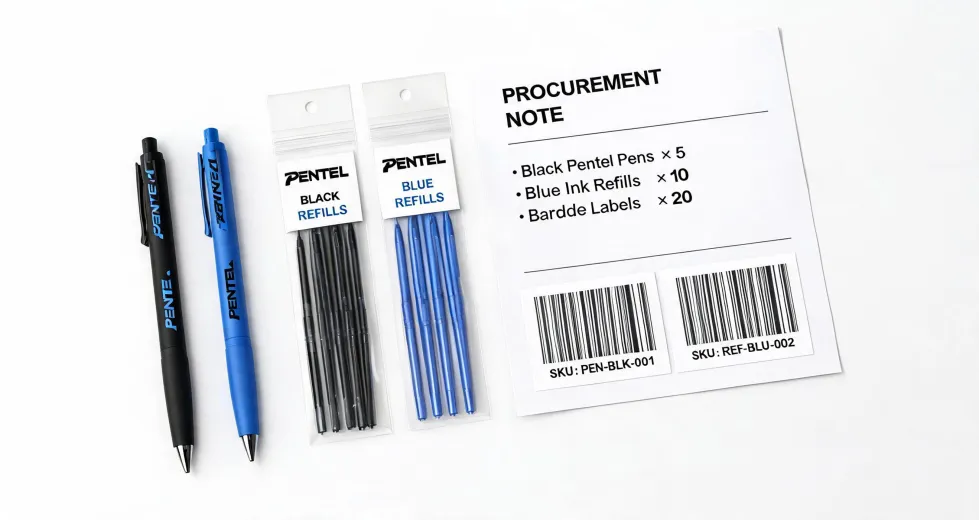
I've been handling office supply orders for seven years. I've personally made (and documented) 19 significant mistakes, totaling roughly $9,000 in wasted budget. This article is about the mistake that finally made me stop guessing.
If you've ever stared at a Pentel Energel pen and thought, 'These smear on everything,' I get it. I thought the same thing in September 2022. Then I watched a $3,200 office supply order go sideways, and I had to admit the problem wasn't the pen.
The Surface Problem: I Checked the Boxes and Hit Submit
In 2022, I approved an order that included Pentel Energel refills, the Pentel Ain Stein lead refill in 0.5 HB, and HP printer ink. I checked the quantities. I matched the product numbers. Then I hit submit and went to lunch.
Two weeks later, three different people complained. A client-facing person said the Energel smeared on her notes. A designer said leads were breaking in the mechanical pencils. The finance printer went through a set of HP cartridges in what felt like a week. I started doing what office managers do: I blamed everyone else, including the manufacturers.
To be fair, the products were fine. That was the confusing part.
The Deep Cause: It Wasn't the Pens or the Ink. It Was the System.
People think expensive supplies perform worse because the manufacturer's quality control slipped. That's backwards. Good products perform well only when they're used in the environment they were designed for. The causation runs the other way: when the system is wrong, every brand looks bad.
Take Pentel Energel writing. I love it. The liquid gel formula lays down a smooth, vivid line, and it dries fast. On the right paper. Our office was using cheap 20 lb multipurpose paper that had been sitting in a storage closet. That paper pulls the ink differently and makes it sit on the surface longer. So the same pen that glides on 24 lb paper became a smear machine on our notes. The product didn't change. The paper did.
Then there was the Pentel Ain Stein lead refill. I ordered 0.5 HB because that's what we'd always ordered. But the team at the drafting table had switched to 0.7 mm pencils months earlier, and nobody told me. The 0.5 lead wasn't bad. It was wrong for the holder. Wrong size always feels like a quality problem, even when it's an inventory problem.
The HP printer ink was a similar story. The cartridges were genuine. The printer didn't have a leak. But after an IT update, the printer's default had switched to 'normal' quality and 'color' for everything. We were printing color signatures and calendar invitations that had never needed to exist on paper. A perfectly good HP cartridge will run out fast when it's being asked to do unnecessary work.
And then there was the search I won't admit to on a professional expense report: 'why is my pee highlighter yellow.'
I'm an office manager, not a doctor. Bright yellow urine is often just vitamin B2 from a multivitamin or energy drink. It can also mean you're dehydrated. But here's the part that surprised me: the same carelessness that made me order the wrong lead refill was connected to the fact that I'd been running on coffee, forgetting to drink water, and making decisions too fast. You don't need a water intake calculator to know you're dehydrated. But if you're asking that question at 3 PM and about to approve a supply order, that's a signal.
What the Mistake Actually Cost
The visible cost was bad enough. The $3,200 order included about $890 of product that had to be reordered or replaced. That's the number I put in the monthly report. The invisible cost was worse: every complaint chipped away at the team's confidence that the supply closet could be trusted.
In my first year, 2017, I made the classic mistake of ordering based on what the previous office manager had always ordered, not what the team actually used. That was a $450 lesson. The 2022 order was a bigger version of the same lesson. We didn't have a formal process for matching an order to the actual devices and paper stock in the building. The third time we ordered the wrong lead size, I finally created a verification checklist. Should have done it after the first time.
I don't have hard data on how much of our supply budget went into the wrong configuration over those years, but based on seven years of orders, I'd estimate it was 12 to 15 percent. For a 40-person firm, that's not a rounding error. It's the difference between buying the right tools and paying to look like you did.
If you want a number for the printer ink part: genuine HP replacement combo cartridges were around $54 on HP's own site in January 2025 (based on a quick check; prices change fast, so verify current rates). When the printer is set to print every email in color, you're not spending $54 a month. You're spending $54 every time someone's name turns orange.
The Fix (Short Version)
The fix wasn't to switch brands. It was to check the system before blaming the item. Now, before any Pentel or HP order goes through, I ask four questions: Is this the right product number? Is it the right size or color for the device that actually uses it? What paper or printer is it going to interact with? And is the person who requested it actually going to use it?
Since we built that checklist in Q1 2024, we've caught 47 potential errors. Some were small. A few would have been expensive. The best part is that it takes two minutes and makes me feel like a professional instead of a detective who only investigates after the damage.
And if you're about to approve a supply order while also wondering why your hydration is off, take a break. Drink a glass of water. Use a water intake calculator if you like tools, or just use a glass. If the highlighter-yellow pee doesn't go away, that's worth checking with a doctor. But for the office version of the problem, the fix is usually slower decisions and better conditions.
Granted, this requires more upfront attention. But it saves time, money, and the awkward moment when you have to explain to a designer that the pencil lead was 0.5 when her pencil takes 0.7. If you ask me, that's the real bottom line.