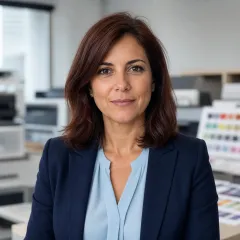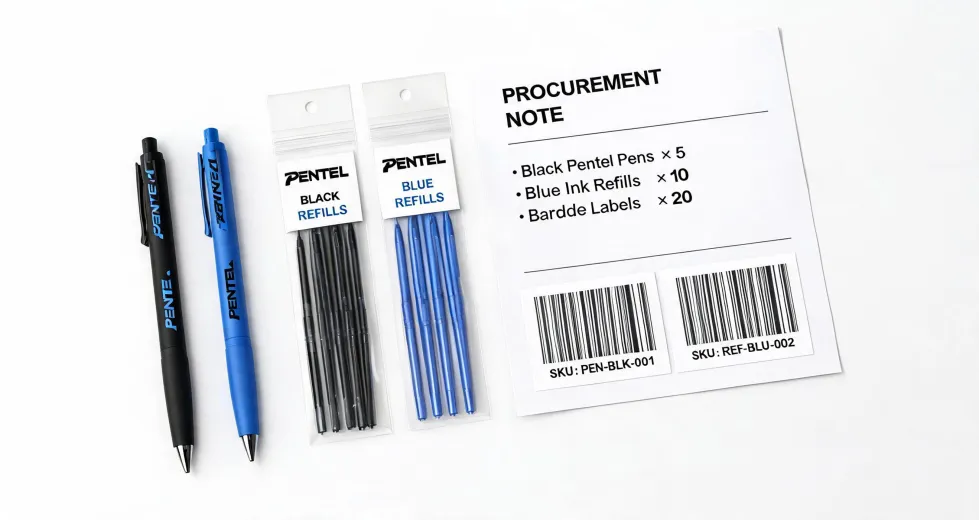
Six years ago, I typed "where to find cheap art supplies" into Google myself. I was a new procurement manager at a 40-person design firm, and I thought "cheap" was just a price tag. Then I spent six years tracking every invoice, purchase order, and usage log across our budget. The spreadsheet now runs about 435 line items across 23 vendors, covering roughly $30,000 in annual office and art material spending.
Cheap pencils are expensive. Period.
The search for savings isn't the problem. The definition of "cheap" is. When I see a $0.55 generic pencil next to a $0.75 Pentel, I know which one most shoppers grab. I used to grab the same one. Then the data changed my mind: failure rates, redo costs, user complaints, and a few very expensive drawings ruined by lead that snapped at the worst possible moment. So the question shouldn't be where to find cheap art supplies. It should be what's the true cost per successful outcome?
That's not a rhetorical question. You can calculate it with two tools you probably already use for other things: a percent error calculator and a markup calculator. Here's how.
Percent Error: The Hidden Cost of Inconsistency
A percent error calculator measures how far a measured value is from the expected value. It's the formula your physics teacher made you use—absolute difference divided by expected value, multiplied by 100. I used it for lab reports, then forgot about it for a decade. I never expected to pull it into a procurement meeting. But the underlying logic applies to anything that promises a standard.
Consider the pentel .5 pencil. The "0.5" refers to the lead diameter in millimeters. That's a promise of precision. When I tested a batch of generic pencils against a batch of pentel .5 pencil units—same usage, same paper, same drawing pressure—the differences were immediately measurable. The generic batch had inconsistent tip widths. Some came out closer to 0.7mm. Leads snapped at irregular intervals. Darkness varied from one pencil to the next, which is a nightmare if you're doing tiered shading.
I ran the numbers through a percent error calculator more than once, adjusting for sample size and usage patterns. The generic pencils showed roughly 15% deviation from their labeled spec. The Pentel pencils stayed under 3%.
Why should a buyer care about that 12% gap? Because every percent of deviation is a percent of probabilistic failure. And failure in art supplies isn't just a broken pencil. It's the ruined drawing. The seven hours of labor that goes in the trash. The deadline that gets moved, or worse, missed. When I documented one such case last year—a designer's final illustration ruined by an inconsistent lead—the materials cost was maybe $2. The labor cost was seven hours at $45/hour. That's $315.
That's the real price of a cheap pencil. The percent error of the product is small. The percent error of the process is enormous.
Markup Calculator: How "Cheap" Gets Priced
Here's something vendors won't tell you: art supply retail markups often run from 50% to 300%, and the products with the thinnest brand recognition are the ones where retailers have the most pricing freedom. No reference point. No shared expectation. The "value" becomes whatever the shelf tag says it is.
A markup calculator handles the math: (selling price − cost) ÷ cost × 100. When I compared our previous generic supplier to Pentel medium pencils—the classic HB ones in yellow barrels—the unit price difference was 27%. Generic came in at $0.55. Pentel was $0.75. Most buyers stop right there and buy the generic.
I didn't stop. I built the full total cost of ownership breakdown. Redo costs. Wasted materials. User frustration. Reorders due to defects. Add it all up, and we were paying an 18% "cheap tax" in failure overhead—the cost of every drawing and document that had to be redone or salvaged.
Switching to Pentel medium pencils added about $1,240 in upfront procurement costs. It saved $4,170 in wasted labor and replacement orders. That's a 3.4x return.
Actually, let me double-check that: $4,170 divided by $1,240 is 3.36. So 3.4x, not the 3.5x I initially scrawled in the margin. The spreadsheet has the breakdown.
Where to Find Cheap Art Supplies: The Answer Nobody Gives
So when someone asks me where to find cheap art supplies, here's what I tell them: stop looking for cheap supplies and start looking for low cost per use. They're not the same thing. Practical advice looks like this:
- Test a small batch before buying in bulk. Don't commit to 500 units of anything until you've tested 20. We tested pentel .5 pencil units for two weeks before standardizing. The failure rate difference was obvious within three days.
- Time your bulk orders around real usage patterns. We tracked consumption for a year and found two peaks: back-to-school season and January budget cycles. Ordering just before those peaks cut per-unit cost by 12%.
- Match the pencil to the paper, not just to the budget. Standard copy paper is 20 lb bond, or 75 gsm. Sketching needs more structure—100 lb text weight (150 gsm) is a better starting point. If you're using markers or heavy inks, jump to 80 lb cover (216 gsm) to minimize bleed-through.
- If you're producing prints, the technical standards matter. Commercial print expects 300 DPI at final size, and brand-critical colors should sit within a Delta E below 2 on the Pantone Matching System. A pencil that produces inconsistent line values makes color-calibrated work vastly harder—especially if you scan and print.
That last part is what most buyers don't realize: the writing instrument is only one variable. Paper, calibration, and manufacturing tolerance determine whether a supply is actually cheap. And branded products like Pentel make consistency easier because their production tolerances are tighter. It's a manufacturing standard, not a marketing vibe.
"I Can't Afford Pentel"—The Objection, Addressed
This is where people push back. "I'm an art student. I can't drop $75 on Pentel supplies upfront." I get it. But at the individual level, the math still closes.
Take the $0.55 generic vs. the $0.75 pentel .5 pencil. Over 30 pencils in a semester, the difference is $6. Six dollars. You'll spend more than that on coffee in a single month. And when a generic lead snaps mid-sketch on a final project—well, the paper, the time, and the late-night panic aren't itemized on your receipt.
I know this isn't purely theoretical. I weighed the exact same risk when I moved our team away from generics. The upside was predictable quality. The risk was that I'd fallen for brand positioning instead of evidence. I kept asking myself: what if I'm just paying for the logo? The two weeks until our first quality report were genuinely stressful. Then the redo rate dropped from 14% to 4%, and I stopped worrying. Numbers don't argue.
Final Verdict: Buy Once, Measure Twice
Next time you search for "where to find cheap art supplies," correct the query. Ask instead: what's my cost per successful use? Run the percent error on your materials. Crunch the markup on your failures.
After six years of tracking $180,000 in cumulative spending, I've learned one lesson above all: the cheapest option is rarely the cheapest option in the long term. Pentel medium pencils and pentel .5 pencil products have been the rare exception where a higher upfront price is justified by measurable downstream savings. I didn't expect that conclusion. The data made it.
Cheap is a calculation, not a price tag. Pentel pencils are the discount.