-
When You Need This Checklist
-
Step 1: Verify the Ink Type (and What It Means for Your Surface)
-
Step 2: Match the Nib Size to the Job (Don't Assume "Standard" Is Standard)
-
Step 3: Double-Check the Refill Compatibility (Energel Is Not Universal)
-
Step 4: Check for "Waterproof" Claims on Paint Pens (It's Not That Simple)
-
Step 5: Verify the Order Quantity vs. the Minimum Pack Size
-
Common Mistakes & Final Reminders
When You Need This Checklist
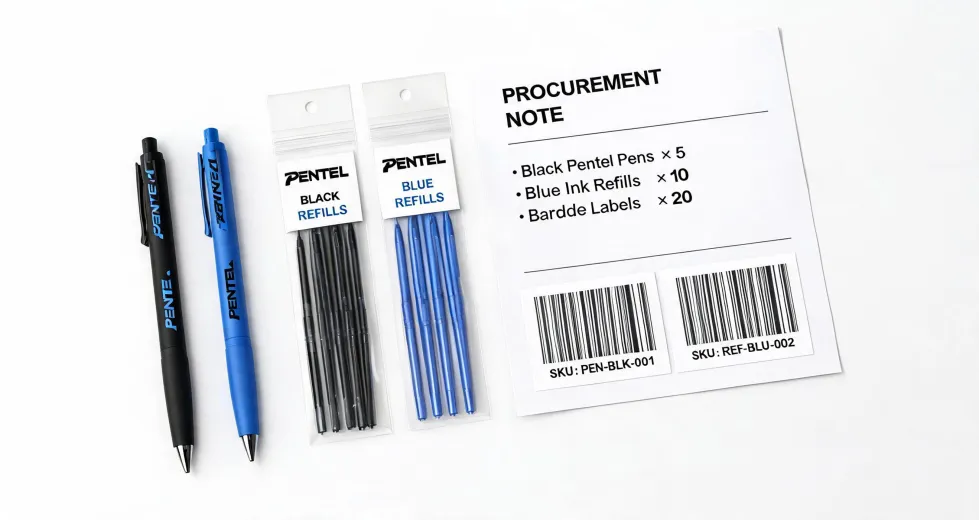
You're looking at Pentel products—specifically paint pens or Energel refills—and you're about to place an order. Maybe it's for an office supply restock, a school art department, or a personal project. I've handled B2B orders for writing instruments for about 5 years now. I've personally made (and documented) 8 significant mistakes in that time, totaling roughly $1,200 in wasted budget on wrong pens, incorrect refills, and mismatched art supplies. Now I maintain our team's checklist to prevent others from repeating my errors.
This is a straightforward, step-by-step list. No fluff. If you follow these steps, you'll avoid the most common pitfalls I see people—including myself—fall into when buying Pentel pens and markers. There are 5 steps.
Step 1: Verify the Ink Type (and What It Means for Your Surface)
The biggest mistake I made—and the one that cost me $450 on a single order—was assuming "paint pen" meant one specific thing. I ordered 200 Pentel paint pens in assorted colors for a client's workshop kits. They arrived, and the ink wouldn't stick to the plastic badges we were using. That order went straight to the trash.
Pentel offers several types of paint and marker inks, and they are not interchangeable for every surface. Here's your check:
- Pentel Paint Pens (Water-based acrylic): These are the standard ones. They work on paper, cardboard, wood, glass, and some plastics. They are not waterproof once dry, despite what you might think. They are water-resistant. (Should mention: this means they can smudge if exposed to heavy moisture.)
- Pentel Oil-Based Paint Pens: These are for non-porous surfaces—metal, glass, plastic, ceramics. They are permanent and waterproof once cured. The mistake I see: people buy water-based for plastics and wonder why it chips off.
- Pentel Energel Pens: These are liquid gel ink. They are not paint. They are brilliant for writing and everyday use, but they are not designed for art or surface decoration. The ink is water-resistant but not waterproof.
To be fair, the product descriptions are often vague. But the rule is simple: if it says "paint pen," it's paint. If it says "gel pen," it's ink. If you need permanence on a non-porous surface, you want the oil-based version.
Step 2: Match the Nib Size to the Job (Don't Assume "Standard" Is Standard)
I once ordered 50 Pentel Color Brush pens for a client's calligraphy workshop. The listing said "brush pen," so I assumed they were all the same size. They were not. Half were fine tip, half were medium. The client needed the fine tips for detail work. The mediums were useless for her project. $320 order, 1-week delay for a return and re-order.
Here's what most people don't realize: Pentel uses specific codes for nib sizes, and they aren't always obvious from the product image. For paint pens, check for "Fine" (0.7mm), "Medium" (1.0-1.2mm), or "Broad" (2.0mm+). For brush pens, they have "F" (fine) and "M" (medium). For Energel, the refills come in 0.35mm, 0.4mm, 0.5mm, 0.7mm, and 1.0mm.
Checklist item before ordering: Confirm the specific nib size code from the product page. Don't rely on the product name alone—read the specifications or look for the model number suffix.
Step 3: Double-Check the Refill Compatibility (Energel Is Not Universal)
This is the one that keeps tripping people up, and I see it all the time in forum posts. People buy Pentel Energel refills thinking they fit any Energel pen body. They do—mostly. But there's a catch: the LR7 refills are for the standard Energel bodies. The XLRN5 refills are for the Energel-X and some specific models. They are physically different lengths. I mixed them up once and ended up with 40 refills that were 5mm too long for the pens we had. That cost about $180 in exchange fees and shipping.
Here's the shortcut: if you're buying refills for an existing Penel pen body, look at the original refill's model number. Don't just search "Pentel Energel refill." Check if it's LR7, XLRN5, or the needle-point LRN5. (Which is to say, the LRN5 is the needle-point version of the LR7—it's the same length but a finer tip.)
I get why people assume all refills are the same—the packaging is similar. But this is where the savings vanish. A 10-second check can save you a headache.
Step 4: Check for "Waterproof" Claims on Paint Pens (It's Not That Simple)
The conventional wisdom is that "acrylic paint pen" equals "waterproof." This was true 15 years ago when most paint pens were oil-based or old-formulation acrylic. Today, the reality is more nuanced. I learned this the hard way when a client's outdoor signs started running after a rainstorm. They had used the water-based Pentel paint pens, which I had confidently described as "waterproof." They were not.
Here's what vendors won't tell you: Water-based acrylic paint pens are water-resistant once dry, but not waterproof. The distinction matters:
- Water-resistant: Can handle light splashes and humidity. Will not smudge under normal handling.
- Waterproof: Can withstand rain, full submersion, or scrubbing. This is for oil-based or cured acrylics.
For interior projects (card-making, journaling, labeling office supplies), the standard Pentel paint pens are fine. For anything that will face the elements, you want the Pentel Oil-Based Paint Pens or the Pentel Permanent Markers. The product page for a standard paint pen will not say "waterproof"—look for that exact word.
Step 5: Verify the Order Quantity vs. the Minimum Pack Size
This sounds obvious, but I've fallen for it twice. Pentel often sells items in multi-packs. The listing might say "$12.99" but that's for a pack of 12, not a single pen. The buyer from a small business once ordered what they thought was 10 individual Pentel Energel pens for $45. They received 10 packs of 12—120 pens total. The invoice was $540. We had to return the extra 110 pens, incurring a 20% restocking fee.
Checklist item: On the product page, look for the UPC or model number and then verify the pack count. Is it sold individually or by the box? For B2B, you're often buying by the case. For single-use, you might need to look for "single" or "each."
My rule now is: when the price seems too good to be true, or when you're unsure, add 1 unit to the cart and check the total. If the price jumps by $50 instead of $4, you're looking at a multi-pack. It's a simple way to catch the mistake before you pay.
Common Mistakes & Final Reminders
I should add that these are the top 5 mistakes I've made or seen in the past 3 years of handling writing instrument orders. They're not theoretical. Here's one more thing:
- Don't assume "metallic" is the same as "glitter": Pentel makes both. Metallic paint pens have a smooth, shiny finish. Glitter pens have sparkly particles. They are different products, and the application is different.
- Check the expiration date on refills: Gel ink does have a shelf life (around 2-3 years from manufacture). If you're buying in bulk, ensure the stock is fresh.
- Test one before you open the whole case: Always take one pen from the box and test it on your intended surface. I once ordered 50 paint pens for a project, and the ink was too thin on the porous cardstock we used. One test would have saved the entire order.
Out of my 8 mistakes, these 5 were the most expensive. They cost me a total of about $1,200 and wasted a good 3 weeks of my time. The checklist is simple—5 steps, maybe 10 minutes of your time—but it will save you from the same fate.