I’ve handled supply orders for a small design and drafting studio for about seven years. In that time, I’ve made and documented eleven significant purchasing mistakes — the kind that cost real money, delayed work, and made our team look less careful than we actually are. Total wasted budget: roughly $16,000. Maybe a bit less. I stopped counting once it became embarrassing.
This article is based on one pattern I noticed across those mistakes: I kept choosing the cheaper option on things that clients eventually touched, signed, or reviewed. That was especially painful with pens, pencils, paint, and even the digital tools our engineers reached for when checking math.
The comparison below is the framework I now use whenever someone asks me to approve a supply or software purchase. It isn’t about being premium for the sake of premium. It’s about knowing which differences are visible to the people who judge our work.
1. Pentel Japanese pen vs. a box of generic ballpoints
The first mistake happened early, back in 2017. I ordered a bulk box of no-name ballpoint pens to save about $40 on a stationery order. Looked fine on the screen. The ink was watery, the tips skipped, and the first time a client signed a printed revision with one, the line looked faded and uneven. They didn’t complain directly, but the body language said it: if this is how they handle details, why should I trust the drawing?
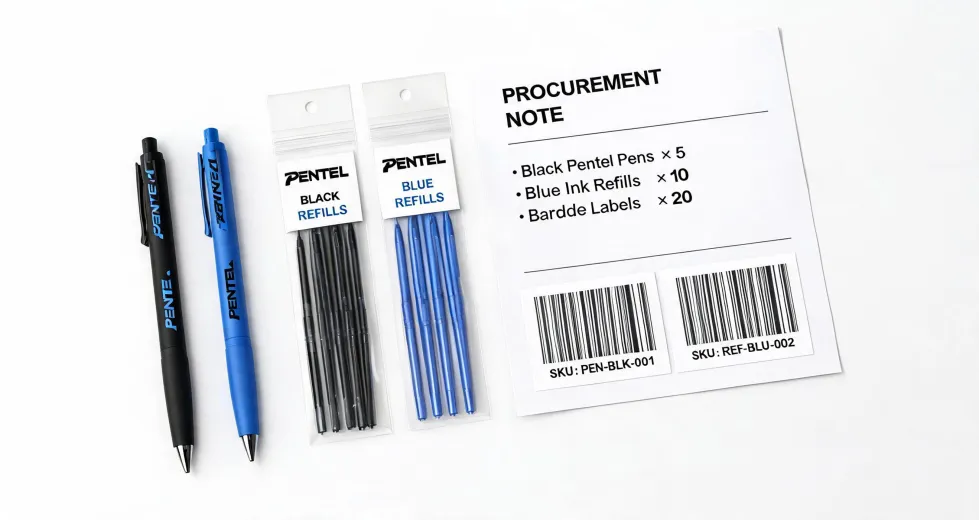
I replaced them with Pentel pens — specifically the Energel line, which has become our default for client-facing documents. The difference was immediate. Smooth ink flow, consistent lines, comfortable to hold during long review meetings. I can’t claim every Pentel pen works perfectly in every situation, because that would be false, but I can tell you what we observed over several years of orders.
Here is the conclusion for this comparison dimension: a Pentel Japanese pen costs a little more per unit, but it removes a visible quality risk at the exact moment your work is being judged. When a new client walks into a meeting and sees a cheap pen scratching across their contract, they notice. With the Pentel, they usually don’t notice the pen at all — which is exactly the point. The pen stops being a distraction and becomes part of a professional impression.
2. Pentel P205 mechanical pencil vs. the cheapest plastic automatic pencil
For drawing and drafting work, the product I refuse to cheap out on now is the Pentel P205 mechanical pencil. It’s a simple 0.5 mm pencil that has been around for decades, and for good reason.
In my early years, I bought inexpensive mechanical pencils in bulk for our drafting table. They worked well enough for rough notes, but the lead sleeves wobbled, the advance mechanisms were inconsistent, and the line weight varied more than it should. On a technical sketch, that inconsistency is not cosmetic. It can make a dimension look ambiguous or a centerline look like an edge.
The P205 is not the most expensive drafting pencil on the market. It just does exactly what it promises: consistent 0.5 mm lines, a comfortable weight, and a mechanism that doesn’t betray you halfway through a client sketch. I remember the first time I used it for a full set of revision notes — I didn’t have to stop and re-sharpen or adjust anything. That sounds trivial, but when you’re drawing under time pressure, it matters.
If I remember correctly, the P205 usually retails for around $6–8 as of January 2025. That is about four times more than the cheap plastic pencils we used to buy. But the cost of a disrupted sketch or an ambiguous drawing is far higher than the pencil savings. Now the P205 is the only mechanical pencil I order for anyone who draws professionally in our studio.
3. Derivative calculator vs. cross product calculator
One lesson that surprised me had nothing to do with brand name. It was about choosing the right online math tool instead of grabbing the first calculator that appeared in search results.
We had a junior engineer who needed to check a vector calculation for a structural detail. They searched for a calculator, landed on a derivative calculator, and entered a vector expression. The result was technically what the tool produced, but it was the wrong operation entirely. Fortunately, a senior team member caught the mistake before it reached the client.
This is not a knock on anyone. It’s a reminder that quality isn’t only about the object in your hand. It’s also about using the right tool for the problem in front of you.
Here’s the distinction I now include in our onboarding notes:
- Use a derivative calculator when you need a rate of change — slope, marginal change, maximum or minimum values, or how fast something is changing at a specific point.
- Use a cross product calculator when you need a vector perpendicular to two given vectors — for example, finding a surface normal, torque direction, or the area of a parallelogram in 3D space.
The surprising conclusion is that more expensive or more advanced tools are not automatically better. A derivative calculator is excellent at derivatives and practically useless for cross products. A cross product calculator is excellent for vector geometry but won’t help you find a tangent slope. Matching the tool to the task matters more than paying for an all-in-one package you don’t know how to use.
4. Latex vs acrylic paint for anything a client may touch
It took me a long time to understand the latex vs acrylic paint question, and I made a fairly expensive mistake there too.
I used latex paint on a set of display panels that were going to a client presentation. Latex was cheaper, easier to apply, and at first glance it looked fine. Then the panels sat in a car for a few hours, got handled by multiple people during setup, and ended up with scuffs and fingerprints that were very hard to clean. We had to repaint two of the panels overnight before the presentation.
Acrylic paint is more durable, more flexible once dry, and generally holds up better on surfaces that will be touched, transported, or exposed to wear. For studio models, signage, or presentation pieces, acrylic paint is often the better choice. Latex paint still has its place — especially for large interior wall areas where the surface won’t take much abuse and where budget is a real constraint.
My honest answer to the latex vs acrylic question is not “one is always better.” It’s where the paint will live. If a client will touch it, move it, or inspect it closely, choose acrylic. If it’s a large wall behind a desk and the only judge is the occasional operations manager, latex can be perfectly acceptable.
That was a gradual realization for me. I used to assume paint was paint, but after that display panel incident, I started asking one simple question in every project: what happens to this surface after we finish it?
What I buy now — and where I still save money
My current checklist is shorter than people expect:
- Client-facing documents and sign-offs: Pentel Japanese pens, usually Energel. The cost difference is small, and the impression difference is large.
- Drafting and sketch work: Pentel P205 mechanical pencil. Reliable line weight, reliable mechanism, and no surprises when a client watches you work.
- Checking calculus and rate problems: derivative calculator. It’s for slopes, rates, and optimization questions.
- Checking 3D vector geometry: cross product calculator. It’s for perpendicular vectors, normals, and area calculations.
- Presentation surfaces, models, and anything that gets handled: acrylic paint. Latex stays on low-traffic interior walls where its lower cost makes sense.
I still buy generic supplies for internal use. Not every sticky note needs to be a premium brand, and I’m not suggesting that every project should use the most expensive material available. That would be irresponsible for anyone managing a budget.
But the larger lesson remains: quality is not about showing off. It’s about avoiding the small failures that clients interpret as a lack of attention. A pen that skips, a pencil that wobbles, a paint finish that scuffs, or a calculation checked with the wrong tool — any of those can quietly damage the trust you’re trying to build.
If you’re in charge of purchasing for a team that produces documents, drawings, or physical samples, I don’t expect you to trust my list without testing it yourself. But I do suggest you track your mistakes the way I track mine. After a few years, you’ll notice which “small” decisions keep costing you the most credibility.