-
1. What Pentel products do you actually order every year?
-
2. Why do I keep recommending Pentel Energel 0.7 pens?
-
3. Is the Pentel Multi 8 color pencil actually useful?
-
4. What calculator tools do we keep on our desktops?
-
5. Why would a school use a WHO growth chart calculator?
-
6. What was your most expensive ordering mistake?
-
7. What should I check before placing a bulk Pentel order?
-
8. What would I tell someone who's starting a supply job?
I've processed office and classroom supply orders for a small private school for six years. I've personally made—and documented—twelve significant mistakes, totaling roughly $3,800 in wasted budget. Now I maintain our team's ordering checklist. If you found this because you're deciding between Pentel options, or because you need a free calculator tool, this post is for you.
A few honest caveats before the FAQs: I can only speak to my context. My sample is about 150 orders for a school with roughly 120 staff and 800 students. If you're buying for a large corporate office or a design studio, your mileage will vary. This isn't a formal product review—just a list of answers I wish I had when I started.
Here are the questions I hear most, plus one I wish I'd asked myself sooner.
1. What Pentel products do you actually order every year?
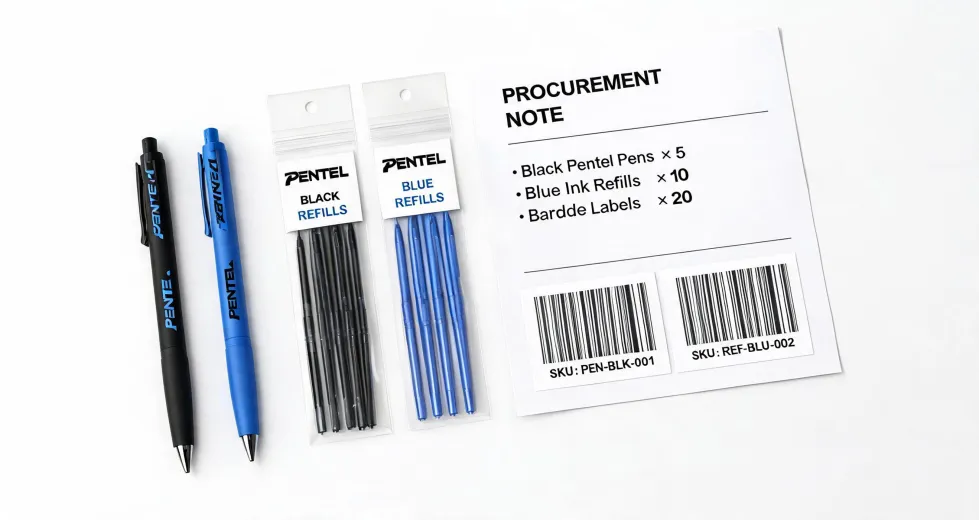
I order more Pentel things than I can list here, but two items show up on nearly every budget request: Pentel Energel 0.7 pens and the Pentel Multi 8 color pencil. Energel pens are the default for teachers who grade essays and office staff who write in planners. The Multi 8 is the default for anyone who needs multiple colors in one barrel. I also order erasers and refills, but those two are the anchors. That wasn't planned. It came from listening to what people actually asked for after I stopped choosing the cheapest option. That's not because I'm a Pentel fanboy. It's because they earn their place in the budget.
2. Why do I keep recommending Pentel Energel 0.7 pens?
First, let me narrow that down. Pentel makes several Energel models, and I cannot speak to all of them. We've used the 0.7mm liquid gel versions consistently for about three years. Pentel calls Energel a liquid gel ink (pentel.com, accessed January 2025). In our building, that translates to less smudging than the gel pens we used before. That matters because left-handed users and fast writers are everywhere. The pens are also comfortable enough for a full day of note-taking. Are they the smoothest pens money can buy? I won't make that claim. But they're the ones employees don't complain about, and in my job, silence is a sign of a good supply decision.
3. Is the Pentel Multi 8 color pencil actually useful?
I thought it was a novelty until a first-grade teacher showed me how she uses it for reading groups. She reads with a small group, marks a student's name with one color, writes the level in another, and tracks daily notes in a third. No digging through a pencil bucket. That one tool replaced three highlighters and a regular pencil. The Pentel Multi 8 color pencil works the same way for our administrative office: one person codes folders, another marks dates on a shared calendar. The 8 colors are not artist-grade pigments, so if you need professional art supplies, buy those separately. For everyday annotation and coding, it's a workhorse. Just remember the lead is a color pencil, not a wax crayon and not a marker. It looks like a mechanical pencil and feels similar, but it's not designed for long writing tasks.
4. What calculator tools do we keep on our desktops?
This is the FAQ that surprises people. We keep three free online calculators on our shared resources page. The first is a system of equations calculator. Our algebra teachers use it to verify answer keys, and students use it to check homework. The second is a Pythagorean theorem calculator. It sounds basic, but geometry teachers and even the facilities team use it for quick right-angle measurements. Third is a WHO growth chart calculator, which I'll explain in the next answer. None of these replace teaching the math. They're checks, not crutches. But a system of equations calculator catches sign errors in seconds, and a Pythagorean theorem calculator saves someone from doing the same square root by hand five times. In a busy school, that counts. I know it's not a brand-name software suite. It works.
5. Why would a school use a WHO growth chart calculator?
Our school nurse asked for this in her first week. A WHO growth chart calculator uses the World Health Organization's child growth standards to turn a child's height, weight, age, and sex into a percentile. The WHO data is a common reference for pediatric growth (source: who.int, child growth standards, accessed January 2025). The nurse plugs in the numbers during screenings and then marks the paper chart. That paper chart gets a note written with a Pentel Multi 8 color pencil so the color means something to the next reader. The calculator is not a medical diagnosis. It's a screening tool. If the percentile changes sharply, the nurse sends the family to their doctor. It keeps our records consistent and gives us a quick visual flag. We also keep printed copies, but the calculator gives us the same result every time.
6. What was your most expensive ordering mistake?
My worst mistake happened in my first year. I saw a unit price that was about 40% lower for a gel pen that wasn't on our approved list. I thought I was being smart. I ordered 60 boxes. When they arrived, the ink skipped and smeared, and a few pens leaked inside their caps. Teachers stopped using them, but the supplies were already in classrooms. That $200 budget saving turned into a $1,400 problem when I had to replace the order with Pentel Energel 0.7 pens and answer frustrated emails from staff. Since then, I've had two smaller mistakes, but the lesson stuck: the lowest quote isn't always the lowest total cost. You have to count the time spent fixing the problem too. Did we save money on the unit price? Yes. Was it worth the hassle? Not even close.
7. What should I check before placing a bulk Pentel order?
Before I click submit, I check four things. First, the exact SKU, because Pentel sells a lot of variations and two similar boxes can have different refills. Second, the refill type and tip size. 0.7 doesn't always equal the same needle tip. Third, the packaging count. Is it 10 pens per pack or 12? That sounds obvious, but I've mixed them up. Fourth, the total cost with shipping and any rush fees. Unit price alone can be misleading. I also order a small test batch when a new product or a new packaging size appears. That's not a guarantee that everyone will love it, but it's better than finding out after 2,000 units are in the supply closet.
8. What would I tell someone who's starting a supply job?
I'd say: don't try to be the hero who saves money on the first order. Buy the Pentel Energel 0.7 pens and the Pentel Multi 8 color pencil in small quantities, test them with the actual people who will use them, then scale up. And add the calculator links to your shared drive while you're at it. The system of equations calculator and Pythagorean theorem calculator are free; the WHO growth chart calculator is free too. Tools don't have to cost more. What costs more is reordering after a failed batch, losing time, and replacing something that should have been right the first time. That's my whole philosophy now.