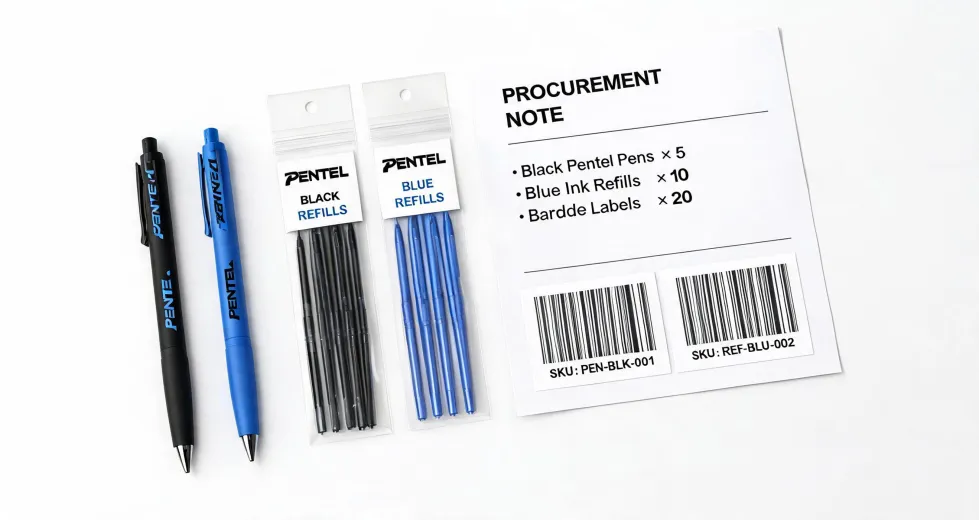
Here's the thing no one tells you about picking a writing instrument for your team or your own daily carry: there's no universal "best" option. I learned this the hard way. In my first year handling office supply orders (2017), I bought 500 Energel RTX pens for the entire engineering department. They hated them. Hated them. The reason? They were mechanical pencil users. I'd just spent $1,200 on the wrong tool for the wrong people.
Take it from someone who's made about $3,200 in writing instrument ordering mistakes over the past six years: the choice between a Pentel P200 series mechanical pencil and a Pentel Energel RTX gel pen isn't about which is "better." It's about which is better for your situation.
Let's break this down into three common scenarios. By the end, you'll know exactly which camp you fall into—and which tool to pick.
The Three Scenarios: Who Are You?
Before we dive into recommendations, let's figure out which category fits your needs. I've seen these three patterns over and over again in offices, studios, and schools:
- Scenario A: The Efficiency-First Daily Writer — You take lots of notes, write lists, and need a tool that's always ready. Reliability and speed matter more than line quality.
- Scenario B: The Detail-Oriented Hobbyist or Diversity Seeker — You write in different contexts (a journal at home, quick notes at work, sketches during meetings). You want options, and you're willing to carry more than one tool.
- Scenario C: The Strict Professional or Precision User — You do drafting, engineering calculations, or precise figure work. You need consistent line width and never want to worry about smudging.
Which one sounds like you? Be honest. I've seen people in Scenario C try to force themselves into Scenario A because they wanted to "simplify." It didn't end well. Let's walk through each.
Scenario A: You Just Want to Write — Go With the Energel RTX
If you're in this camp, you're optimizing for convenience. You want a pen that starts writing immediately, doesn't skip, and looks professional. The Pentel Energel RTX Retractable Bold Gel Pen is your tool.
Why? Three reasons:
- It's retractable. No cap to lose. No fumbling. Clip it, click it, write. Simple.
- The ink dries fast. This is huge for left-handed writers or anyone who's ever closed a notebook only to find a smeared mess on the facing page. Energel's liquid gel ink is one of the fastest drying on the market.
- It's bold. The 0.7mm and 1.0mm tips produce vibrant, readable lines. Great for signing documents or writing meeting notes that you'll actually read later.
The trade-off? You're committing to one line width and one color. If that's fine with you, stop reading and buy the RTX. It's that simple.
But here's the catch I didn't understand until 2022: The Energel RTX is not refillable in the same way a fountain pen or mechanical pencil is. When the ink runs out, you replace the whole pen or buy a new refill. The refill cost is reasonable (around $3–$4), but the cartridge isn't universal across all Pentel pens. I once ordered 200 refills for an RTX model that had been quietly discontinued. That was a $600 mistake. Check the SKU before you bulk order.
Scenario B: You Want Versatility — The P200 Series Is Your Gateway Drug
This is the scenario most people think they're in but aren't. If you genuinely need different tools for different tasks — a fine 0.3mm pencil for annotating, a bold 0.7mm for sketching, a 0.5mm for everyday writing — the Pentel P200 series mechanical pencil is the most cost-effective way to do it.
The P200 series (which includes the P203, P205, P207, and P209 for 0.3mm, 0.5mm, 0.7mm, and 0.9mm respectively) is legendary for one reason: consistent performance at a low price point. A single P205 costs about $6–$8. Compare that to a premium drafting pencil at $25+. The P200 is the value king.
I bought a set of four (0.3, 0.5, 0.7, 0.9) back in 2018 for $30. I'm still using them. The clutch mechanism on the 0.5mm broke after three years of daily use—which is honestly good for a $7 pencil—but the others are fine. Over six years, that's roughly $5 per year for a complete set. The total cost of ownership (TCO) is absurdly low.
The downside? You have to carry extra lead and erasers. The eraser under the cap is tiny. If you're a heavy eraser, you'll need a separate eraser. And the P200 is not retractable; the tip is exposed when you carry it. I've poked holes in more than a few shirt pockets. Pentel addressed this with the Twist-Erase series, which adds a retractable feature and a larger eraser, but it costs $4–$5 more per pencil. Worth it for some, not for others.
Scenario C: You're a Detail-Focused Professional — You Probably Need Both
This might surprise you. But in my experience, the most demanding users—engineers doing calculations, architects sketching floor plans, artists doing cross-hatching—end up needing both a pencil and a pen.
Here's why: pencils fade, pens don't. If you're writing something that needs to be permanent, you need the Energel RTX (or another archival-quality pen). But if you're sketching, calculating, or drafting something that might change, you need the P200.
I once watched an architect try to use a 0.5mm mechanical pencil for a final presentation drawing. The graphite smudged during the scan. The client rejected it. $2,000 worth of work had to be reprinted because of smudging. The fix? Use a 0.5mm P205 for the drafting, then trace over the final lines with a 0.5mm Energel RTX. Problem solved.
And here's a niche use case: if you're using a dew point calculator on a job site or in a lab, you need a writing tool that works on non-standard surfaces. The Energel RTX can write on glossy paper and labels without smearing. The P200 can write on mixed-media paper and trace around stencils. Neither is perfect for every surface, but having both covers 95% of scenarios.
One more thing about Scenario C: I've also seen people use their mechanical pencils for how to start a journal — they want the freedom to erase and rewrite their thoughts. That's fine for the first draft, but for any journal entry you want to keep, use the gel pen. Graphite smudges and fades over time. Your 2045 self will thank you for using ink.
How to Know Which Scenario You're In
Here's the self-diagnostic test I use after my third major ordering mistake (the $1,200 engineering department incident):
- Ask yourself: "Do I ever need to erase?" If yes, lean toward the P200. If no, go with the Energel RTX.
- Ask yourself: "Do I ever need to write on labels, glossy surfaces, or non-standard paper?" If yes, the Energel RTX wins. The liquid gel ink adheres to surfaces where pencil graphite just sits on top.
- Ask yourself: "Will this be stored for more than 5 years?" Ink fades, but graphite smudges and erases. If longevity matters, pick whichever one you're more likely to preserve. For archival purposes, an ink pen with pigment-based ink is better than graphite. Check the refill type; Energel ink is dye-based but fade-resistant in normal conditions.
If you answered "yes" to two or more questions, you probably fall into Scenario C and need both tools. If you only answered "yes" to the erasing question, buy the P200. If you only answered "yes" to the longevity or surface questions, buy the Energel RTX. If you answered "no" to all three, you're in Scenario A. Get the RTX and never look back.
One Final Note on TCO
This is where the total cost of thinking really matters. The P200 costs $7. The Energel RTX costs $8. The difference is $1. But the hidden costs are real:
- Refill costs: P200 lead refills cost about $2 for 12 pieces. That's months of writing. Energel RTX refills cost about $3 and last 2–3 months with heavy use. Over a year, the P200 costs about $5–$6 in lead. The Energel costs about $12–$18 in refills.
- Time cost: If you're in a fast-paced job, the extra second it takes to click out a mechanical pencil vs. clicking a retractable pen adds up. I calculated that switching from a capped pen to a retractable pen saved our customer service team about 45 seconds per page of notes. That's real money.
- Risk cost: The P200's exposed tip can break in a bag. I've broken two tips this year. Each replacement pencil costs $7. The Energel's retractable tip is protected. That lower risk matters for field workers.
Prices as of January 2025; verify current pricing before bulk orders.
Bottom line: there's no wrong choice between the Pentel P200 series and the Energel RTX. But there's a wrong choice for your situation. Don't make the $1,200 mistake I made. Pick your scenario, pick your tool, and move on.
Postscript: If you're buying for a team, buy a variety pack first. Let them test. My rule now: order a 12-pack of Energel RTX pens and one each of the P203, P205, P207, and P209. Let people use them for a week. Then ask. The results will surprise you. I did this in Q1 2024 and discovered that 40% of our team preferred the P200 over any gel pen. That saved us $800 in misordered inventory.