Last year, when I audited our 2023 office supply spending, I found something that made me stop and stare at my screen.
Let me give you my credentials first, because this article depends on them. I'm a procurement manager at a 40-person engineering firm. I've managed our office supply budget—around $30,000 a year—for six years. I've negotiated with more than 30 vendors, and I log every single order in our cost tracking system. Some people count sheep to sleep. I count SKUs.
So when I say we spent roughly $1,400 on budget mechanical pencils in 2023, it isn't a vibe. It's in the invoice data, sorted by vendor, category, and item number.
If you're reading this, you're probably here for one of three reasons. Either you typed "pentel orenz mechanical pencil reviews" into Google after one too many snapped leads. Or you searched for a "pentel automatic pencil" because you're tired of fumbling with wooden pencils at your drafting table. Or you're a student with a "college GPA calculator" tab open, wondering why your exam fill-in sheet looked like it went through a washing machine.
Stick with me. The problem isn't the lead, and it isn't the pencil. The problem is how we think about cost.
The Surface Problem: Lead Breaks at the Worst Possible Moment
You know the scene. You're in a calculus exam, halfway through a limit problem—maybe you pulled up a limit calculator before the test to check your work—and the lead snaps. Not once. Three times. The replacement lead jams in the clutch. Your answer sheet looks like a crime scene.
In my office, I watched a junior draftsman live through it during deadline week. His pencil kept breaking while he annotated drawings, so he had to redo every line, re-measure, re-check. He missed a submission deadline by one day. That single miss cost us $900 in client late fees—more than our entire annual pencil budget.
From the outside, it looks like the problem is simple: "cheap pencils break." From my perspective, the real problem is that we buy cheap pencils because we don't believe writing tools deserve our attention. They're an afterthought category. And that's exactly how they get you.
The Real Problem: We Treat Writing Tools as Disposable
The "just buy the cheap ones" thinking comes from an era when a pencil was a wooden stick with a graphite core. You could break it, lose it, chew on it, and it was still the most forgiving tool on your desk. That era is gone.
Today's mechanical pencils are precision instruments. They have lead hardness ratings, clutch mechanisms, and tip geometries. And they vary wildly in total cost of ownership—a term I usually reserve for $50,000 machines, not desk supplies. But the math doesn't care about my habits.
From my side of the desk, this problem is getting worse. The faster your workflow gets—online quotes, digital drawings, same-day orders—the more a single broken tool slows everything down. I'd argue the real price of "cheap" is paid in speed.
In 2023, I put two options side by side in our tracking spreadsheet:
- A budget mechanical pencil at $0.79, with a fresh pack of lead refills every six weeks per user.
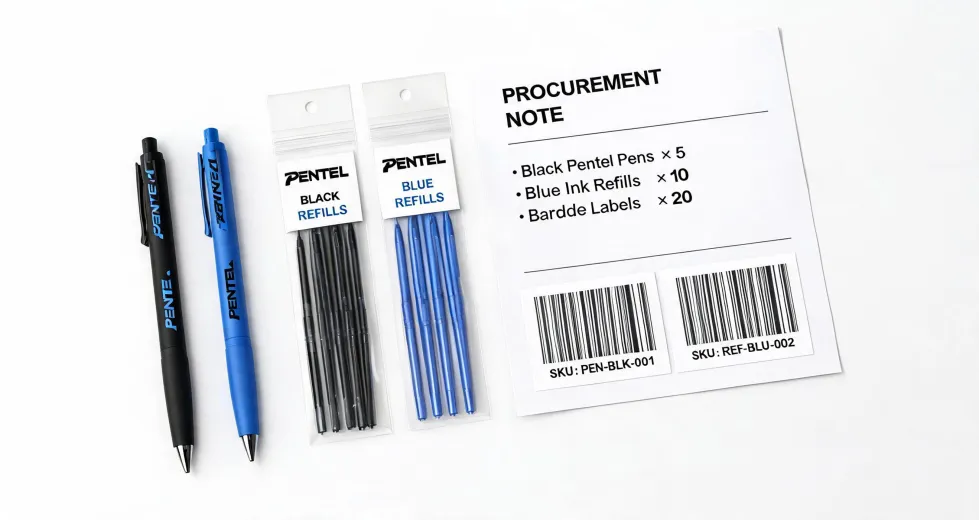
- A Pentel Orenz 0.5mm at about $7, with a sliding sleeve that limits how much lead is exposed—so the lead doesn't snap when you press hard.
I know what you're thinking: $6.21 more per pencil looks like a luxury. But that's the surface illusion. Look at the full picture.
The budget pencil ate lead refills—$2.50 per pack, multiplied by six weeks, multiplied by 12 staff members. It smeared when the writer's hand dragged across the page, so annotations had to be redone. And it broke at high-pressure moments, which produced errors that had to be caught in review. When I calculated the real cost—pencil, refills, time lost, and rework—it came to about $34 per pencil per year. The Orenz came in around $11 per year.
If you ask me, that one comparison is the entire article. But there's a deeper layer, and it involves the students we hire part-time.
The Hidden Cost No One Calculates
Here's the part I didn't see until I started paying attention to how students actually use these things.
One of our part-time student employees told me she uses a college GPA calculator before every semester to plan which classes she can afford to take. She's strategic about everything except her tools. In her final exam, her budget pencil kept breaking. The fill-in sheet ended up with erased marks, smudges, and one answer the scanner couldn't read. She ran the GPA calculator after finals and watched her hoped-for 4.0 drop to a 3.8.
One pencil did that.
To be fair, that's an anecdote, not data. But it lines up with the pattern I see in procurement: when quality fails at a critical moment, the rework cost dwarfs the purchase price. It's the same reason I won't buy the cheapest printer paper. 20 lb bond (about 75 gsm) is a standard office weight, but the ultra-budget brands come out of the box with inconsistent surfaces, and the reprints cost more than the paper ever saved.
This is the classic save-a-little, lose-a-lot move. We once switched to a discount stationery vendor and saved $40 a quarter. Then a batch of dried-out markers forced a $1,200 reprint job. The savings were real. The cost was realer.
What About "Can I Use Acrylic Paint on Wood?"
I know this is the question a lot of you actually came here to ask. Same root problem, different aisle—so I'll answer it straight: yes, you can use acrylic paint on wood, if you respect the surface.
Raw wood is oily, dusty, and uneven. Paint slapped onto it will lift, peel, and age badly. Then you're back in the penny-wise-pound-foolish cycle: buying new wood, new paint, and losing a weekend to redo the project.
And if you're trying to match a brand color, precision becomes a different game entirely. Pantone's color matching system measures differences in Delta E values. For brand-critical work, a Delta E below 2 is generally considered a match; anything above 4 is visible to most people. Paint on raw wood shifts both the value and the hue, so the same jar of acrylic will look different on pine, plywood, or oak. Sand it, prime it, and test it on the same surface you're going to finish. That prep work isn't wasted time. It's cheap insurance.
The Fix Is Simple (Which Is Why We Avoid It)
If you came here for a dramatic recommendation, sorry to disappoint.
Buy a Pentel Orenz and stop thinking about pencils for a year. The sliding sleeve keeps the lead protected and limits how much lead you can expose—think of it as a built-in limit calculator that works out the safe length for you, so you can press hard and keep writing. That's the exact thing a cheap pencil won't let you do without snapping.
If you want an automatic pencil without the sleeve, the Pentel Sharp P200 series has been a drafting-room standard for decades. The GraphGear line adds a metal grip and a stiffer clutch, so it resists the wobble cheap pencils develop after a couple of months.
For the paint question: yes, use acrylic on wood. Prep the surface first, and buy paint that fits the job. The $3 difference between craft paint and artist-grade acrylic is nothing compared to redoing a weekend project.
After that audit, I changed our procurement policy: any writing tool that goes through our system has to show a cost-per-month figure, not just a unit price. It trimmed that $1,400 pencil line item to about $400 in the first year.
I still buy budget pencils—for the community table, where they get borrowed, licked, and lost. That's their natural habitat. But for actual work, for exams, for drawings that matter, I stopped pretending "cheap is fine." When the spreadsheet did its job, the efficient choice turned out to be the better tool. Efficiency isn't about spending less. It's about spending where it counts.
Six years of invoices taught me one thing: you don't save money by buying the same problem twice.